The session opened with a weaker dollar. Yesterday, the US dollar softened, and the euro and pound both gained. The driver was political, not economic: Israel's Channel 12 reported a Pakistani-mediated compromise with US backing and preliminary Iranian approval—a report later contradicted by a diplomat involved in the talks. The bounce this morning therefore rests on an unconfirmed rumor. Tuesday's same-day unconfirmed report had already knocked oil off five-month highs and pushed the euro and pound higher.
Europe: yesterday's data did not help the euro. The eurozone ZEW expectations index — a gauge of analysts' six-month outlook — fell in October to 18.5, below the expected 24.2. The eurozone current-account surplus for August shrank to €8.7bn, down from the expected €25.2bn. In short, noticeably less foreign money came into the region via trade and services, removing support for the euro. So the current euro lift is driven by dollar weakness rather than strong European fundamentals; don't mistake it for a confident trend reversal.
UK: the pound had a better day. UK unemployment unexpectedly fell to 4.7% in August, down from 4.9% expected, which supported sterling. Lower unemployment makes the labor market look healthier and reduces the Bank of England's hesitation to tighten policy.
US housing data on Tuesday added pressure on the dollar. Housing starts fell 5.2% to 1.221m annually, versus 1.300m expected. Pending home sales plunged 7.3% to a record low of 66 (index), far worse than the expected 0.5% fall. Building permits were 1.400m vs 1.390m expected, but single-family permits were at the lowest level since early 2023. ADP payrolls slowed to +18.5k from +26.0k. Together, these show that expensive mortgages amid the US–Iran conflict continue to cool the housing market. While the diplomatic-deal story remains unconfirmed, the dollar should stay under pressure; but any official denial of the deal would quickly restore dollar demand and could push EUR/USD and GBP/USD lower.
What awaits us this morning? No euro data is due, so attention will turn to politicians' remarks. Bundesbank president Joachim Nagel will speak, and the Bundesbank's monthly report will be published — the report typically assesses the state of the German economy, price risks and growth prospects. Later in the day, European Central Bank president Christine Lagarde will speak. For the euro, these are the day's main events, and in my view the currency can only extend its rally if the tone is hawkish. The market already knows Nagel's stance: on October 16 he said the ECB has raised rates twice and that further steps cannot be ruled out if conditions persist, and that rising global yields complicate the picture. If he repeats that line and adds conclusions from the report, it will bolster rate expectations — the deposit rate is currently 2.50%. Dovish language, by contrast, would disappoint euro buyers. Lagarde has previously noted that events in the Middle East and around Ukraine have pushed energy prices higher and will likely keep inflation significantly above target into the first half of 2027. If she reiterates that view tonight and does not emphasize downside risks to growth, EUR/USD will have reason to keep rising. Without a hawkish tone, the pair will likely lose momentum quickly.
For the pound, the key event is UK inflation. September's headline CPI and core CPI (excluding food and energy) will be released—the core gauge better indicates whether inflation is heating up in the economy. BoE governor Andrew Bailey will speak afterward. That's the critical pairing for GBP/USD today: inflation directly shapes rate expectations, and the Bank Rate is currently 3.75%. Strong readings would strengthen the case for further tightening — recall that in July Huw Pill, Megan Greene and Catherine Mann voted for an immediate hike. A sharp slowdown in prices, meanwhile, would weaken their case and remove some support from sterling. Bailey's comments will be especially important in light of the data. His last speech on October 14 focused on social media and did not touch rates, so sterling did not get a lift. If today he addresses monetary policy and confirms readiness to react to prices, the pound would gain additional impetus. If the prints come in well below forecasts, the pound could correct sharply versus the dollar; otherwise, I expect the pair to continue higher. In my view, the session outcome will depend on the combination of the readings and the central bank's tone.
For the euro, the key references are 1.1259 on the upside and 1.1222 on the downside. I consider long positions only after a decisive close above 1.1259; then targets are 1.1298 and 1.1336. Frankly, I have only moderate confidence in that scenario — it requires a hawkish tone from Nagel and Lagarde, and the current rise rests on an unconfirmed political report. Short positions below 1.1222 with targets at 1.1189 and 1.1155 are at least as likely. A denial of the rumors or dovish speeches would quickly put the currency below that level. The range between the levels is fairly wide — 37 pips — so the first touch of either boundary should not be treated as a confirmed breakout.
For the pound, buy above 1.3402 with targets 1.3437 and 1.3467; sell below 1.3365 with targets 1.3335 and 1.3303. The range is also around 37 pips, and UK data and Bailey's remarks will decide the outcome. If inflation is high and the governor speaks about rates, I will look for an upside break. If the prints are weak, a move down toward 1.3335 is more likely. Only after the releases will it become clear which scenario is closer, and I would avoid looking for an entry before then.
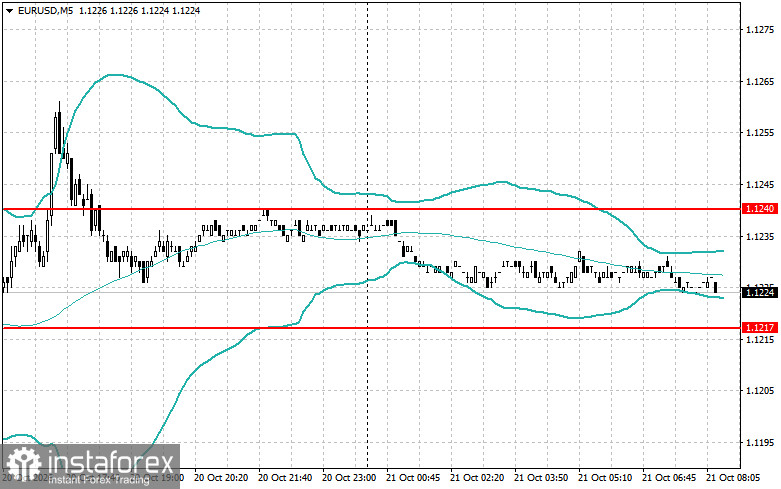
For the euro, the reversion levels are 1.1240 and 1.1217. The upper one sits 19 pips below the buy-break point at 1.1259 and 18 pips above the sell-break point at 1.1222, i.e. roughly mid-range. Here I look for a situation where price spikes on the news, fails to hold, and then returns — that would be a sell setup. The lower level 1.1217 lies only 5 pips below the downside breakout point at 1.1222, so beginners need to be extra cautious: a single touch cannot distinguish a true breakout from a false reversion. If price breaks 1.1222, reaches 1.1217, and closes convincingly below, that is a confirmed downside breakout and buying is not allowed. If price instead dips under 1.1217, quickly returns above 1.1222, and holds, longs with a stop under the probe low are appropriate.
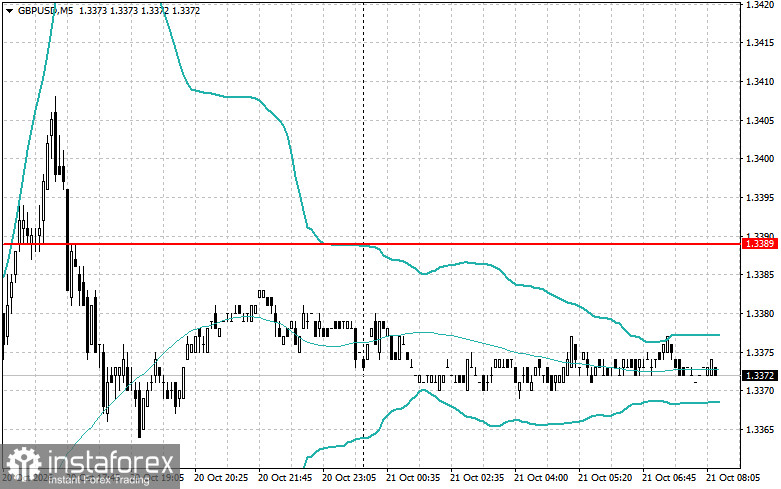
For the pound, the reversion levels are 1.3389 and 1.3352. The upper one sits 13 pips below the buy-break at 1.3402. If price jumps to 1.3389 on an emotional reaction to the data, fails to hold, and falls back, I would consider selling. But if it closes above 1.3389 and reaches 1.3402, that is a confirmed breakout and selling is not allowed. The lower level 1.3352 lies 13 pips below the downside break at 1.3365. Here I look for a probe below 1.3352 that quickly returns above 1.3365 — that gives a buy opportunity with a stop under the probe low. If price closes below 1.3352, the reversion has failed and attention shifts to the downside target at 1.3335.
*The market analysis posted here is meant to increase your awareness, but not to give instructions to make a trade.
InstaSpot analytical reviews will make you fully aware of market trends! Being an InstaSpot client, you are provided with a large number of free services for efficient trading.