




The legend in the InstaSpot team!
Legend! You think that's bombastic rhetoric? But how should we call a man, who became the first Asian to win the junior world chess championship at 18 and who became the first Indian Grandmaster at 19? That was the start of a hard path to the World Champion title for Viswanathan Anand, the man who became a part of history of chess forever. Now one more legend in the InstaSpot team!





Borussia is one of the most titled football clubs in Germany, which has repeatedly proved to fans: the spirit of competition and leadership will certainly lead to success. Trade in the same way that sports professionals play the game: confidently and actively. Keep a "pass" from Borussia FC and be in the lead with InstaSpot!

See also: InstaSpot trading indicators for AUD/USD
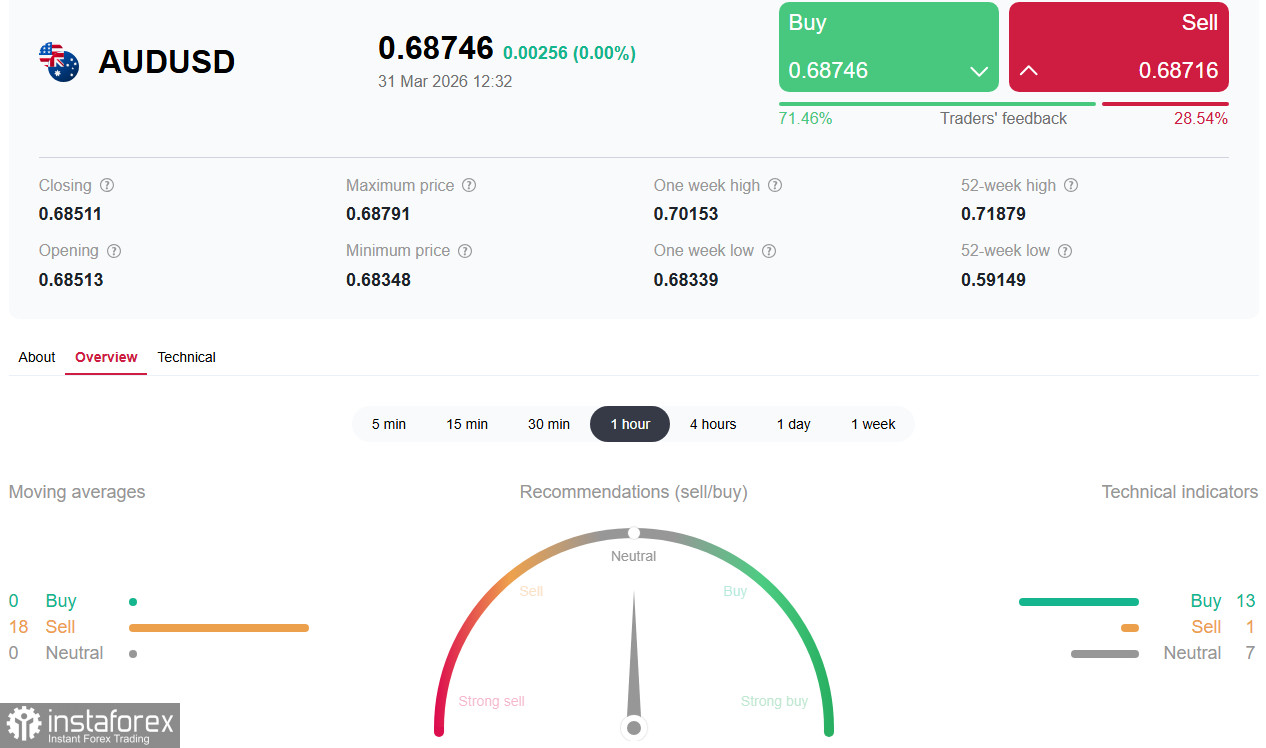
AUD/USD is ending the first quarter of 2026 in a state of uncertainty, consolidating around 0.6840–0.6870 during the first half of today's trading after publication of the minutes from the RBA's March meeting and statements by US President Donald Trump about readiness to end the war with Iran. The Australian dollar is at the epicenter of a clash of forces: on one side, a hawkish RBA that leaves the door open for a May rate rise, and on the other, a strengthening US dollar and rising stagflationary risks for the global economy.
Current situation: rebound on hopes for peace
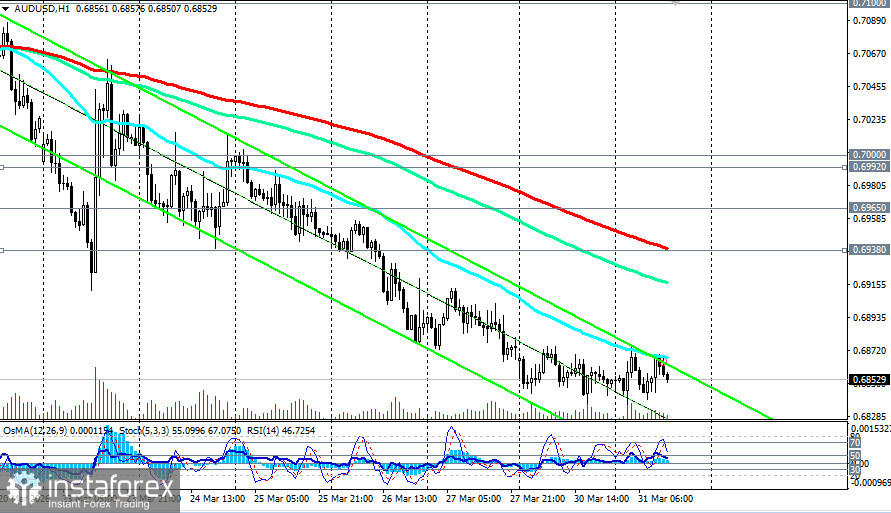
On Tuesday, March 31, AUD/USD rose 0.15% to 0.6870–0.6875 after US President Donald Trump said he was ready to end the military campaign against Iran even if the Strait of Hormuz remains largely closed. Futures on the S&P 500 index rose more than 0.7%, reflecting improved investor risk appetite.
However, the Australian dollar remains under pressure: since the conflict began on February 28, the pair has fallen by about 3.5%. WTI oil trading above $100 per barrel and the threat of a Bab-el-Mandeb Strait blockade continue to weigh on the currencies of energy-importing countries (Australia exports liquefied natural gas and coal but imports oil and petroleum products).
Key factor: hawkish RBA
The minutes of the Reserve Bank of Australia's meeting, published on Tuesday, showed that the decision to raise the cash rate by 25 basis points to 4.10% (a ten-year high) was more contested than markets had assumed. Board members agreed that further tightening will probably be required but differed on timing.
The March hike was aimed primarily at preserving flexibility for another increase in May should the Iran conflict persist and inflationary effects become more evident.
Australian macro data remains positive:
- Household wealth rose 2.5% in the December quarter of 2025 (AUD 453.7 billion), with housing prices up 3.2% — the main driver of positive dynamics for the third consecutive quarter;
- Household borrowing increased 2.0% (AUD 64.2 billion), and total credit demand amounted to AUD 142.4 billion.
Thus, a May hike becomes increasingly likely if the conflict continues.
Dollar factor: Fed chooses wait-and-see stance
Federal Reserve Chair Jerome Powell said on Monday that policy is well positioned to wait and see how the situation evolves. He noted that events in the Middle East affect gas prices but emphasized a tendency not to react to supply shocks while saying that inflation expectations must be monitored.
Powell also argued that tariff-driven inflation is a one-off price rise and that inflation expectations appear anchored.
According to the CME FedWatch tool, traders increasingly expect the Federal Reserve to hold rates at current levels through 2026, after markets had earlier priced in nearly a 50% chance of a hike. Powell's comments did not justify expectations of early increases, and money markets have shifted back to pricing in a rate cut by year-end.
However, the US dollar index, USDX, trades near 100.30, close to ten-month highs. JOLTS vacancy data for February (release at 14:00 GMT) are expected to be resilient, which could support the dollar, while consumer confidence figures for March may show a return to lows.
Brief technical analysis
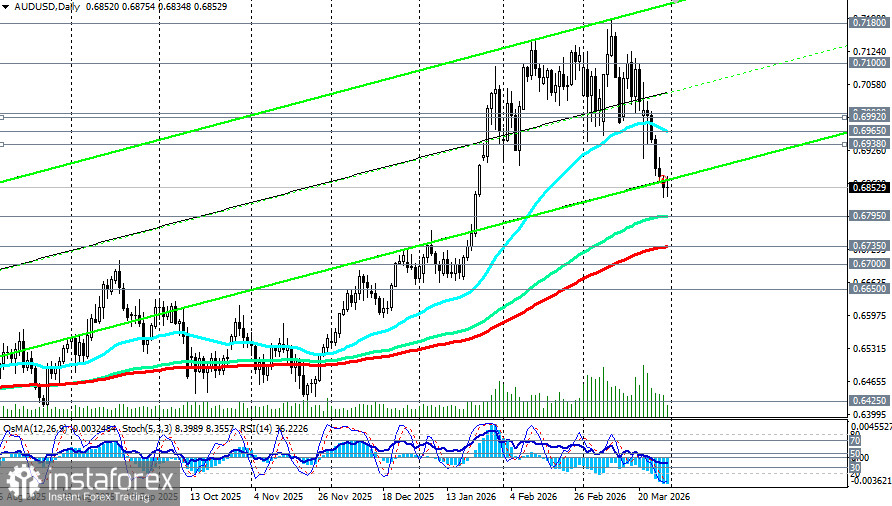
On the daily chart, AUD/USD sits slightly below the support line of an upward channel with bounds of 0.7220–0.6860 but above key medium-term support levels at 0.6795 and 0.6735 (EMA144 and EMA200), which preserves the advantage for medium-term long positions.
The long-term trend is also supported by weekly support levels 0.6700 (EMA200 on the weekly chart) and 0.6650 (EMA144 on the weekly chart).
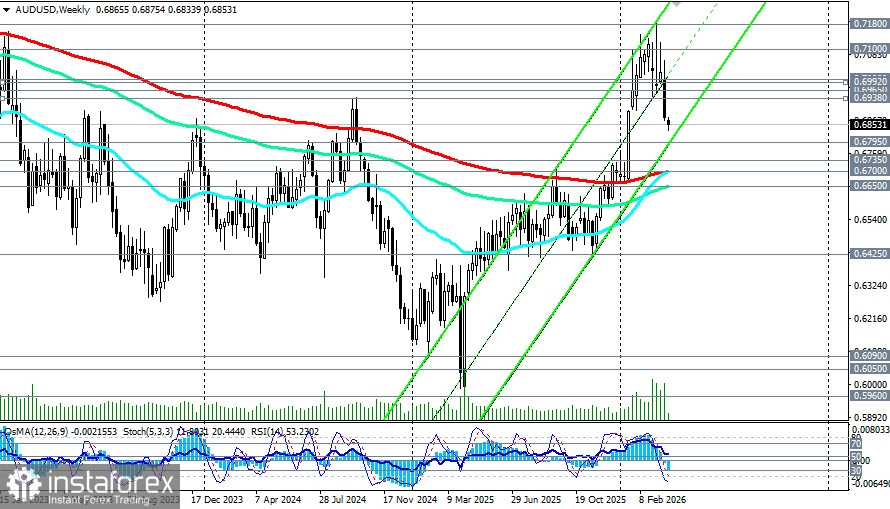
Technical indicators (OsMA, Stochastic) on daily and weekly charts maintain sell signals, moving in bear-market territory, while the weekly RSI at 56 remains in buy territory (above 50).
Conclusion
AUD/USD is trapped between a hawkish RBA and a strengthening US dollar. The Reserve Bank of Australia retains the option to raise rates in May, especially if the Iran conflict continues and inflationary effects become clearer. At the same time, the Federal Reserve has adopted a wait-and-see stance, noting that "policy is well positioned to wait and see."
The key zone 0.6800–0.6900 will be the arena of a decisive battle in the coming days. Holding above it will keep the chance of a rebound to 0.6938 (EMA200 on the 1-hour chart), while a break below will open the way to 0.6735–0.6700.
Under any scenario, volatility will remain high. Investors should closely watch the development of diplomatic contacts around the Strait of Hormuz and, importantly, the forthcoming US employment data and Australian inflation releases. The May RBA decision will depend more on the Iran conflict and its consequences than on "normal" economic developments. Success will favor those who can weigh the balance between a hawkish RBA and a strengthening dollar amid ongoing geopolitical uncertainty.
*The market analysis posted here is meant to increase your awareness, but not to give instructions to make a trade.
InstaSpot analytical reviews will make you fully aware of market trends! Being an InstaSpot client, you are provided with a large number of free services for efficient trading.


