




¡La leyenda en el equipo de InstaSpot!
¡Leyenda! ¿Cree que es una retórica grandilocuente? Pero, ¿cómo deberíamos llamar a un hombre, que se convirtió en el primer asiático en ganar el campeonato mundial de ajedrez júnior a los 18 años y en el primer Gran Maestro indio a los 19 años? Ese fue el comienzo de un camino difícil hacia el título de Campeón del Mundo para Viswanathan Anand, el hombre que se convirtió en parte de la historia del ajedrez para siempre. ¡Ahora una leyenda más en el equipo de InstaSpot!





Borussia es uno de los clubes de fútbol con más títulos en Alemania, que ha demostrado repetidamente a los fanáticos: el espíritu de competencia y liderazgo que ciertamente conducirán al éxito. Opere de la misma manera que los profesionales del deporte: con confianza y de forma activa. ¡Mantenga un "pase" del Borussia FC y lidere con InstaSpot!
The key Tankan business-sentiment index for large Japanese manufacturers rose from 22 to 24 in the September survey, hitting its highest level in more than eight years and marking the sixth consecutive quarter of improvement. The result was slightly below the consensus forecast of 25, which is telling — the market had expected an even more optimistic picture. The non-manufacturing sentiment index slipped from 37 to 35, reflecting more restrained domestic consumption dynamics.
According to the Tankan, Japanese firms expect consumer prices to rise about 2.5% year-on-year on average in five years — slightly below the 2.6% recorded in the previous survey but still materially above levels typical of decades of deflation. For the first time in decades, Japanese companies have a real opportunity to pass rising costs onto consumers, and they are actively doing so.
Tokyo inflation data released on October 2 were a cold shower for those hoping price pressure would remain moderate. The core consumer-price index for the metropolitan area, excluding fresh food, jumped to 2.7% year-on-year — well above the 2.3% consensus and markedly higher than August's 1.8%. This is the first time since January that Tokyo inflation has reached or exceeded the Bank of Japan's 2% target, and importantly, the acceleration is not isolated but part of a broader front of rising prices.
Despite these signals, the BOJ's rhetoric remains deliberately restrained. BOJ Governor Kazuo Ueda, speaking on October 6 at a securities conference, confined himself to the standard wording — the central bank "will continue to raise the policy rate and adjust the degree of monetary accommodation in line with economic, price and financial conditions."
Reuters reports a cautious consensus inside the central bank. The fact that the Tankan shows corporate inflation as "moving sideways" rather than accelerating relieves some of the immediate pressure that might have forced the BOJ to act urgently.
Net long JPY positioning fell over the reporting week to $4.52bn; positioning remains bullish, and the implied fair price is still below the long-term average.
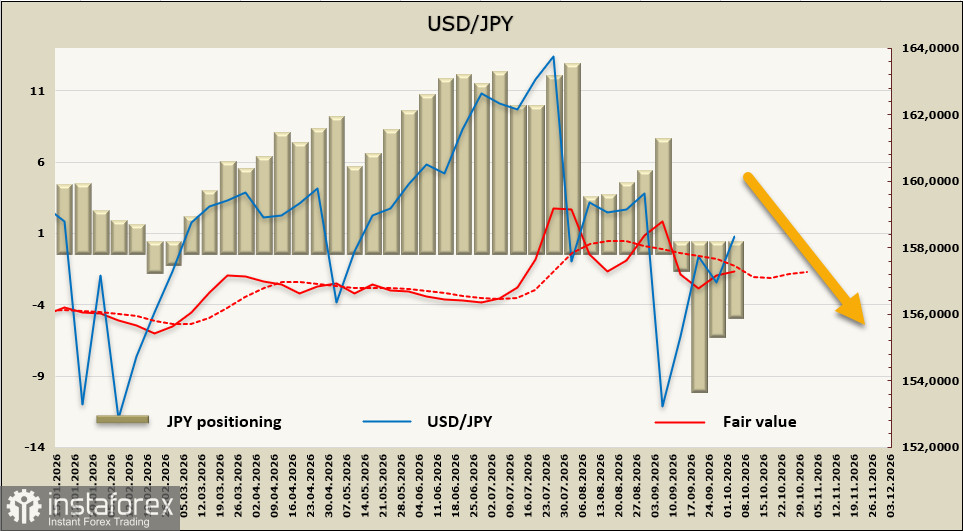
Fundamentals continue to work against the yen even after two rate hikes in June and September: the interest-rate gap between the US and Japan remains significant. The 157–160 area remains key for the pair in the coming weeks.
We assume the USD/JPY reversal has occurred so long as the pair holds below 160; the probability of further decline is high. We expect a move toward 152.90 once market odds of Federal Reserve hikes decline and the Japanese economy finally feels the energy-resource shortage it has so far avoided.
*El análisis de mercado publicado aquí tiene la finalidad de incrementar su conocimiento, más no darle instrucciones para realizar una operación.
¡Los informes analíticos de InstaSpot lo mantendrá bien informado de las tendencias del mercado! Al ser un cliente de InstaSpot, se le proporciona una gran cantidad de servicios gratuitos para una operación eficiente.


