




¡Nuestro equipo cuenta con más de 7,000,000 operadores!
Cada día, trabajamos juntos para mejorar las operaciones. Obtenemos grandes resultados y seguimos adelante.
El reconocimiento de millones de operadores en todo el mundo es el mejor agradecimiento a nuestro trabajo! ¡Usted hizo su elección y haremos todo lo que esté a nuestro alcance para satisfacer sus expectativas!
¡Juntos somos un gran equipo!
InstaSpot. ¡Orgulloso de trabajar para usted!





¡Actor, 6 veces ganador del torneo UFC y un verdadero héroe!
El hombre que se hizo a sí mismo. El hombre que sigue nuestro camino.
El secreto detrás del éxito de Taktarov es el constante movimiento hacia el objetivo.
¡Revele todo los lados de su talento!
Descubra, intente, fracase, ¡pero nunca se rinda!
InstaSpot. ¡Su historia de éxito comienza aquí!
The PMI data for September, released on September 23, were unexpectedly strong. The eurozone composite PMI rose to 53.1 — the highest since April 2023 — beating forecasts and marking the third consecutive month of growth. The services index climbed to 53.0 — a ten-month high — while manufacturing output reached a 55-month peak.
This gives the European Central Bank some room to maneuver. The economy is not collapsing under the energy shock as feared.
At the same time, consumer confidence in the eurozone unexpectedly fell to –16.5 in September from –15.5 in August, interrupting a four-month improvement streak. The reason appears to be the sharp rise in fuel prices: transport costs are quickly passing through to consumers.
The market now leans toward further tightening; after the September ECB meeting, expectations of additional hikes rose noticeably, and some analysts say the next step could come in October or, at the latest, December.
The most serious risk for the euro — and for the entire European economy — is the gas situation. Gas prices in Europe remain extremely high: by the end of September TTF trades around €74/MWh, having reached €80 earlier in the month. That's several times higher than pre-conflict levels. Gas storage in European facilities is only 70.2% full versus a five-year average of 85.9%; in Germany, storage is 57% full versus a five-year average of 84.5%. Austria and Slovakia have already begun withdrawals from storage, an extremely early signal at the end of September.
The European Commission demands storage be filled to 90% by December 1 (with 10% flexibility), but current injection rates, despite accelerating, are insufficient to meet this target, and a cold winter will inevitably force industrial production cuts.
For the euro, this implies that high energy prices will continue to weigh on consumer spending, increase inflationary pressure, and force the ECB to maintain a hawkish course even at the cost of slowing the economy. That is a stagflationary scenario, historically unfavorable for a currency.
Friday's CFTC report showed net short positions nearly doubled to –€7.525 billion, and implied prices keep drifting lower.
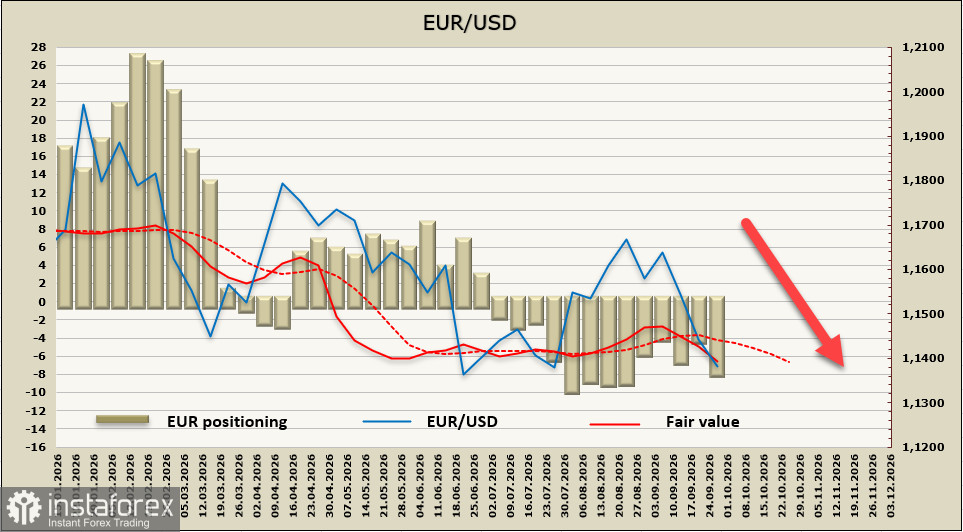
A week ago we expected a drop to 1.1410–1.1420; that target was reached, and the euro fell further. The nearest targets are 1.1354 and 1.1325 — we expect bearish pressure to be strong enough to reach those levels. A rapid decline increases the odds of a correction, but the euro is unlikely to climb above 1.1442.
*El análisis de mercado publicado aquí tiene la finalidad de incrementar su conocimiento, más no darle instrucciones para realizar una operación.
¡Los informes analíticos de InstaSpot lo mantendrá bien informado de las tendencias del mercado! Al ser un cliente de InstaSpot, se le proporciona una gran cantidad de servicios gratuitos para una operación eficiente.


