




¡La leyenda en el equipo de InstaSpot!
¡Leyenda! ¿Cree que es una retórica grandilocuente? Pero, ¿cómo deberíamos llamar a un hombre, que se convirtió en el primer asiático en ganar el campeonato mundial de ajedrez júnior a los 18 años y en el primer Gran Maestro indio a los 19 años? Ese fue el comienzo de un camino difícil hacia el título de Campeón del Mundo para Viswanathan Anand, el hombre que se convirtió en parte de la historia del ajedrez para siempre. ¡Ahora una leyenda más en el equipo de InstaSpot!





Borussia es uno de los clubes de fútbol con más títulos en Alemania, que ha demostrado repetidamente a los fanáticos: el espíritu de competencia y liderazgo que ciertamente conducirán al éxito. Opere de la misma manera que los profesionales del deporte: con confianza y de forma activa. ¡Mantenga un "pase" del Borussia FC y lidere con InstaSpot!
Iran is prepared for a more intense war and will step up retaliatory strikes if the US continues to attack its territory and infrastructure, a senior Islamic Republic official said. Tehran does not intend to back down in the face of a US naval blockade and attacks on its oil tankers, and the country's leadership views the conflict as an existential threat, leaving virtually no choice but to continue fighting.
Against this backdrop, Brent crude broke $100 per barrel, bringing its year-to-date gain to roughly 65 percent, and US retail diesel prices hit historical highs.
The scale of Iran's economic damage is striking and highlights its stubbornness. The blockade has effectively removed the country's ability to export petroleum products and to import many essential goods; inflation has surged to nearly 90 percent, and the rial is rapidly depreciating.
Why does Tehran not enter negotiations under such conditions? The answer lies in the logic of Iran's leadership: it intends to fight until it is convinced Washington will be too cautious to attack again in the future. The goal is not to "win" the conflict quickly but to create a future-deterring precedent, which by definition has no fast solution.
Yesterday's timeline shows how this plays out in practice. Washington reported that one of its warships was forced to maneuver to avoid an Iranian attack and, in response, destroyed five IRGC oil tankers. Tehran then launched about 20 missiles at a Jordanian airbase used by the US, struck additional US Navy vessels, and hit several commercial ships.
The White House posture, however, diverges from assessments inside its own administration. On Wednesday, President Trump downplayed fears of rising oil prices and said the war would end within weeks. "I think the war will end right after the elections because they can't hold," he told reporters — referring to the midterms. Yet Vice President J.D. Vance and Secretary of State Marco Rubio said Iran may not yield to increased pressure and the conflict could extend through the end of the presidential term in January 2029.
I view this gap between public rhetoric and internal estimates as the day's most significant information. A divergence between a few weeks and three years suggests the administration lacks a unified sense of timing, while the market is pricing in an optimistic scenario shared primarily by the president. For the oil market, this directly signals that a quick end should not be expected and that energy-supply disruptions will persist. Add the Kharg Island situation and potential attacks on its loading infrastructure, and it becomes clear why oil is trading at these levels.
I expect Brent to remain in the $100–$110 range through the November elections, because neither side has incentives to concede now, and Trump's comment that the war will end after the vote should be read inversely: the administration acknowledges no resolution will come before the election. For central banks, this implies the energy shock moves from temporary to more persistent, weakening the arguments for a pause that Waller and Williams relied on; those arguments will erode month by month as the conflict persists.
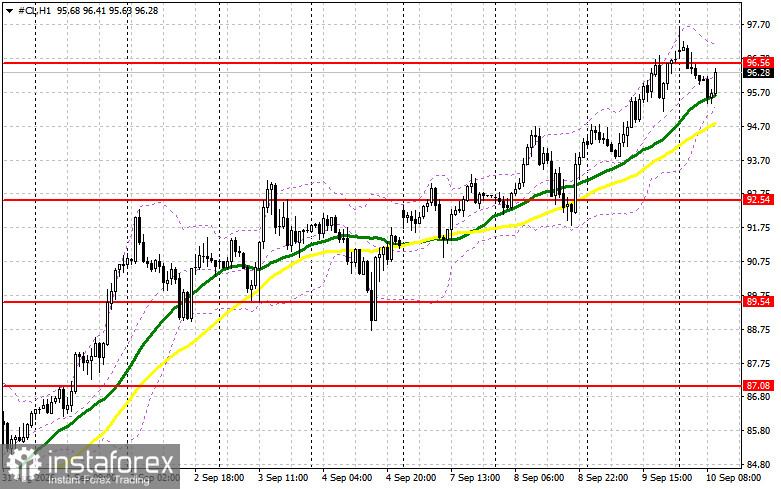
Buyers need to reclaim the nearest resistance at $96.50. That would allow a target of $100.40, above which a breakout becomes difficult. The farther target lies around $103.40. If oil falls, bears will try to take control of $92.54. If they succeed, a break of that range would deal a serious blow to bulls and push oil toward the $89.54 low, with a further prospect of reaching $87.10.
*El análisis de mercado publicado aquí tiene la finalidad de incrementar su conocimiento, más no darle instrucciones para realizar una operación.
¡Los informes analíticos de InstaSpot lo mantendrá bien informado de las tendencias del mercado! Al ser un cliente de InstaSpot, se le proporciona una gran cantidad de servicios gratuitos para una operación eficiente.


