




The trade statistics from Germany and France turned out to be exactly the kind of situation where there are plenty of figures, but no clear signal for the currency. German exports fell by 0.8 percent month-on-month, while annual growth remained at 6.1 percent, but imports plunged by as much as 5.7 percent. The trade surplus widened to €21.3 billion, which at first glance looks like an achievement. However, it is important to look at what is behind the figure, and that is concerning. The surplus increased not because Germans started selling more abroad, but because they sharply reduced their purchases.
France moved in the opposite direction. Its trade deficit increased by €0.9 billion to €6.7 billion after the improvement in June, with the widening deficit driven by higher imports of transport equipment and cars. This creates an interesting picture. The two largest economies in the bloc produced divergent results, and the market, unable to derive a single clear narrative from them, simply ignored both releases. This is a useful lesson for beginners. Data move a currency not when they are released, but when they lead to a clear conclusion. Conflicting signals suppress the market reaction.
The same situation as in the previous session was repeated for the pound. Buyers once again tried to break above the major resistance level of 1.3545 and once again failed. A second consecutive failure at the same level tells us something quite clearly. There is no significant buying interest behind the bulls, and without a strong fundamental catalyst, such resistance cannot be broken on its own.
In the second half of the day, the NFIB Small Business Optimism Index and consumer credit data will be released. Neither release is a top-tier indicator, so a strong market reaction should not be expected. However, the broader context changes the significance of both figures.
Momentum, Breakout Trading
The idea is that there are clusters of orders around the levels, and once they are triggered, the price gains momentum.
For the euro, the upper working level has shifted lower along with the market and is now at 1.1617. A breakout of this level could lead to a rise toward 1.1635 and, if the move develops favorably, to 1.1657. I expect this scenario if the NFIB data are weak, causing the dollar to give back some of its gains and giving the euro a chance to recover from yesterday's decline. The lower boundary is 1.1598. A breakout below this level could lead to euro selling toward 1.1584 and then 1.1568. I consider this the main scenario if U.S. data are strong, as the euro currently has few arguments in its favor, while expectations ahead of the ECB meeting are more likely to restrain buyers than support them.
The levels for the pound remain unchanged, which is significant in itself, as the pair has been moving within the same range for the third consecutive day. A breakout of 1.3545 opens the way toward 1.3573 and 1.3596. It is worth noting that this is the same level from which the pound has already been rejected twice, and a third attempt without an external catalyst looks questionable. If the breakout does occur and is supported by weak U.S. data, the move could be substantial because a considerable volume of stop orders has accumulated above the level from traders who sold at resistance. The lower reference level is 1.3521, with a breakout below it targeting 1.3501 and 1.3480. Given the two failed attempts to move higher, I consider the downside scenario more likely today.
Mean Reversion, Trading on a Return
Here, we trade against those who moved too quickly. The price moves beyond a level, fails to attract significant buying or selling interest, and returns back, while the closing of unsuccessful positions strengthens the retracement.
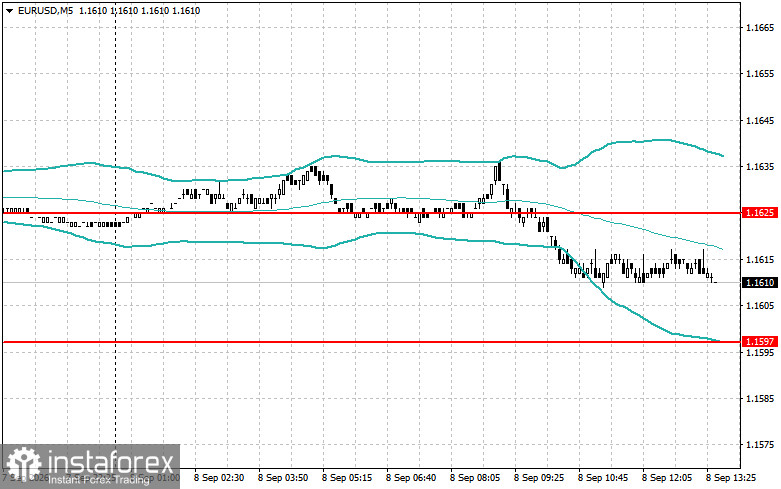
For the euro, the upper boundary is 1.1625. I would look for short positions not when the price moves above the level, but after a failed attempt to consolidate above it and a return below the level. The lower reference level is 1.1597, where the reverse logic applies: long positions can be considered after a failed break below the level. Note that 1.1597 is located almost directly next to the breakout level of 1.1598, creating a situation that requires attention. The same price area presents two opposing scenarios, so what matters is not the fact that the level is touched, but how the price behaves afterward. Consolidation below the level followed by continued movement favors the breakout scenario. A brief break below the level followed by a quick return above it favors long positions. For a beginner, it is more reasonable in such a zone to skip the initial reaction and wait for clarity rather than try to predict the outcome.
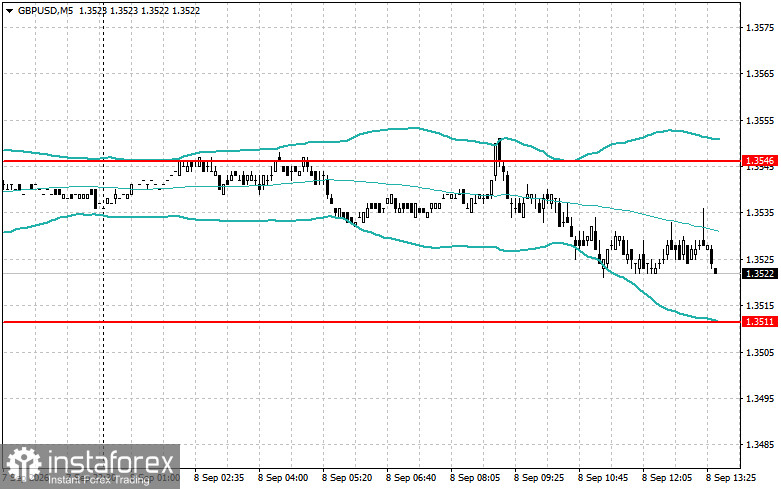
For the pound, the upper reference level is 1.3546 and the lower one is 1.3511. The upper level almost coincides with the resistance that has already rejected buyers twice, which makes the mean-reversion scenario more convincing. If the pound moves above the level again today and once again fails to hold above it, that would be a third consecutive rejection, and such sequences usually end with a move toward the lower boundary of the range. At 1.3511, I apply the reverse logic, looking for long positions after a failed attempt to push the market lower.
In my view, the euro is likely to remain in a downward trend over the next few sessions, as Eurozone statistics are not providing support for buyers, while the ECB meeting has already been priced in. For the pound, I would not rule out a decline toward the lower boundary of the range, as the pair has exhausted its attempts to move higher and is now entirely dependent on dollar weakness, while today's U.S. data are unlikely to provide a sufficient reason for such weakness.
*El análisis de mercado publicado aquí tiene la finalidad de incrementar su conocimiento, más no darle instrucciones para realizar una operación.
¡Los informes analíticos de InstaSpot lo mantendrá bien informado de las tendencias del mercado! Al ser un cliente de InstaSpot, se le proporciona una gran cantidad de servicios gratuitos para una operación eficiente.