




Legenda dalam pasukan InstaSpot!
Legenda! Anda fikir ia adalah satu retorik yang besar? Tetapi bagaimana untuk kita memanggil seorang lelaki, yang telah menjadi pemain Asia pertama yang memenangi kejohanan catur dunia junior pada usia 18 tahun dan menjadi Grandmaster India pertama pada usia 19 tahun? Itulah permulaan yang sukar untuk merangkul gelaran Juara Dunia untuk Viswanathan Anand, seorang juara yang telah menjadi sebahagian daripada sejarah catur. Kini satu lagi legenda dalam pasukan InstaSpot!





Borussia adalah salah satu kelab bola sepak paling terkemuka di Jerman, yang telah berulang kali membuktikan kepada peminatnya: semangat persaingan dan kepemimpinan pasti akan membawa kepada kejayaan. Berdagang dengan cara yang sama seperti atlet sukan profesional beraksi menentang lawan: yakin dan aktif. Simpan "hantaran" dari Borussia FC dan menjadi pedagang hebat dengan InstaSpot!

By the end of yesterday's session, the euro continued to weaken against the dollar and returned to weekly lows, while the pound showed greater resilience and broadly held its ground. No major macro releases came from the euro area or the UK, so central bank remarks set direction—and here policymakers diverged noticeably.
Christine Lagarde's hawkish rhetoric was already priced in, so the euro gained no support from her words. Notably, the market responded not to the mere fact of ECB firmness but to any change relative to expectations, and no such change occurred yesterday. The euro was therefore the primary loser: the market expected a surprise and received only confirmation of the known stance.
The story for the pound was different. Dave Ramsden signaled a possibility of a Bank of England rate rise, and that was not an ordinary comment: whereas the committee had previously looked like a 6–3 split, Ramsden himself has shifted toward a more resolute tightening stance. He said that, absent the Iran war, he would expect policy to be about 0.5 percentage points lower now and that energy price pressures could push inflation higher. The pound rallied in early European trading, benefiting where the euro lost.
Geopolitics added pressure to both currencies. Trump rejected Iran's offer of a seven-day ceasefire while seeking talks on his terms, and the market reacted in a classic pattern: buyers bought the dollar, gold fell, and oil rose. Higher oil on the ongoing Strait of Hormuz tensions strengthens inflation risks and feeds expectations of further Fed tightening—direct support for the dollar versus the euro and the pound.
This morning, the UK releases mortgage approvals and the M4 money supply monthly change; approvals are expected to rise to 57k from 56k in August, and M4 growth is forecast at +0.1% month-on-month versus -0.3% previously. That data is unlikely to materially change sentiment: even yesterday's Ramsden comments were quickly absorbed, and the pound returned to easing against the dollar.
In the euro area, new ECB commentary is expected, with Bundesbank President Joachim Nagel's stance of particular interest. I expect his tone to be at least as hawkish as Lagarde's, so any euro rebound this morning will likely be only situational. In the US attention shifts to labor market data and the Michigan consumer sentiment index, forecasted to rise to 90.1 from 89.4 in September; a beat there would be an additional dollar supportive argument versus risk currencies and assets. The July house price index, as a lagging indicator, is unlikely to move markets. Comments from Fed officials—Goolsbee, Barr, Williams, and Waller—and from BOE members Catherine Mann and Martin Taylor could set the tone through the day; if the euro and the pound receive no backing from those remarks, dollar demand is likely to persist.
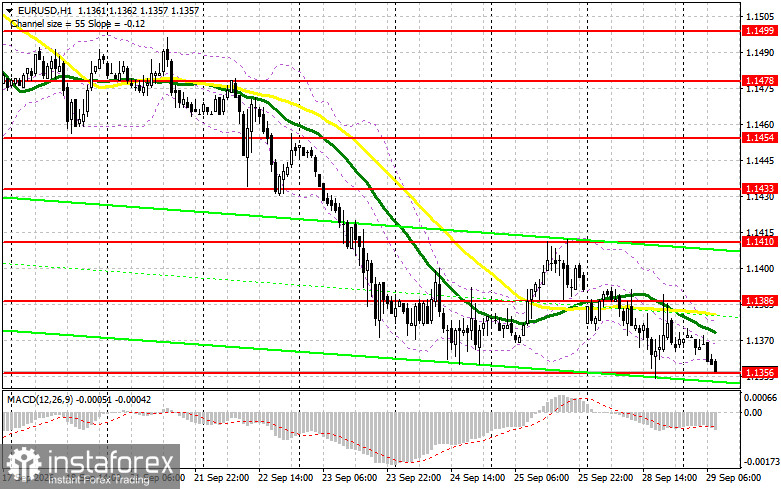
Analysis of EUR/USD
On the hourly chart, I consider 1.1356 a buy area on a false break: a failed downside break opens longs targeting the channel midpoint at 1.1386. A break and hold above 1.1386 extends the move to the channel top at 1.1410, where a failed break signals shorts targeting 15–20 pips; selling on a rejection toward 1.1433 is the same idea. Shorts from 1.1386 and 1.1410 work only on false breakouts; sellers' target remains 1.1356, which has already been tested twice. A break and close below 1.1356 opens the way to 1.1335 and then to 1.1312; a failed break there is a buy-the-dip trigger for 15–20 pips. Longs from 1.1335 and 1.1356 follow the same false break logic.
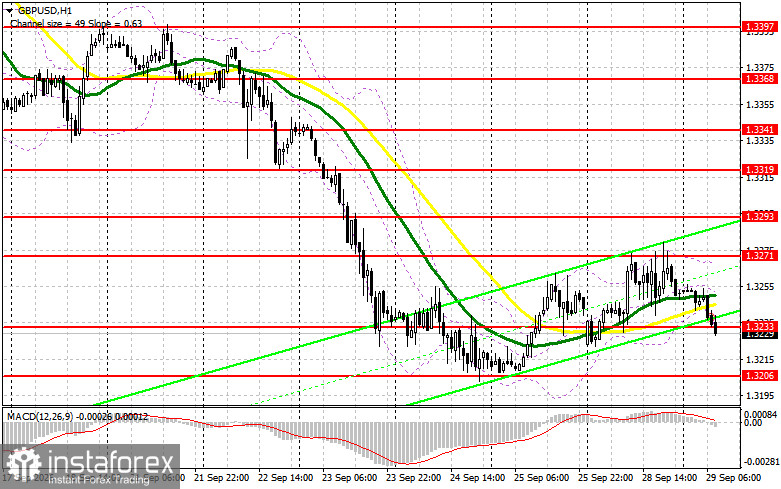
Analysis of GBP/USD
The pound so far holds the middle of the range at 1.3233. A false upside break gives a buy signal toward 1.3271—a level that triggered sellers yesterday. Shorts from 1.3271 are only on false breakouts. If the pound's advance continues, a correction could reach 1.3293 and 1.3319, where I would look to sell into rallies for about 25 pips; shorts from those levels also require false breaks. The reverse scenario—a return to 1.3233, a break and hold below it—opens the way to last week's low at 1.3206, where I expect buyers only on a failed break; more conservative bounce buys sit at 1.3182 and 1.3137 for 15–20 pips.
Policymakers have diverged: the Bank of England, through Ramsden, has shifted toward an earlier rate increase, while the ECB reiterates a hawkish stance with no new signals. In this environment the pound could trade more resiliently than the euro in the near term, while the dollar retains buyer support thanks to a combination of a geopolitical premium and Fed rate expectations.
* Analisis pasaran yang disiarkan di sini adalah bertujuan untuk meningkatkan kesedaran anda, tetapi tidak untuk memberi arahan untuk membuat perdagangan.
Kajian analisis InstaSpot akan membuat anda mengetahui sepenuhnya aliran pasaran! Sebagai pelanggan InstaSpot, anda disediakan sejumlah besar perkhidmatan percuma untuk dagangan yang cekap.


