




Our team has over 7,000,000 traders!
Every day we work together to improve trading. We get high results and move forward.
Recognition by millions of traders all over the world is the best appreciation of our work! You made your choice and we will do everything it takes to meet your expectations!
We are a great team together!
InstaSpot. Proud to work for you!





Actor, UFC 6 tournament champion and a true hero!
The man who made himself. The man that goes our way.
The secret behind Taktarov's success is constant movement towards the goal.
Reveal all the sides of your talent!
Discover, try, fail - but never stop!
InstaSpot. Your success story starts here!

The GBP/USD pair has already gained 400 points amid sharply increased chances of achieving a lasting ceasefire between Iran and the United States. Although negotiations in Islamabad failed, the market expects a new round and is clearly encouraged by falling oil prices, as well as the absence of new missile strikes in the Middle East. I would highlight two reasons for the pound's growth. The first is technical. Last week, a new bullish imbalance was formed, and the price effectively worked it off on Monday night, producing a reaction. In other words, a bullish signal was formed within a bullish trend. The second is geopolitical. The market had enough time and opportunity to price in the most pessimistic Middle East scenario. After the failed negotiations in Islamabad, nothing changed. Oil did not reach new record highs, no new missiles were launched at Iran, and the Strait of Hormuz remains blocked. Things have not improved, but they have not worsened either. I would also note that all recent bearish patterns failed to trigger a bearish attack, as did the sweep of bearish liquidity (red line on the chart).
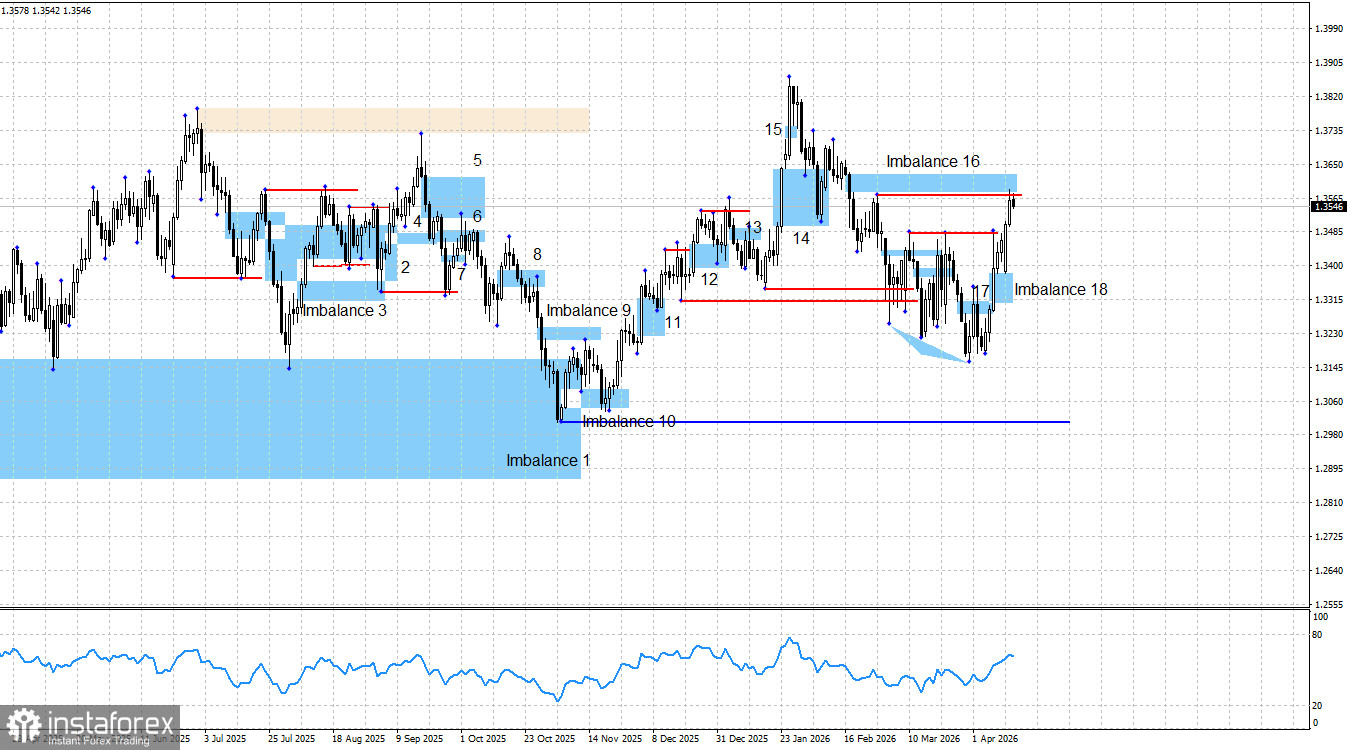
I also mentioned in recent articles that an important and relatively rare "Three Drives pattern" had formed, after which the upward movement began. Thus, traders received a bullish signal at the very beginning of the move, while the trend remained bullish throughout. At present, the ceasefire is quite fragile, and the parties involved have not yet decided whether to continue negotiations or resume fighting. Talks may resume this week, which is a positive factor. The Strait of Hormuz is under a double blockade, and the Bab el-Mandeb Strait may join it, which is a negative factor. However, as of Wednesday, the overall situation has not changed. The Middle East situation may worsen, but it could also continue moving toward de-escalation.
The probability of a decline in both pairs remains, as the ceasefire in the Middle East is still fragile. At the same time, the "Three Drives pattern," marked by a triangle on the chart, allowed bulls to take the initiative, which is already significant. A second reaction to imbalance 16 may occur today, but second reactions are usually weaker than the first. The pair may also sweep liquidity from the February 26 high. Together, these two factors could trigger a corrective pullback. On the other hand, the only bullish pattern worth noting is imbalance 18, which has already produced a price reaction. A new imbalance may form this week. I would also remind that EUR/USD still has an untested bullish imbalance. The price may react to it, generate a buy signal, and in that case, the pound will likely follow the euro.
The economic news background on Wednesday was absent. Geopolitics has not improved significantly in recent days, but the most pessimistic scenario has already been priced in. For bears to resume attacking, the situation in the Middle East would need to deteriorate significantly—for example, with renewed hostilities or a blockade of the Bab el-Mandeb Strait.
In the United States, the overall fundamental backdrop suggests that, in the long term, little can be expected from the dollar except decline. Even the war between Iran and the US does little to change this. The outlook for the US dollar remains quite challenging in the long term. The US labor market continues to weaken, the economy is moving closer to recession, and the Federal Reserve—unlike the ECB and the Bank of England—is not expected to tighten monetary policy in 2026. Additionally, the fourth major wave of protests against Donald Trump has already taken place across the country. From an economic perspective, I see no solid reasons for dollar growth.
A bearish trend requires a strong and stable positive backdrop for the dollar, which is difficult to expect under Donald Trump. Geopolitics supported the dollar for two months, but that support is now fading. It cannot be ruled out that the US currency may rise again due to geopolitical factors, but at present, there are no clear reasons to expect this.
News calendar for the US and the UK:
On April 16, the economic calendar includes four entries, none of which can be considered particularly important. The impact of the news background on market sentiment on Thursday is likely to be weak or absent.
GBP/USD forecast and trading advice:
For the pound, the long-term picture remains bullish. The "Three Drives pattern" warned traders of potential growth, followed by the formation of a bullish imbalance and a bullish signal. The price swept liquidity from the last two bullish swings, but bears failed to launch an attack—another positive sign for the pound.
Thus, under current conditions, despite geopolitical factors, I believe the upward movement will continue. Most likely, the euro will also keep rising, and the pound may follow. I see the 2026 high as the target for GBP/USD. A reaction to imbalance 16 may trigger a corrective pullback.
*The market analysis posted here is meant to increase your awareness, but not to give instructions to make a trade.
InstaSpot analytical reviews will make you fully aware of market trends! Being an InstaSpot client, you are provided with a large number of free services for efficient trading.


