




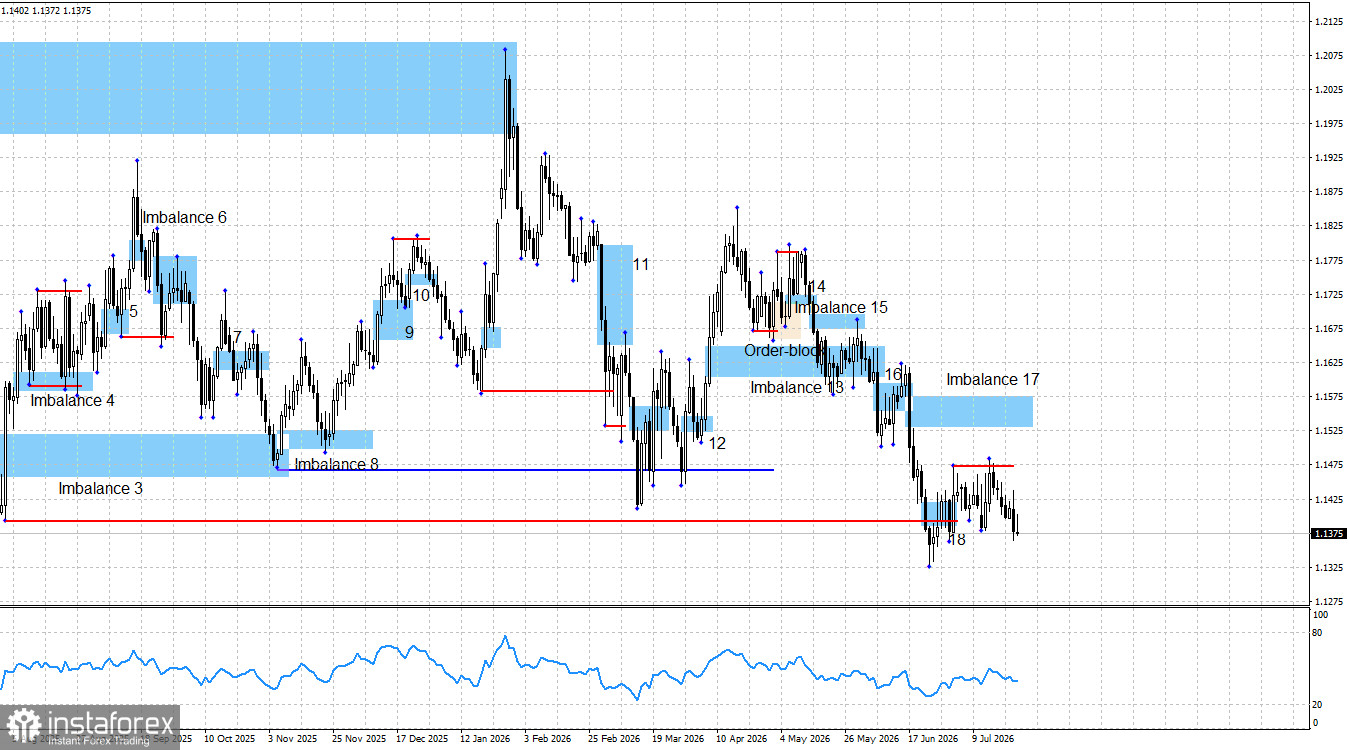
EUR/USD remains within the local bearish impulse that began on April 17. Over the past three weeks, buyers have managed only to push sellers back marginally. Although an attempt to move higher was made, it lacked conviction. Today marks the seventh consecutive day of renewed weakness in the euro, and over recent weeks buyers have demonstrated little strength. The latest liquidity sweep signaled a high probability that the downward move would resume. It is difficult to determine how strong or prolonged the next decline may be, but sellers have one clear downward target—the most recent swing low at 1.1325. A liquidity sweep below that level could provide buyers with another opportunity to regain control of the market.
From a fundamental perspective, I still see little justification for the sellers' continued strength. Geopolitical developments remain disappointing, but they are unlikely to be the primary driver for traders, considering that the temporary ceasefire and the reopening of the Strait of Hormuz attracted little market attention. Yesterday, the European Central Bank (ECB) decided to leave its monetary policy unchanged, but this can hardly be described as a dovish decision. It is also worth remembering that the Federal Open Market Committee (FOMC) has yet to begin raising interest rates, and the timing of any future hike remains uncertain. In addition, today's PMI data from Germany and the euro area came in stronger than expected and could have supported the euro. Nevertheless, it is the U.S. dollar—not the euro—that continues to strengthen.
It is also worth recalling that the latest U.S. labour market data were relatively weak, while the inflation report showed further moderation in price growth. Job creation has remained subdued. Over the past three months, the U.S. economy created approximately 100,000 fewer jobs than market participants had expected. Therefore, the slowdown in both the labour market and inflation raises doubts about further monetary tightening by the FOMC. Under the current circumstances, sellers cannot rely solely on Federal Reserve policy to justify the dollar's strength.
Geopolitical developments remain a secondary factor; otherwise, the U.S. dollar would have strengthened much earlier. Tehran and Washington have withdrawn from the June 17 agreement, but this development came as little surprise to the market. Donald Trump revoked the authorization for Iranian oil exports, reinstated restrictions on Iranian shipping, while Iran once again closed the Strait of Hormuz and continued attacking vessels attempting to pass through it. A month ago, the market failed to deliver the widely anticipated decline in the U.S. dollar following easing geopolitical tensions, just as it failed to reward the euro after the ECB's policy tightening six weeks earlier. Sellers have remained in control despite an overall fundamental and geopolitical backdrop that does not fully support their position. Now, renewed geopolitical tensions provide at least a formal justification for further downside. Nevertheless, in my view, the market is once again pricing in geopolitical developments that have already been reflected in prices—or have not yet materialized.
The current technical picture continues to point to the bearish impulse that began on April 17. Bearish Imbalance 17 has not yet been mitigated, while Imbalance 18 was invalidated following weak U.S. labour market data. No bullish patterns have formed, and they are unlikely to emerge in the coming days given the market's lack of momentum. Buyers may therefore continue the corrective recovery toward Imbalance 17, but there is currently no reliable technical basis for trading that move. Liquidity has already been swept below the August 1 low from last year (marked by the red line on the chart), followed later by a sweep above the July 2 high. As a result, sellers have technical reasons to remain active, although no new bearish patterns have formed.
Friday's economic calendar once again offered several potentially supportive releases for the euro, just as it had a day earlier. All six PMI readings for Germany and the euro area exceeded market expectations. Even so, the euro failed to benefit from the stronger data. This increasingly reinforces my view that the market is currently paying little attention to macroeconomic releases. Sellers continue to dominate without a clear fundamental catalyst.
Buyers still have numerous long-term arguments in their favor in 2026, and the conflict in the Middle East has not fundamentally changed that picture. Structurally and strategically, Trump's policies—which contributed to the sharp decline in the U.S. dollar last year—remain largely unchanged. At present, I see few compelling long-term drivers supporting the U.S. dollar despite the FOMC's relatively hawkish stance. Nevertheless, sellers remain in control, while bullish trading signals are still absent.
Economic Calendar
Germany
United States
The economic calendar for July 26 includes only two releases, neither of which is likely to attract significant market attention. Buyers are currently ignoring positive economic news, while sellers continue to dominate without support from the fundamental backdrop. As a result, the impact of economic data on market sentiment on Monday is expected to be minimal or nonexistent.
EUR/USD Forecast and Trading Tips
In my view, EUR/USD remains in the process of forming a long-term bullish trend. Although the fundamental backdrop shifted sharply in favor of sellers five months ago, the broader trend cannot yet be considered invalidated or complete. Consequently, buyers may launch another advance after liquidity has been swept below clearly defined swing lows. However, opening long positions at the current stage would be neither prudent nor sufficiently safe. It is preferable to wait for confirmed bullish price patterns before considering long entries. At present, the only active technical setup available to sellers remains Bearish Imbalance 17, which has yet to be mitigated.
*এখানে পোস্ট করা মার্কেট বিশ্লেষণ আপনার সচেতনতা বৃদ্ধির জন্য প্রদান করা হয়, ট্রেড করার নির্দেশনা প্রদানের জন্য প্রদান করা হয় না।
ইন্সটাফরেক্স বিশ্লেষণমূলক পর্যালোচনাগুলো আপনাকে মার্কেট প্রবণতা সম্পর্কে পুরোপুরি সচেতন করবে! ইন্সটাফরেক্সের একজন গ্রাহক হওয়ায়, দক্ষ ট্রেডিং এর জন্য আপনাকে অনেক সেবা বিনামূল্যে প্রদান করা হয়।