




¡Nuestro equipo cuenta con más de 7,000,000 operadores!
Cada día, trabajamos juntos para mejorar las operaciones. Obtenemos grandes resultados y seguimos adelante.
El reconocimiento de millones de operadores en todo el mundo es el mejor agradecimiento a nuestro trabajo! ¡Usted hizo su elección y haremos todo lo que esté a nuestro alcance para satisfacer sus expectativas!
¡Juntos somos un gran equipo!
InstaSpot. ¡Orgulloso de trabajar para usted!





¡Actor, 6 veces ganador del torneo UFC y un verdadero héroe!
El hombre que se hizo a sí mismo. El hombre que sigue nuestro camino.
El secreto detrás del éxito de Taktarov es el constante movimiento hacia el objetivo.
¡Revele todo los lados de su talento!
Descubra, intente, fracase, ¡pero nunca se rinda!
InstaSpot. ¡Su historia de éxito comienza aquí!
Oil is trading in a narrow range, seeking equilibrium after a historic quarterly crash. Brent has surpassed $72 per barrel, while WTI holds around $69 per barrel. The market is grappling with two key factors pulling in the same direction. Shipping through the Strait of Hormuz continues, and OPEC+ has indicated an increase in supply. Both signals are fundamentally bearish, and only the residual geopolitical premium is keeping prices from falling more deeply.
The restoration of transit through the Strait continues, although not without nervousness. On Sunday, signs of recovery in shipping along the U.S. guarded corridor emerged, a day after several vessels made inexplicable U-turns. Western naval forces continue to assert that there is a significant threat and that the central part of the strait is mined, causing ships to avoid the attention of Iranian military forces. This duality is important. Physically, oil is flowing into the market, but lingering fears about the route's safety prevent prices from collapsing completely.
The OPEC+ decision has added another bearish argument. Seven countries led by Saudi Arabia and Russia have agreed to increase quotas by another 188,000 barrels per day, continuing the easing of restrictions introduced a few years ago. While these barrels are largely theoretical at this point, the signal itself is significant. The group is demonstrating a clear desire to increase production as the situation normalizes. The largest producers in the Gulf are already recovering quickly. Saudi Arabia's exports have already approached pre-war levels, and the UAE, which exited OPEC during the conflict, has also resumed oil exports.
It is no surprise that Wall Street banks are bearish and predicting further declines. Brent fell by 30% in the second quarter following a temporary peace agreement, and Citigroup is already pointing to a possible return to $60 by the end of the year. All of this indicates that while the political backdrop remains tense, it is not currently hindering normalization.
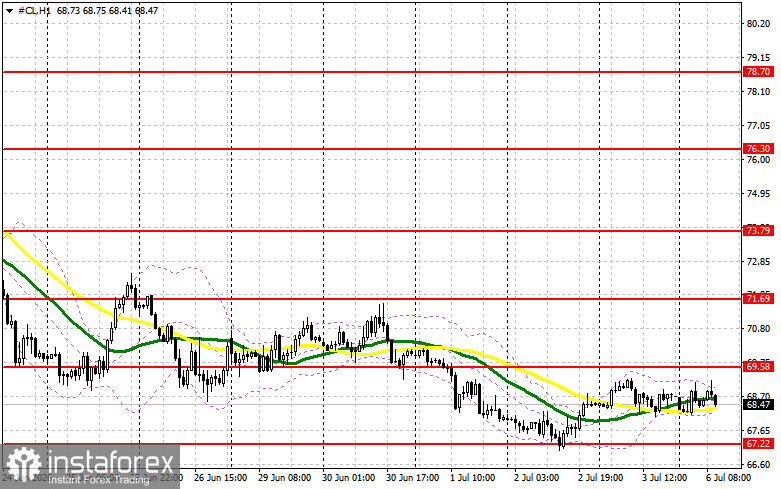
As for the current technical picture of oil, buyers need to break through the nearest resistance at $69.58. This will allow them to target $71.69, above which it will be quite challenging to break through. The furthest target will be the $73.79 area. In the event of an oil price drop, bears will attempt to regain control over $67.22. If this is achieved, a breakout of this range will deal a serious blow to the bulls' positions and push oil down to a low of $63.79, with the potential to reach $59.96.
*El análisis de mercado publicado aquí tiene la finalidad de incrementar su conocimiento, más no darle instrucciones para realizar una operación.
¡Los informes analíticos de InstaSpot lo mantendrá bien informado de las tendencias del mercado! Al ser un cliente de InstaSpot, se le proporciona una gran cantidad de servicios gratuitos para una operación eficiente.


