




¡Nuestro equipo cuenta con más de 7,000,000 operadores!
Cada día, trabajamos juntos para mejorar las operaciones. Obtenemos grandes resultados y seguimos adelante.
El reconocimiento de millones de operadores en todo el mundo es el mejor agradecimiento a nuestro trabajo! ¡Usted hizo su elección y haremos todo lo que esté a nuestro alcance para satisfacer sus expectativas!
¡Juntos somos un gran equipo!
InstaSpot. ¡Orgulloso de trabajar para usted!





¡Actor, 6 veces ganador del torneo UFC y un verdadero héroe!
El hombre que se hizo a sí mismo. El hombre que sigue nuestro camino.
El secreto detrás del éxito de Taktarov es el constante movimiento hacia el objetivo.
¡Revele todo los lados de su talento!
Descubra, intente, fracase, ¡pero nunca se rinda!
InstaSpot. ¡Su historia de éxito comienza aquí!
The wave pattern on the 4-hour chart for EUR/USD has changed somewhat. There is still no reason to talk about the cancellation of the upward trend segment (lower chart), which began in January of last year. However, the trend structure has now taken on a corrective appearance. From a long-term perspective, a wave C may be expected to develop, with its low positioned below the low of wave A.
At the moment, it is difficult to believe in such a significant decline of the euro, but the first quarter of 2026 demonstrated that geopolitics can produce dramatic market shifts and reverse established trends.
On the lower time frame, I can identify a classic three-wave corrective upward structure. Following its completion, a new downward trend segment began to develop, which logically should take the form of an impulsive structure. If this assumption is correct, we should expect the formation of a five-wave structure within wave C of the higher degree, with targets below the 1.1400 level.
Are there fundamental reasons to expect such a strong strengthening of the U.S. dollar? In my opinion, not at this stage. Last week showed that Tehran and Washington continue negotiations, which could theoretically lead to a successful outcome. As long as the possibility of an agreement remains, it will be difficult for the dollar to continue strengthening.
The EUR/USD pair remained unchanged throughout Friday, while volatility once again remained limited. Thursday was a much more active trading day, but it also featured a greater number of significant events.
Today, only Germany's inflation and unemployment reports deserve attention, although the market largely ignored both releases. Nevertheless, I would like to focus on the Consumer Price Index, as it does not provide particularly positive implications for the euro.
The preliminary inflation reading for May came in at 2.6%, which was 0.3 percentage points lower than in April on an annual basis and also 0.3 percentage points below market expectations. The 2.6% figure suggests that inflation is not merely slowing—it is gradually moving toward the ECB's target level.
Of course, this is only a preliminary estimate rather than the final May reading. Furthermore, it reflects data from only one Eurozone country. However, Germany has the largest economy in the bloc, making its economic indicators particularly important.
If inflation is slowing in Germany, it may also be slowing across the Eurozone. If inflation is indeed easing in the Eurozone, the ECB may have less urgency to proceed with monetary policy tightening in June.
It is worth recalling that only yesterday market participants expected the ECB to be the only major central bank likely to tighten policy next month. In the United Kingdom, inflation slowed in April, while the Federal Reserve currently has little room to raise interest rates and continues to maintain a wait-and-see approach.
As a result, the market had been positioning for tighter policy in the Eurozone. However, the probability of this scenario has now declined significantly, which could create additional pressure on the euro.
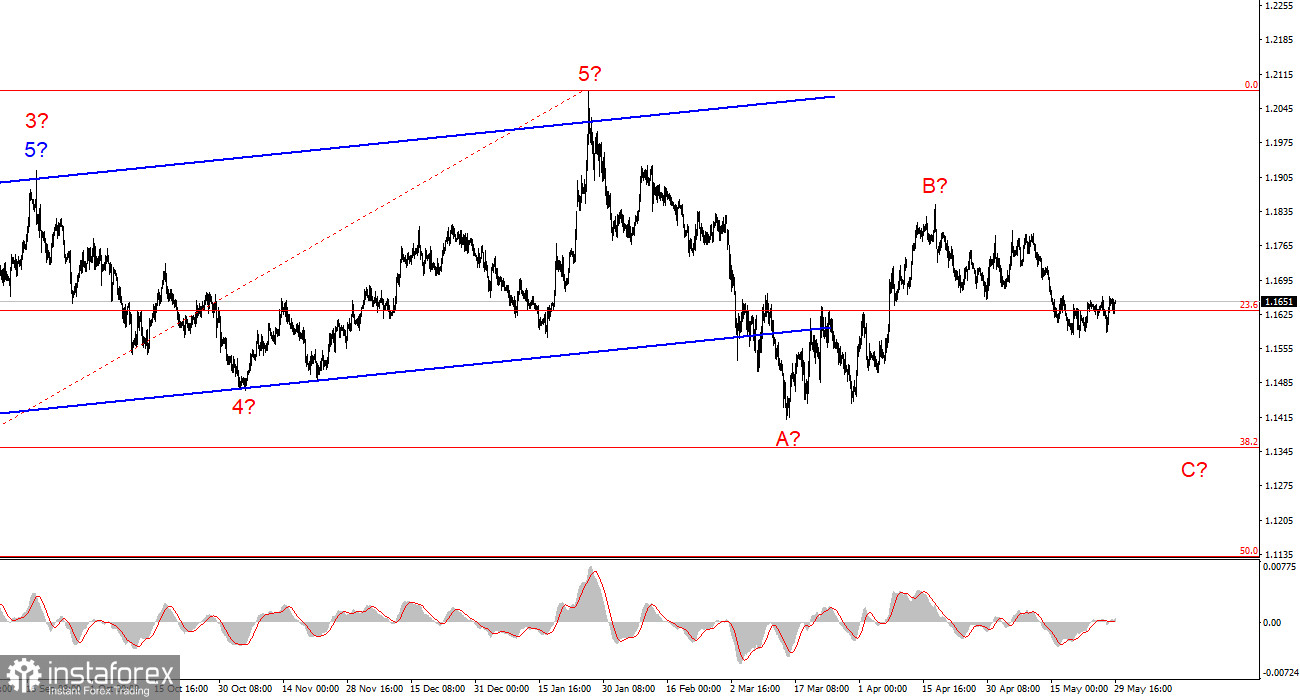
Based on my EUR/USD analysis, I conclude that the instrument remains within an upward trend segment (lower chart), while in the shorter term it remains within a corrective structure.
The corrective a-b-c wave pattern appears complete. Therefore, wave 3 or wave c continues to develop and may form part of a larger wave C structure. The entire wave C (if the current wave count is correct) could eventually extend well below the 1.1400 level.
However, such a scenario would require strong geopolitical support. Otherwise, the current downward wave sequence could take the form of an a-b-c correction and conclude near the 1.1578 level.
On the higher time frame, an upward trend segment remains visible, followed by the development of a corrective wave structure. In the near term, wave C is expected to form with targets near 1.1352, which corresponds to the 38.2% Fibonacci retracement level.
Once the A-B-C structure is complete, a new long-term upward trend may begin to develop.
*El análisis de mercado publicado aquí tiene la finalidad de incrementar su conocimiento, más no darle instrucciones para realizar una operación.
¡Los informes analíticos de InstaSpot lo mantendrá bien informado de las tendencias del mercado! Al ser un cliente de InstaSpot, se le proporciona una gran cantidad de servicios gratuitos para una operación eficiente.


