




Our team has over 7,000,000 traders!
Every day we work together to improve trading. We get high results and move forward.
Recognition by millions of traders all over the world is the best appreciation of our work! You made your choice and we will do everything it takes to meet your expectations!
We are a great team together!
InstaSpot. Proud to work for you!





Actor, UFC 6 tournament champion and a true hero!
The man who made himself. The man that goes our way.
The secret behind Taktarov's success is constant movement towards the goal.
Reveal all the sides of your talent!
Discover, try, fail - but never stop!
InstaSpot. Your success story starts here!

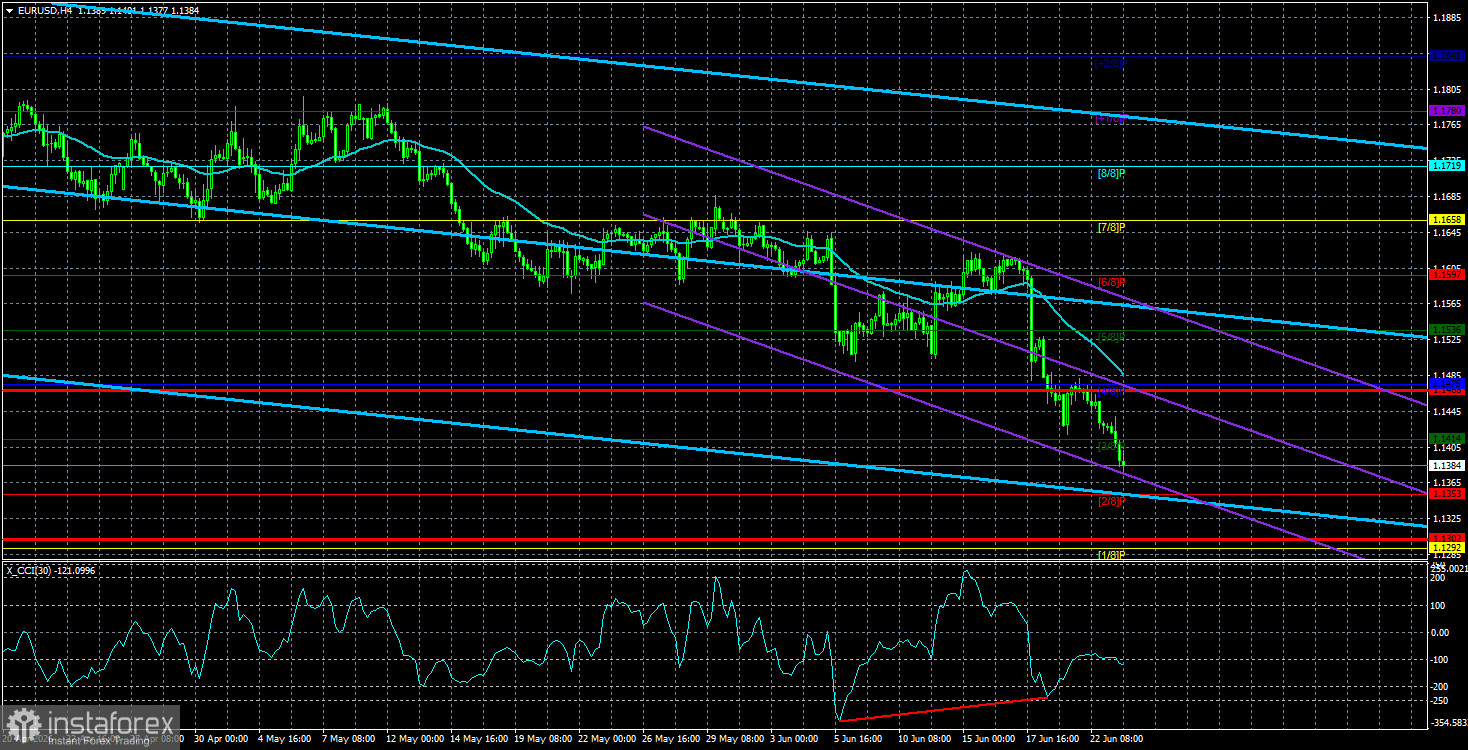
The EUR/USD currency pair continued its steady decline on Tuesday, dropping further. Recall that the European currency's decline began last week following the Federal Reserve meeting. The U.S. central bank adopted a slightly more "hawkish" stance than expected, triggering a sharp rise in the dollar on Wednesday evening. However, Wednesday is long gone, and it is a new Wednesday of a new week, yet the dollar continues to rise. The increase is only seen in the pair with the euro and the Japanese yen. It seems that the Fed's impending rate hike (which will occur no earlier than September) is unrelated to the British pound...
Many analysts believe that the issue with the European currency lies in the Fed's monetary policy. In our view, this is a mistake or, more accurately, a fairy tale. Many experts simply find a suitable event or reason to explain a particular movement in hindsight, completely forgetting about other events, other causes, and the fact that the market can trade not only on the basis of fundamentals and macroeconomics. The European currency has been falling for almost an entire week. During this time, are traders actively pricing in the future (and still uncertain) tightening of monetary policy by the FOMC? But what about the British pound? Why is it not declining? Recall that on Monday, Prime Minister Keir Starmer resigned, and the market typically sells the pound in such situations. Such events have been occurring with enviable regularity over the past 10 years.
Thus, it turns out that the British pound has twice as many reasons to decline, yet it is somehow not falling. Illogical. Also, let's remember that the euro does not have significant reasons for decline against the dollar. The European Central Bank raised its key interest rate two weeks ago, becoming the first among the G7 central banks to do so. However, this fact went unnoticed by the market.
So, it appears that the ECB's monetary policy tightening was ignored, while the market has been pricing in the yet-to-occur Fed policy tightening for a week now. Again, illogical. We believe that there is only one specific reason for the current decline of the EUR/USD pair. And this is not even geopolitics since it has long ceased to support the U.S. dollar. Negotiations over the nuclear agreement between Iran and the U.S. continue, and even if the market does not believe in their success, that is not a reason to make weekly purchases of the U.S. dollar "at any cost." It seems strange that the conflict is over and the parties are moving toward a peace agreement, yet the dollar is increasing, as it did at the height of the war in the Middle East.
We believe that the market simply continues to sell the pair. Without reasons. There is a trend, there are big players, and there are commercial banks. Market participants are not obligated to trade solely on the basis of fundamental, geopolitical, and macroeconomic factors. At present, the direction of movement does not correspond to current events and news. It has not coincided for two weeks since the ECB held its meeting.
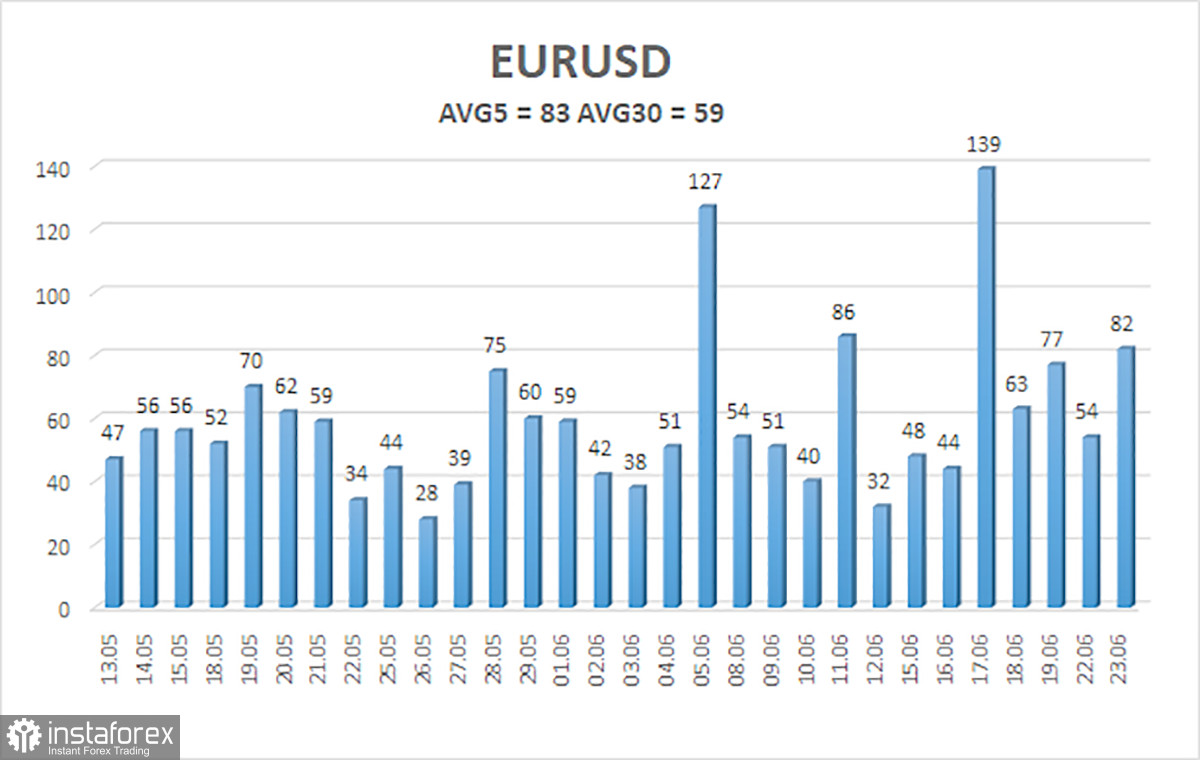
The average volatility of the EUR/USD currency pair over the last 5 trading days, as of June 24, is 83 pips, which is considered "average." We expect the pair to move between 1.1302 and 1.1488 on Wednesday. The upper channel of the linear regression has turned downward, indicating the continuation of the downward trend. The CCI indicator has entered the oversold area and formed a "bullish" divergence, which again warns of a possible end to the downward trend. But the decline continues.
S1 – 1.1353
S2 – 1.1292
S3 – 1.1230
R1 – 1.1414
R2 – 1.1475
R3 – 1.1536
The EUR/USD pair continues its downward movement, which presumably acts as a correction within the framework of a global upward trend, as is clearly visible on the daily or weekly timeframes. The global fundamental backdrop for the dollar remained negative, but in 2026, first geopolitical factors and then the Federal Reserve's "hawkish" stance provided strong support for the American currency. When the price is below the moving average, short positions can be considered with targets of 1.1302 and 1.1292. Above the moving average line, long positions are relevant with targets of 1.1536 and 1.1597. The resolution of the conflict in the Middle East has not created any problems for the dollar. Bears are currently extremely strong, but a sideways movement is in place on the daily timeframe, so the potential for dollar growth is limited.
Linear regression channels help determine the current trend. If both are directed in the same way, it indicates a strong trend;
The moving average line (settings 20,0, smoothed) determines the short-term trend and the direction in which trading should currently be conducted;
Murray levels are target levels for movements and corrections;
Volatility levels (red lines) indicate the probable price channel in which the pair will move over the next day, based on current volatility metrics;
The CCI indicator – its entry into the oversold area (below -250) or the overbought area (above +250) indicates that a trend reversal in the opposite direction is approaching.
*The market analysis posted here is meant to increase your awareness, but not to give instructions to make a trade.
InstaSpot analytical reviews will make you fully aware of market trends! Being an InstaSpot client, you are provided with a large number of free services for efficient trading.


