




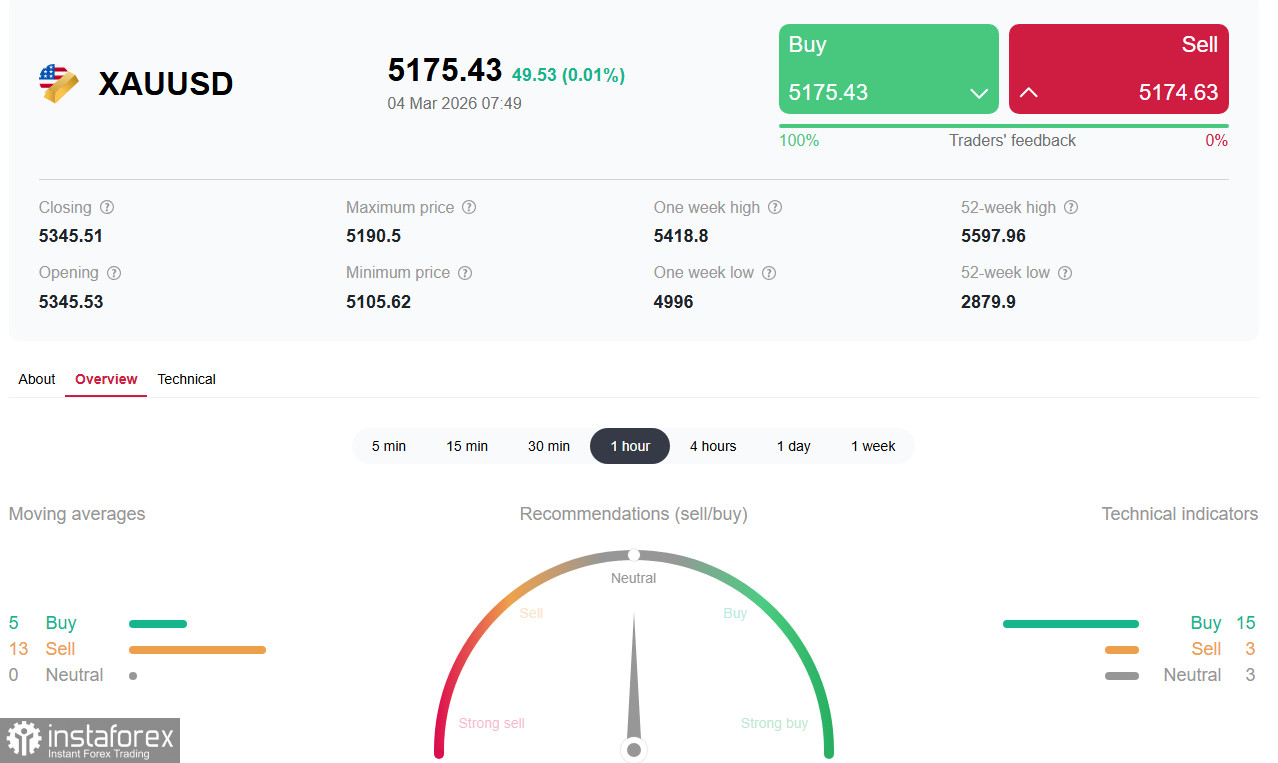
The current situation in the gold market challenges classical logic: amid acute geopolitical escalation between the US and Israel on one side and Iran on the other, an effective blockade of the Strait of Hormuz and the threat of a global energy crisis, gold is not rising but undergoing a deep correction. At first glance, this seems paradoxical. However, when you look at the fundamentals, the metal's behaviour is easy to explain. Gold has been hit by a "perfect storm," where the role of primary safe-haven has been temporarily taken by the US dollar, and inflationary risks have paradoxically turned against the metal.
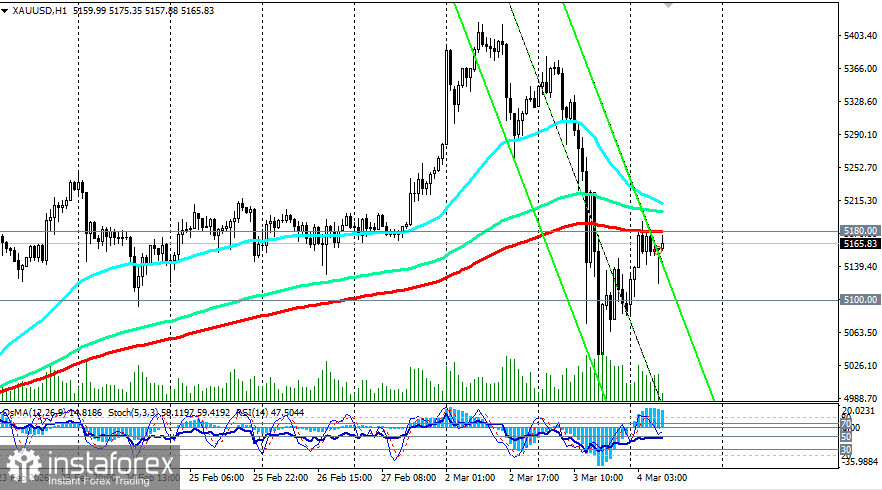
On Wednesday, 4 March, XAU/USD is consolidating just above $5,150.00, facing resistance below the important short?term level of $5,180.00 (the 200?period EMA on the 1?hour chart) and showing modest intraday gains of around 1.50%. This is happening against the backdrop of ongoing investor concerns about a protracted Middle East conflict. US President Donald Trump said the military operation in Iran could last four to five weeks and that strikes will continue as long as necessary.
Geopolitics would normally push gold up, yet it fell from monthly highs above $5,400.00. To understand why, let's examine four key factors.
4 main reasons for gold's decline
2.The inflationary shock from oil turned against gold. The blockade of the Strait of Hormuz — through which roughly 20% of global oil passes — has triggered a spike in energy prices to levels not seen since June 2025. Iran warned it will not allow any oil to leave the region, adding fears of a new energy crisis.
Key takeaway
In the short term, fear of uncontrolled inflation and a tighter Federal Reserve (or merely, the abandonment of easing) has outweighed demand for gold as a safe haven. Investors are now more worried about the conflict's consequences, slowing global growth and sustained high rates than about the war itself.
Brief technical analysis
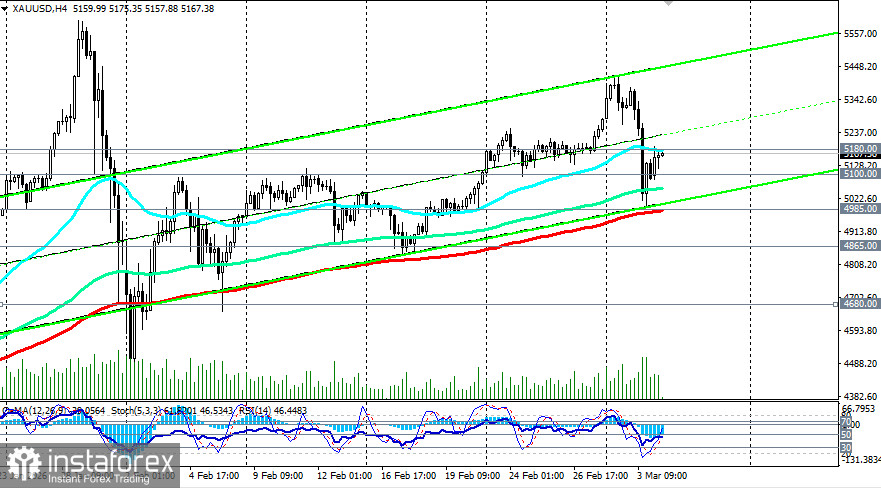
On the 1?hour chart, the short?term trend has turned bearish. Price retreated from the upper border of the rising channel on the 4?hour chart near $5,415.00, which had guided the rally since early February.
Key support levels:
Key resistance levels:
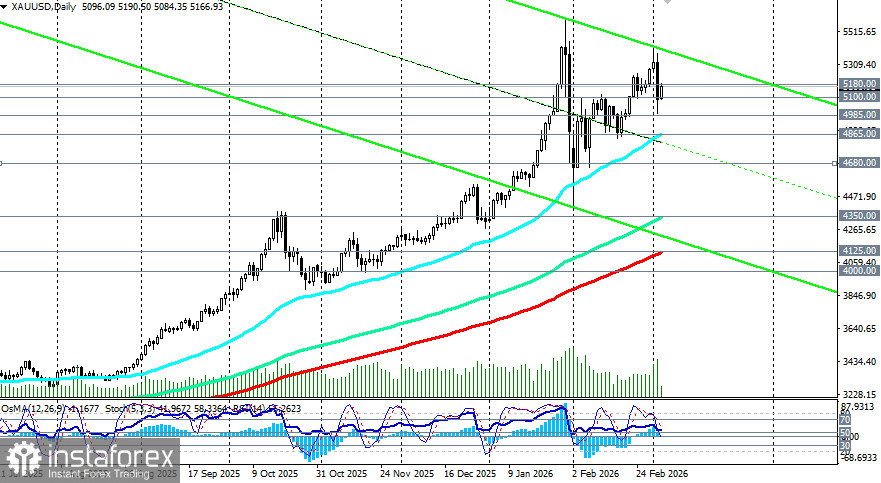
The daily RSI (14) is recovering toward 55.40, indicating some remaining upside momentum. The broader uptrend remains intact but is under pressure.
Outlook
Despite the fall, economists do not see the uptrend in gold as broken. The correction is severe but likely technical. All eyes are on the $4,985.00–$5,100.00 zone: if gold can hold above that area, it has a chance to resume higher. Once panic subsides and stagflation concerns persist, gold will regain attractiveness. If it becomes clear that the Fed cannot fight inflation by raising interest rates (because of recession risk), the precious metal should benefit again.
What matters today?
Market participants are watching the ADP private sector employment report and the ISM services PMI. However, these data may take a back seat as attention is focused on geopolitical developments in the Middle East.
Conclusion
To sum up, despite gold's traditional role as a safe-haven asset amid geopolitical risk, its short-term behaviour can be driven by a range of factors such as:
In this situation, a stronger dollar amid risk concerns can push gold prices lower despite escalating geopolitical risk. However, the current drop is not the end of the gold era — it is a stark reminder that in moments of extreme stress, cash (the US dollar) often rules. In the medium and long term, the fundamental drivers for gold (geopolitics, inflation, and debt) remain in place. Investors seeking entry opportunities should watch the reaction at $5,100.00 and the key support near $5,000.00 closely.
*The market analysis posted here is meant to increase your awareness, but not to give instructions to make a trade.
InstaSpot analytical reviews will make you fully aware of market trends! Being an InstaSpot client, you are provided with a large number of free services for efficient trading.