




Our team has over 7,000,000 traders!
Every day we work together to improve trading. We get high results and move forward.
Recognition by millions of traders all over the world is the best appreciation of our work! You made your choice and we will do everything it takes to meet your expectations!
We are a great team together!
InstaSpot. Proud to work for you!





Actor, UFC 6 tournament champion and a true hero!
The man who made himself. The man that goes our way.
The secret behind Taktarov's success is constant movement towards the goal.
Reveal all the sides of your talent!
Discover, try, fail - but never stop!
InstaSpot. Your success story starts here!

The Australian dollar was not left out, sharply strengthening in step with the market amid panic-selling of the US dollar.
In the previous review, we noted that, until the release of labour market and consumer inflation data on January 22 and 28, the Aussie would have no grounds to resume growth unless news from the US sent the dollar crashing. That is exactly what happened: Trump's demand that it cede to him — not just a little but an entire Greenland — provoked a massive sell-off of American assets.
Nevertheless, the main domestic factor affecting AUD/USD dynamics remains the RBA rate outlook. End-of-last-year forecasts have become noticeably more hawkish, and the threat that inflation will exceed 3% for an extended period has led the market to expect two RBA rate hikes this year. This is a powerful factor in favor of a bullish scenario for the Aussie, but it, of course, needs confirmation.
The annual survey of Australian industry groups in January showed that sentiment is becoming increasingly positive even amid rising concerns about ever-higher costs.
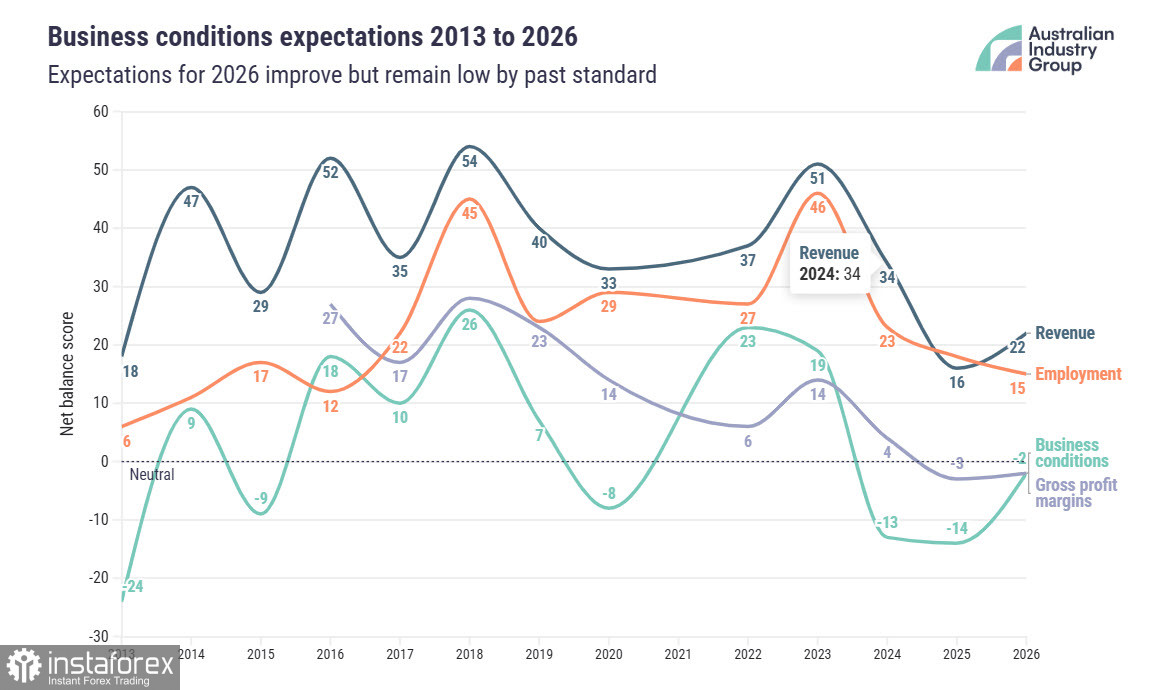
The vast majority of businesses expect further increases in raw material and input costs in 2026, which will also lead to higher selling prices; inflation expectations remain very high. In the long term, high inflation is, without doubt, the main bullish factor for the Aussie.
Employment data for December will be published on Thursday; no other important data is scheduled until the Q4 consumer inflation report on January 28, which suggests a calm news background. Labour market forecasts are generally neutral with a slight tilt toward optimism: NAB expects unemployment to remain at 4.3%, while employment will increase by 40,000, which will partly offset previous weak figures and overall slightly support the Aussie.
Speculative positioning on the Australian dollar has barely changed over the past four weeks, indicating that investors are taking a wait-and-see stance. The net short position is currently -1.3 billion; the calculated price has lost momentum and returned to the long-term average.
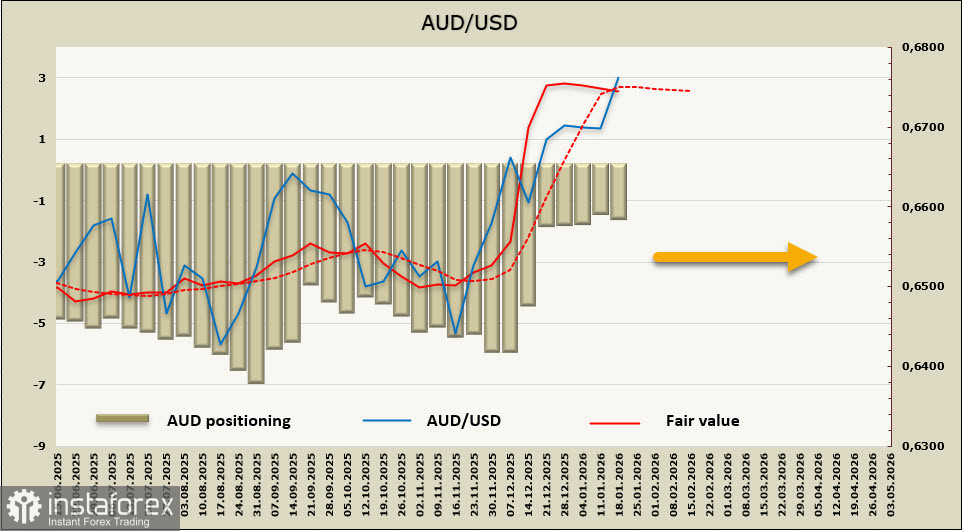
Based on technical and fundamental data, AUD/USD should have remained in a consolidation zone awaiting the Q4 inflation data, since those figures would allow revising forecasts for further RBA actions. But because the market was hit by a wave of sell-offs of American assets, the Aussie was not left out, reaching a new high since October 2024. Technically, the bullish impulse should develop toward 0.6945, but it is too early to count on such a strong move without accounting for other factors. We assume AUD/USD will continue to rise if the US dollar weakens; otherwise, a return to the middle of the wide 0.6660/0.6770 range is possible, as there are no other reasons for further Aussie strengthening until labour and inflation data are released.
*The market analysis posted here is meant to increase your awareness, but not to give instructions to make a trade.
InstaSpot analytical reviews will make you fully aware of market trends! Being an InstaSpot client, you are provided with a large number of free services for efficient trading.


