
我们的团队有超过700万的操盘手!
我们每天都在一起努力改善交易。我们得到了很高的成绩,并继续前进。
世界各地数以百万计的操盘手的认可是我们工作的最大赞赏! 您做出了您的选择,我们将尽一切努力来满足您的期望!
我们是一个共同的伟大团队!
InstaSpot. 自豪地为您工作!



Last Friday, equity indices ended higher. The S&P 500 rose by 0.37%, the Nasdaq 100 strengthened by 0.19%, and the Dow Jones Industrial Average jumped by 0.58%.
Markets have kicked off Monday with cautious optimism. Global equity indices are up, oil is down more than 5%, and the dollar is weaker — all in reaction to reports that the US and Iran have moved close to an agreement over the Strait of Hormuz.
The MSCI All Country World index gained 0.3%, approaching this month's high. Japan's Nikkei jumped by roughly 3% to a record level, with tech once again at the forefront. S&P 500 futures rose by about 1%. Brent fell below $98/bbl, the lowest level in more than two weeks.
The situation in brief: the Washington Post reports that the US and Iran have drafted a framework memorandum of understanding that would extend the ceasefire for 60 days while clearing mines and reopening the Strait of Hormuz. Parallel talks are reportedly underway on the nuclear file and the unfreezing of Iranian assets. There are already tangible signs of thaw: 33 vessels, including oil tankers and container ships, transited the strait in the past 24 hours with permission from the IRGC Navy.
Selling oil on these headlines remains risky. Iran's news agency warned that the draft agreement could collapse over disagreements about asset unfreezing. US President Donald Trump said he would not rush a deal, and Secretary of State Marco Rubio commented that he expected more news Sunday evening but cautioned against overinterpreting early reports.
Many market participants currently judge the odds of a deal at roughly 50/50 — optimistic but far from certain. ANZ warned that oil market volatility could persist even with a partial reopening of the strait.
The market logic is straightforward: lower oil prices ease inflationary pressure, reducing the need for higher rates — a positive for equities, bonds, and gold. This week's US consumer spending data and European inflation prints will tell markets whether diplomatic progress is changing the inflation picture quickly enough for the Fed under new chair Kevin Warsh to consider pausing. Traders have already priced in a year-end interest rate increase, and this data will decide whether that scenario remains plausible.
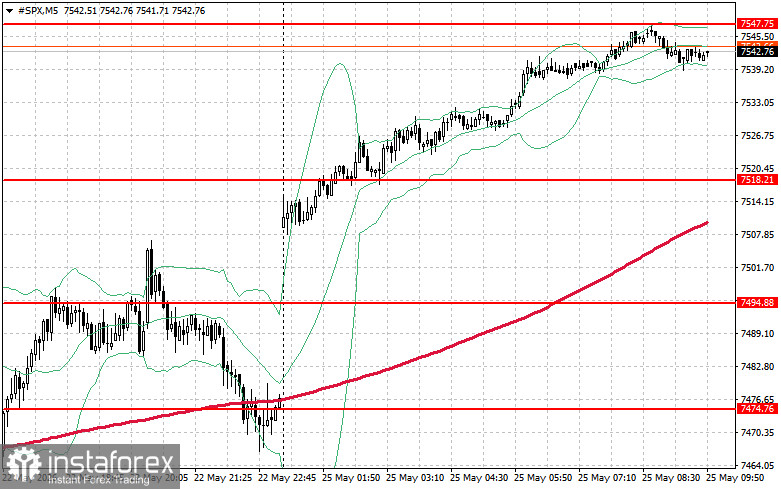
Technically, the S&P 500 analysis shows that the immediate task for buyers is to overcome the resistance level of $7,547. Doing so would confirm further upside and open the path to $7,574. Maintaining control above $7,607 would further cement buyers' positions. On the downside, buyers need to defend the $7,518 area. A break below that level would likely push the index back to $7,494 and open the way to $7,474.
*这里的市场分析是为了增加您对市场的了解,而不是给出交易的指示。
InstaSpot分析评论将让您充分了解市场趋势! 作为InstaSpot的客户,您将获得大量的免费服务以实现有效的交易。