




The legend in the InstaSpot team!
Legend! You think that's bombastic rhetoric? But how should we call a man, who became the first Asian to win the junior world chess championship at 18 and who became the first Indian Grandmaster at 19? That was the start of a hard path to the World Champion title for Viswanathan Anand, the man who became a part of history of chess forever. Now one more legend in the InstaSpot team!





Borussia is one of the most titled football clubs in Germany, which has repeatedly proved to fans: the spirit of competition and leadership will certainly lead to success. Trade in the same way that sports professionals play the game: confidently and actively. Keep a "pass" from Borussia FC and be in the lead with InstaSpot!

The macroeconomic indicators released last week from Australia presented a mixed picture. On one hand, the Melbourne Institute's June inflation index showed signs of disinflation, decreasing by 0.4% month-on-month. The annual rate slowed to 3.9% from 4.4% previously. Furthermore, the core measure fell by 0.5% over the month, reducing its annual estimate to 2.8% from 3.6%. These data suggest that disinflationary processes may be more persistent than previously anticipated, putting pressure on hawkish expectations concerning further rate hikes.
On the other hand, the labor market remains tight, though it is beginning to show signs of cooling. The unemployment rate for May was 4.4%, which is above the Reserve Bank of Australia's forecasts, and the Roy Morgan Research survey recorded the highest unemployment level (11.7%) since January 2021. According to NAB data, employment growth has sharply slowed, confirming expectations of weak employment figures in the June report. This worsening trend in the employment sector becomes a significant argument for the central bank to maintain the current rate and even consider possible policy easing in the future.
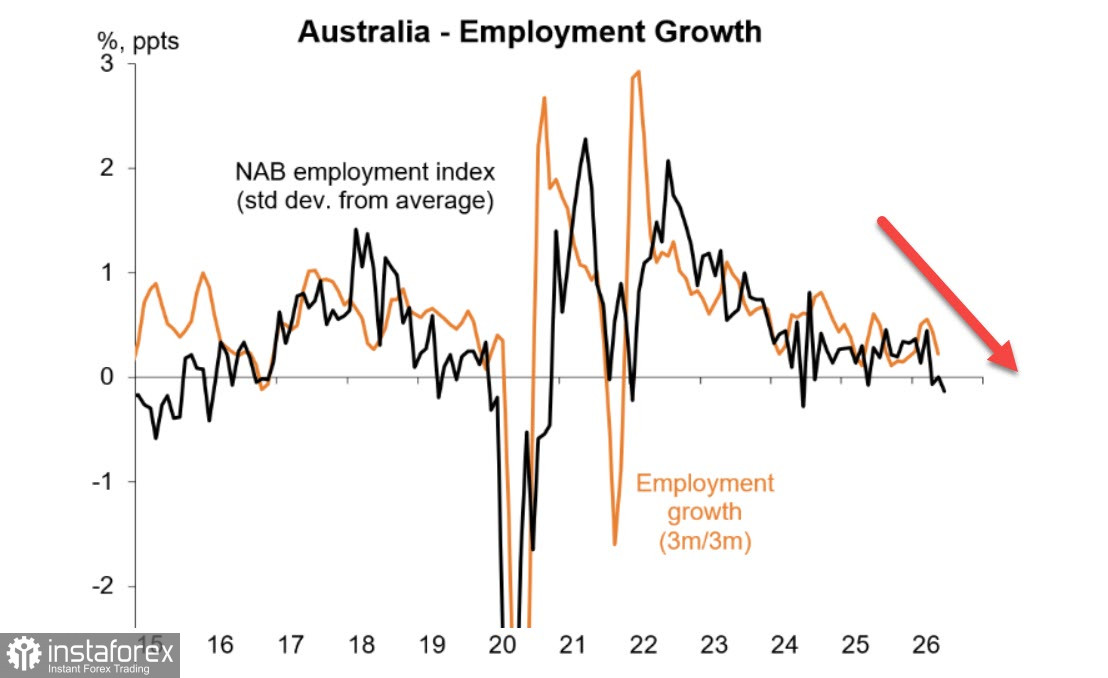
At the July meeting, the RBA kept the key rate at 4.35%, aligning with market expectations. RBA Governor Michelle Bullock confirmed that a rate decrease is not planned in the near future, and the central bank will adhere to a hawkish policy until there is confidence that inflation is returning to the target range of 2-3%.
However, current market forecasts for rate movements (around 16% probability for a hike in August and 50-60% probability for one hike by the end of the year) indicate that investors do not believe in further tightening.
The war in the Middle East exerts a diverse yet overall negative impact on the Australian economy, creating a "perfect storm" for the RBA. Australia is a net importer of oil products, and although temporary reductions in excise and the release of strategic reserves have smoothed out the peak, a second wave of inflation is already on the horizon. According to forecasts, inflation may peak around 5% by mid-2026. There is an unexpected upside – the closure of the Strait of Hormuz and supply disruptions from Qatar have led to a surge in LNG prices, and the Treasury anticipates a noticeable increase in export revenues for the current financial year.
The net short position on AUD increased over the reporting week by $0.6 billion to -$2.3 billion; speculative positioning is worsening, but the calculated price shows signs of reversal.
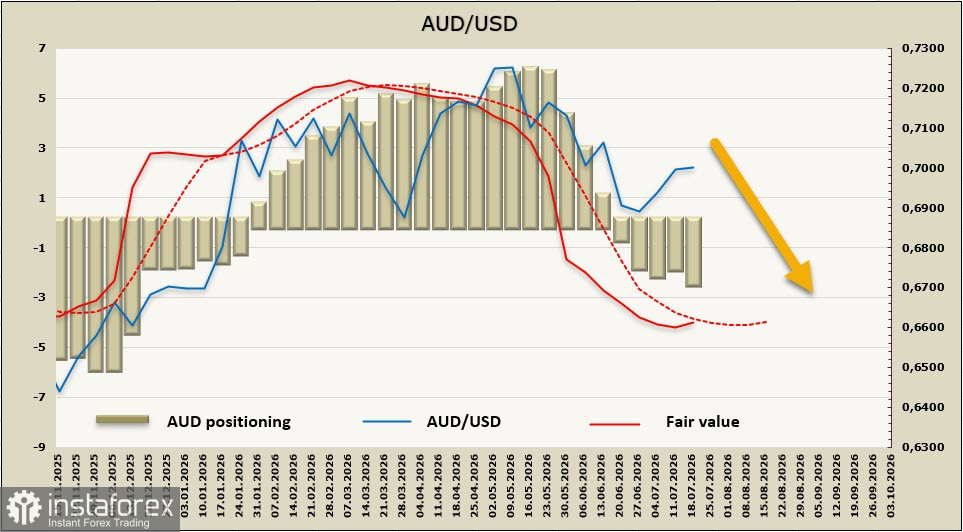
In July, AUD/USD is correcting after a month and a half of decline, but the likelihood of returning to a bullish trend remains low. The corrective rise will encounter resistance at 0.7090, a level that appears unlikely to be breached; in the longer term, we will await buying signals, targeting 0.6885, followed by 0.6757.
*এখানে পোস্ট করা মার্কেট বিশ্লেষণ আপনার সচেতনতা বৃদ্ধির জন্য প্রদান করা হয়, ট্রেড করার নির্দেশনা প্রদানের জন্য প্রদান করা হয় না।
ইন্সটাফরেক্স বিশ্লেষণমূলক পর্যালোচনাগুলো আপনাকে মার্কেট প্রবণতা সম্পর্কে পুরোপুরি সচেতন করবে! ইন্সটাফরেক্সের একজন গ্রাহক হওয়ায়, দক্ষ ট্রেডিং এর জন্য আপনাকে অনেক সেবা বিনামূল্যে প্রদান করা হয়।


