



¡Nuestro equipo cuenta con más de 7,000,000 operadores!
Cada día, trabajamos juntos para mejorar las operaciones. Obtenemos grandes resultados y seguimos adelante.
El reconocimiento de millones de operadores en todo el mundo es el mejor agradecimiento a nuestro trabajo! ¡Usted hizo su elección y haremos todo lo que esté a nuestro alcance para satisfacer sus expectativas!
¡Juntos somos un gran equipo!
InstaSpot. ¡Orgulloso de trabajar para usted!



¡Actor, 6 veces ganador del torneo UFC y un verdadero héroe!
El hombre que se hizo a sí mismo. El hombre que sigue nuestro camino.
El secreto detrás del éxito de Taktarov es el constante movimiento hacia el objetivo.
¡Revele todo los lados de su talento!
Descubra, intente, fracase, ¡pero nunca se rinda!
InstaSpot. ¡Su historia de éxito comienza aquí!
The Elliott wave count on the four-hour chart for EUR/USD has become more complex. On the higher time frame (lower chart), the downward trend segment has taken the form of a five-wave A-B-C-D-E structure, which could be complete at any time, as it appears structurally complete. All waves in this segment are approximately equal in size, so the structure is considered corrective. If this assumption is correct, an impulsive upward trend segment will begin to develop once the correction is complete, with targets well above the 1.2000 level.
On the lower time frame (upper chart), an impulsive wave sequence continues to develop and may belong to wave E on the higher time frame. If this is indeed the case, the dollar's strengthening is nearing its end, regardless of how much further it rises. The projected wave 5 of E is either complete or close to completion. In either case, the current wave structure suggests that the downward wave sequence is nearing completion on both charts. News developments and a sharp shift in market sentiment have driven the US dollar significantly higher, but the number of new factors supporting further dollar appreciation is gradually decreasing.
The EUR/USD exchange rate remained virtually unchanged on Tuesday. The pound, however, gained several dozen basis points, supported by high inflation recorded in the United Kingdom for September. It is reasonable to conclude that UK economic news has supported the pound this week, while the euro has lacked comparable catalysts because there have been no significant news developments in the European Union. However, inflation in the EU is also rising and is currently even higher than in the United Kingdom. For reasons that remain unclear, the market is ignoring news that is favorable to the euro. As a result, the euro has been unable to rise even when the pound gains.
Overall, the outlook for the pound is much clearer than that for the euro. Economists expect the European Central Bank (ECB) to tighten monetary policy once more before the end of the year, and they also expect another round of tightening by the Federal Reserve (Fed). However, demand for the US dollar has been rising for a month and a half, so the impact of the Federal Open Market Committee's (FOMC) monetary tightening has likely been priced in for some time. What about the ECB's policy? Unfortunately, unrest in France and the country's budget crisis continue to prevent the euro from strengthening. In this assessment, the euro's weakness appears unjustified. The wave count for the euro remains almost identical to that of the pound, yet the pound is following its projected wave pattern, while the euro is not.
Under the current conditions, expectations remain for an increase in demand for the euro, but the currency is unlikely to receive new growth drivers in the near term. If the market is not responding to the ECB's monetary tightening or high inflation in the EU, what else could prompt market participants to buy euros? Nevertheless, the current wave count remains valid, so a further decline in EUR/USD is not expected at this stage.
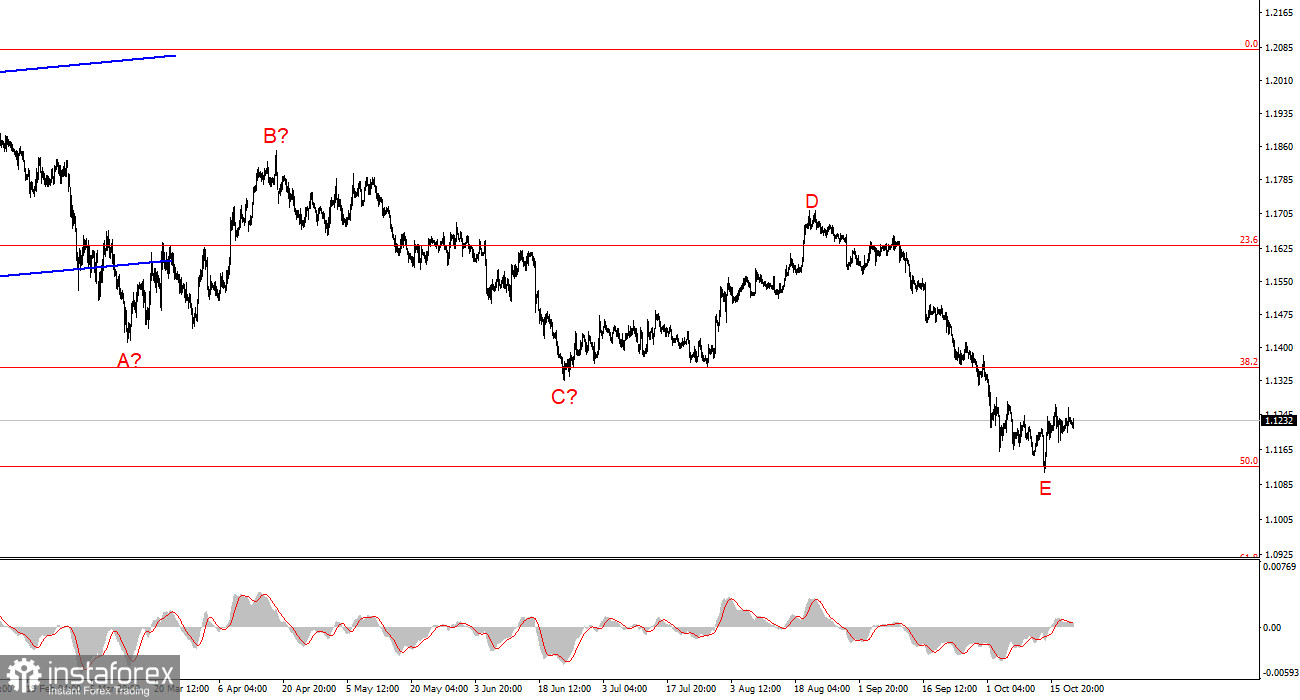
Based on the EUR/USD analysis, the pair remains within the broader corrective trend structure A-B-C-D-E. However, this structure appears fully developed and could therefore be nearing completion. Current conditions appear favorable not only for buying the euro but also for anticipating the development of a sustained upward trend segment. According to the higher time frame, the pair is expected to rise to at least the 1.1700–1.1800 level. The failed attempt to break above 1.1126, corresponding to the 50.0% Fibonacci level (lower chart, higher time frame), also suggests that the market may be preparing for a move higher.
The higher time frame shows a downward trend segment that has taken the form of an A-B-C-D-E structure. The internal wave structure of wave E has developed into a five-wave impulse pattern, which may already be complete. If this assumption is correct, a new upward trend segment will begin to develop.
*El análisis de mercado publicado aquí tiene la finalidad de incrementar su conocimiento, más no darle instrucciones para realizar una operación.
¡Los informes analíticos de InstaSpot lo mantendrá bien informado de las tendencias del mercado! Al ser un cliente de InstaSpot, se le proporciona una gran cantidad de servicios gratuitos para una operación eficiente.


