




¡La leyenda en el equipo de InstaSpot!
¡Leyenda! ¿Cree que es una retórica grandilocuente? Pero, ¿cómo deberíamos llamar a un hombre, que se convirtió en el primer asiático en ganar el campeonato mundial de ajedrez júnior a los 18 años y en el primer Gran Maestro indio a los 19 años? Ese fue el comienzo de un camino difícil hacia el título de Campeón del Mundo para Viswanathan Anand, el hombre que se convirtió en parte de la historia del ajedrez para siempre. ¡Ahora una leyenda más en el equipo de InstaSpot!





Borussia es uno de los clubes de fútbol con más títulos en Alemania, que ha demostrado repetidamente a los fanáticos: el espíritu de competencia y liderazgo que ciertamente conducirán al éxito. Opere de la misma manera que los profesionales del deporte: con confianza y de forma activa. ¡Mantenga un "pase" del Borussia FC y lidere con InstaSpot!
The first wave of the energy crisis caused by the conflict in the Middle East has subsided, but it is far too early to assume the worst is over. A second wave could begin as early as this autumn—and it may prove even more severe than the first.
When the conflict between Iran and the United States began, many countries still had strategic reserves of oil and natural gas. During the blockade of the Strait of Hormuz, these reserves naturally began to decline. By the time a second wave of the crisis emerges, stockpiles may be significantly depleted. With winter approaching only a few months later, demand for fuel, oil, and natural gas is expected to increase, while supplies available to offset potential shortages could be limited.
Experts warn that if Iran and the United States fail to reach another ceasefire agreement and reopen the Strait of Hormuz, the situation could spiral out of control this autumn. Global oil inventories continue to decline even after the strait remained open for about a week. Naturally, that short period was insufficient to replenish strategic reserves.
It is also important to consider the production capacity of Middle Eastern countries, much of which has reportedly been damaged or destroyed by Iranian missile strikes. On one hand, a substantial share of the region's oil exports remains trapped in the Persian Gulf. On the other, Iran could also block the Bab el-Mandeb Strait. In addition, oil production and refining capacity across the Middle East have declined significantly.
According to analysts, the current situation is not substantially better than it was at the peak of the conflict in February and March. The ceasefire has collapsed, oil tankers remain unable to pass through the Strait of Hormuz, while Washington continues to insist that maritime traffic will eventually resume by one means or another. In reality, however, the opposite appears to be occurring. The strait remains closed, another strategically important maritime route could also become blocked, and Donald Trump's repeated attempts to persuade Iran to return to negotiations and sign a new agreement have so far been unsuccessful.
Analysts also note that oil prices did not reach $200 per barrel during the spring and summer only because China reduced imports while the United States increased exports. If the conflict remains limited to disruptions in maritime shipping, the crisis is likely to develop more gradually. Several alternative export routes from the Middle East do exist, including Saudi Arabia's pipeline to Yanbu and the UAE's pipeline to Fujairah. However, many planned pipeline projects have yet to become fully operational, while further Iranian strikes against regional oil and gas infrastructure would deepen a crisis that already appears increasingly difficult to avoid.
Based on these factors, if Iran and the United States fail to reach an agreement, oil prices could quickly climb back above $100 per barrel and are likely to move considerably higher during the autumn and winter.
EUR/USD Wave Analysis
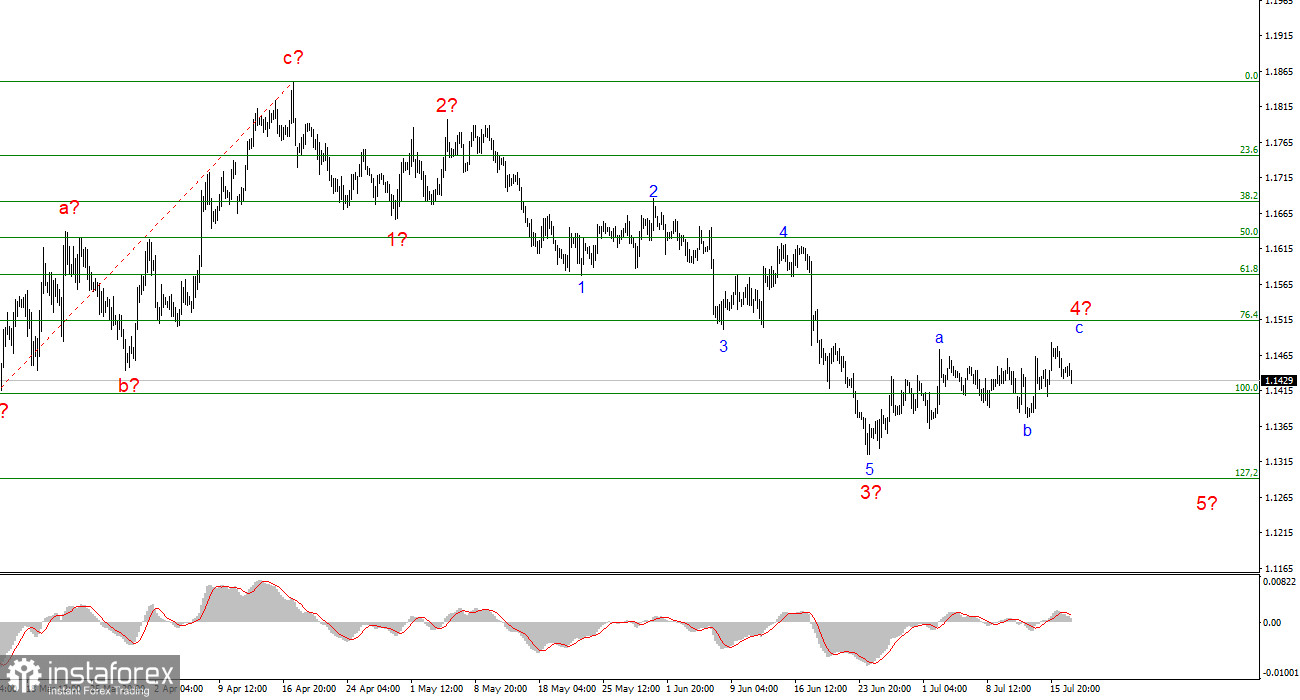
Based on the analysis, EUR/USD remains within a broader upward trend (see the lower chart), while in the shorter term it continues to develop within a downward trend segment. Current market conditions provide a reasonable opportunity to begin considering long positions. However, the pair may still decline toward the 1.13 level as part of wave 5 of wave C. Elliott Wave structures often produce unexpected developments, so attention should already be shifting toward potential buying opportunities.
The wave structure of GBP/USD has become relatively complex. At present, the pair has completed three downward waves, while EUR/USD may ultimately complete a five-wave decline. Consequently, the British pound may still form one additional downward wave, similar to the euro. However, this move could represent the second wave within a new bullish trend segment.
As a result, the difference between the wave structures of the euro and the pound is likely to remain relatively small and of limited significance. Therefore, I expect another corrective decline in the near term, followed by the beginning of a new upward trend, with the initial upward targets located in the 1.37–1.38 level.
Core Principles of My Analysis
*El análisis de mercado publicado aquí tiene la finalidad de incrementar su conocimiento, más no darle instrucciones para realizar una operación.
¡Los informes analíticos de InstaSpot lo mantendrá bien informado de las tendencias del mercado! Al ser un cliente de InstaSpot, se le proporciona una gran cantidad de servicios gratuitos para una operación eficiente.


