




¡La leyenda en el equipo de InstaSpot!
¡Leyenda! ¿Cree que es una retórica grandilocuente? Pero, ¿cómo deberíamos llamar a un hombre, que se convirtió en el primer asiático en ganar el campeonato mundial de ajedrez júnior a los 18 años y en el primer Gran Maestro indio a los 19 años? Ese fue el comienzo de un camino difícil hacia el título de Campeón del Mundo para Viswanathan Anand, el hombre que se convirtió en parte de la historia del ajedrez para siempre. ¡Ahora una leyenda más en el equipo de InstaSpot!





Borussia es uno de los clubes de fútbol con más títulos en Alemania, que ha demostrado repetidamente a los fanáticos: el espíritu de competencia y liderazgo que ciertamente conducirán al éxito. Opere de la misma manera que los profesionales del deporte: con confianza y de forma activa. ¡Mantenga un "pase" del Borussia FC y lidere con InstaSpot!
The GBP/USD currency pair maintained an upward bias on Wednesday but traded with low volatility, ignoring all available events. It is important to start with the speech of Bank of England Governor Andrew Bailey, while other events will be covered in subsequent articles. Bailey's speeches are always important, as they occur relatively rarely. Moreover, Bailey seldom comments on monetary policy, so any statements on this topic attract significant interest. However, not this time.
The head of the BoE announced that the central bank generally remains dovish and intends to simply "wait out" the inflation spike caused by the energy crisis and the war in the Middle East. Bailey confirmed that earlier this year, the BoE was set on two cuts to the key interest rate in 2026, but the war between the U.S. and Iran made adjustments. Currently, inflation in the UK stands at 2.8%, which is an excellent result given the circumstances. The chairman of the BoE allows that it could accelerate to 3.2% in the second half of the year but is expected to drop back to the central bank's target level of 2% by next summer. Thus, the BoE's long-term forecast is for inflation to decrease to 2% even without tightening monetary policy, provided the war in the Middle East does not resume.
Thus, the points have been clarified. Inflation in the UK has been slowing in recent months, and the BoE is not even considering raising the key rate. Therefore, the British pound is losing one potential support factor. The question remains whether the U.S. dollar has sufficient support to sustain growth for two consecutive months. Notably, inflation is slowing in the Eurozone and in the UK. There is every reason to expect it will begin to slow down in the U.S. as well. In this case, the Federal Reserve will also have no grounds to tighten monetary policy—especially under Kevin Warsh, who was appointed Fed chair by Donald Trump not to raise rates.
By the way, Trump has once again called for the Fed to cut interest rates. Thus, the U.S. president's attitude toward Fed monetary policy remains unchanged. We believe that until September, the Fed will take a wait-and-see position, and then everything will depend on inflation. If it does not slow down as it has in the Eurozone or the UK, the Fed may consider a temporary tightening. But only to quickly reduce the pace of consumer price growth and resume the monetary easing cycle. In any case, there are no hawkish signals on the Fed's horizon. Trump needs high economic growth rates, and there have been serious issues with that in recent quarters. Thus, we still consider the recent rise in the U.S. dollar illogical. The market has rushed to conclusions; the Fed may very well proceed without raising the key rate. The decline in both currency pairs in recent weeks could serve as a trap for bears.
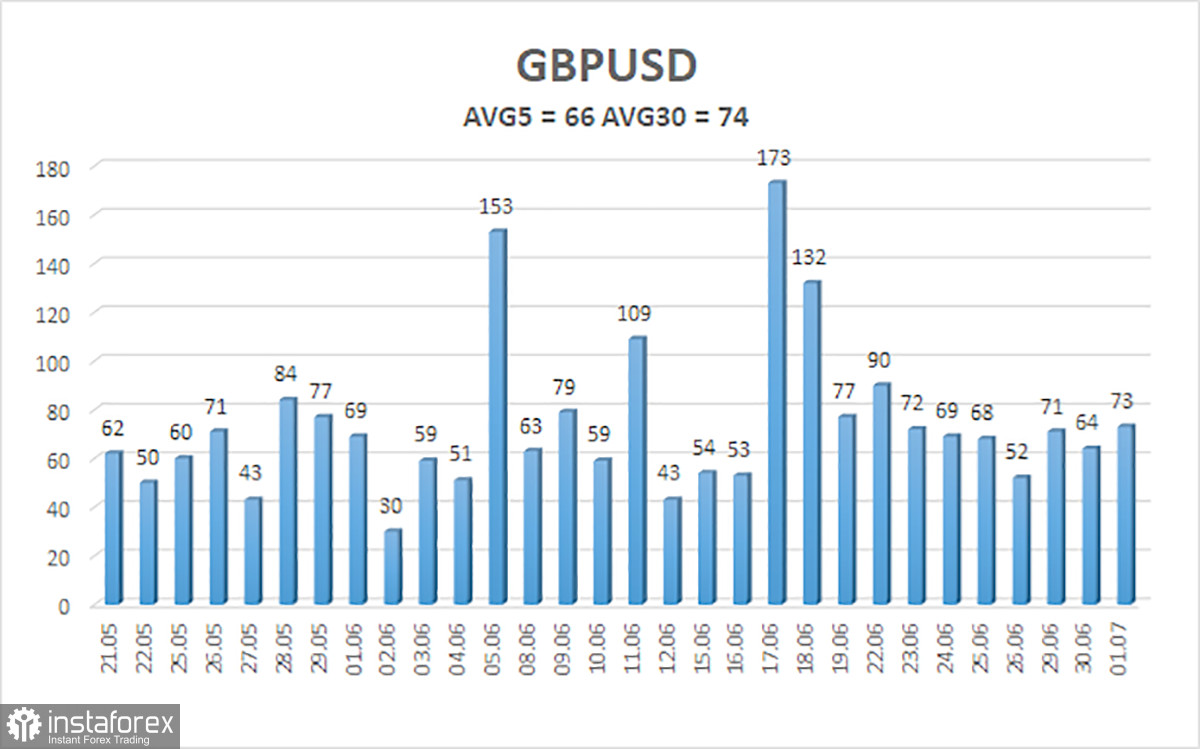
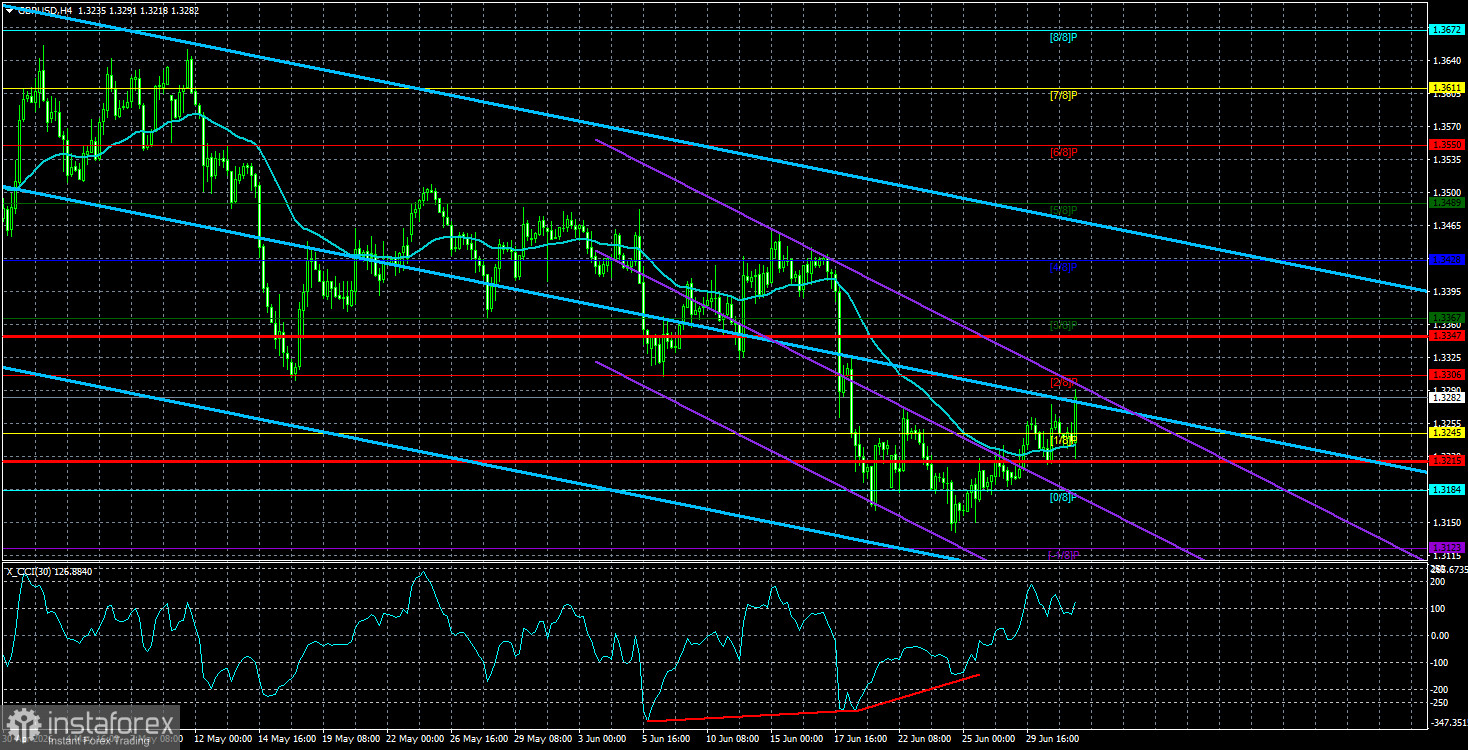
The average volatility of the GBP/USD pair over the last five trading days is 66 pips, which is considered "average" for this pair. On Thursday, July 2, we expect movement within the range bounded by 1.3215 and 1.3347. The upper linear regression channel is directed downwards, indicating a downward trend. The CCI indicator has entered the oversold area twice and formed two bullish divergences, warning of a possible end to the downward trend.
S1 – 1.3245
S2 – 1.3184
S3 – 1.3123
R1 – 1.3306
R2 – 1.3367
R3 – 1.3428
The GBP/USD currency pair maintains a downward trend. Trump's policies will continue to exert pressure on the U.S. economy, so we do not expect long-term growth for the U.S. dollar. While 2026 appears super-positive for the dollar due to geopolitics and the Fed's readiness to raise rates, a range persists on the weekly timeframe between 1.3150 and 1.3780, within a four-year upward trend. Long positions with targets of 1.3306 and 1.3347 can be considered when the price is above the moving average. Positions below the moving average suggest the opposite approach.
Linear regression channels help determine the current trend. If both are directed in one direction, it indicates a strong trend;
The moving average line (settings 20,0, smoothed) determines the short-term trend and the direction in which to trade;
Murray levels are target levels for movements and corrections;
Volatility levels (red lines) indicate the likely price channel in which the pair will spend the next day based on current volatility metrics;
The CCI indicator—its entry into the oversold area (below -250) or the overbought area (above +250) signals that a trend reversal is approaching in the opposite direction.
*El análisis de mercado publicado aquí tiene la finalidad de incrementar su conocimiento, más no darle instrucciones para realizar una operación.
¡Los informes analíticos de InstaSpot lo mantendrá bien informado de las tendencias del mercado! Al ser un cliente de InstaSpot, se le proporciona una gran cantidad de servicios gratuitos para una operación eficiente.


