




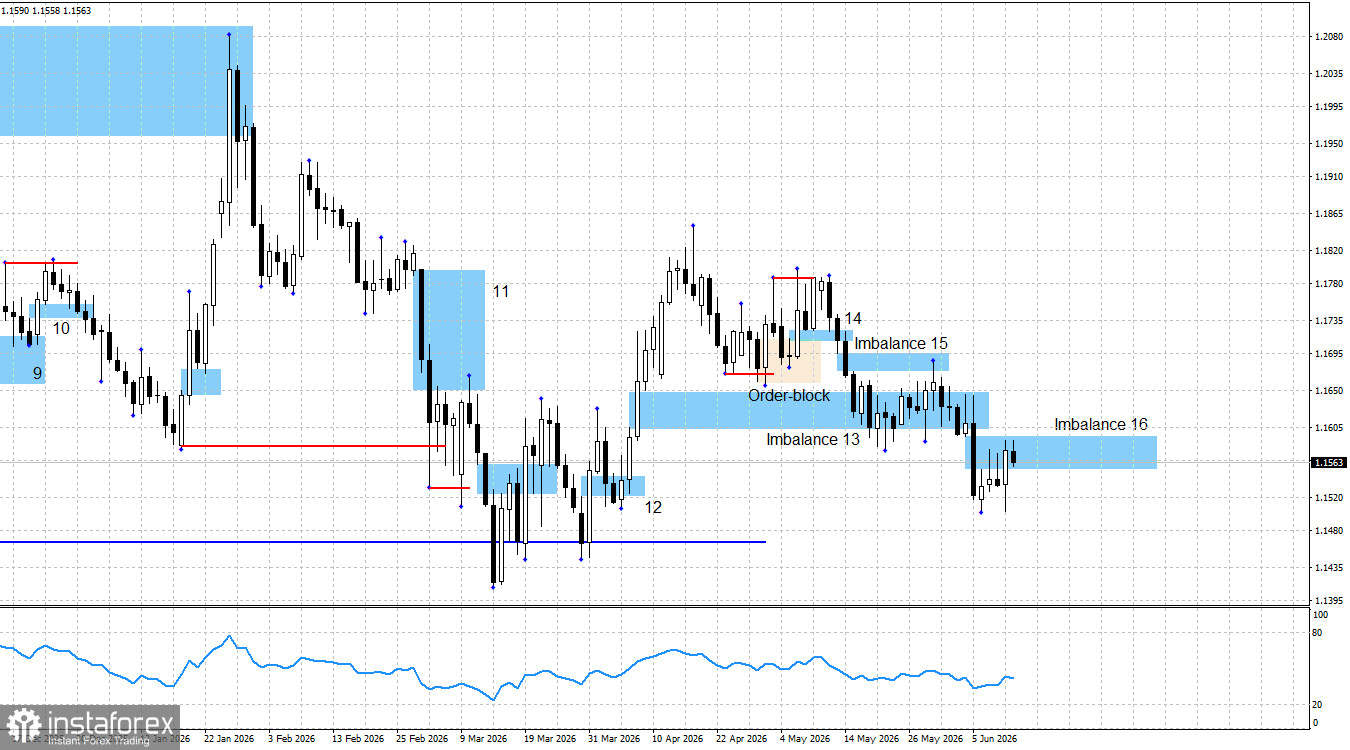
The EUR/USD pair continues to drift gradually lower. This week, bulls made several attempts to halt the bearish advance, but all of them ended in failure to one degree or another. Although the Nonfarm Payrolls report does not fall into the category of geopolitical events, it nevertheless triggered a sharp decline in the pair last Friday, resulting in the formation of bearish imbalance 16. At present, this imbalance serves not only as an area of interest for bears but also as a resistance zone for bulls. As of Friday evening, bulls had failed to overcome this zone. A sell signal had nearly formed within imbalance 16, but yesterday evening Donald Trump once again entered the scene and disrupted the entire technical picture. Traders were calmly preparing for a new escalation of the conflict, just as Trump had promised the day before. However, we all know the expression "changing one's mind every day." Trump appears to do so even more frequently. Late yesterday evening, the U.S. leader stated that an agreement with Iran was already nearly finalized and that leaders of allied Middle Eastern countries had asked him not to launch new strikes against Iran because doing so could jeopardize the deal. It is worth recalling that previously it was Iranian officials who had reportedly urged Trump not to launch strikes because the agreement was supposedly close to completion. Such is the situation. Most importantly, Trump's statements continue to change rapidly.
The objective reality is that the conflict in the Middle East shows no signs of ending, while Tehran and Washington remain unable to agree on a deal acceptable to all sides. Iran and the United States resumed exchanging missile strikes this week, and Donald Trump once again threatened Iran with complete military destruction. However, such developments are unlikely to surprise anyone at this point, as both sides have regularly carried out strikes in recent weeks, appearing more concerned about avoiding any appearance of weakness than about preserving negotiations. Consequently, the dollar remains traders' preferred currency due to the geopolitical factor.
The pair's movement and market sentiment will continue to depend primarily on geopolitical developments in the near term. If Tehran and Washington eventually sign a memorandum of understanding, extend the ceasefire, lift blockades, and make progress on the nuclear issue, bears may be forced to retreat, allowing the euro and the pound to resume their upward movement. At present, however, Donald Trump appears to be the only one seeing positive developments in the conflict. Even then, optimism alternates with threats.
Under current conditions, traders may focus on bearish patterns. A sell signal may still form within bearish imbalance 16, which means the decline could continue toward the 1.1413 level. If an agreement between Iran and the United States is eventually reached, the euro could resume its upward movement despite existing bearish patterns. However, this outcome appears unlikely in the near future, leaving bears in a more favorable position.
Once again, I must note that the entire appreciation of the U.S. dollar between January and March was driven exclusively by geopolitical developments. As soon as the United States and Iran agreed to a ceasefire, bears immediately retreated, and bulls dominated trading for more than a month. At present, the chances of reaching a new agreement once again appear minimal, and the market remains highly skeptical of any reports suggesting a quick end to the conflict or a deal between Iran and the United States while both sides continue to exchange strikes daily. As a result, geopolitical factors continue to exert underlying pressure on the EUR/USD pair.
The economic backdrop had no impact on trader sentiment on Friday. The market largely ignored the University of Michigan Consumer Sentiment Index, and there were no other notable events during the day apart from geopolitical developments.
Bulls still have numerous reasons to remain active in 2026, and the outbreak of war in the Middle East has not reduced their number. Structurally and globally, the policies pursued by Trump, which contributed to the sharp decline of the dollar last year, have not changed. Over the coming months, the U.S. currency may periodically strengthen as investors seek safe-haven assets, but this factor requires a continued escalation of tensions in the Middle East. I still do not believe in a long-term bearish trend for the euro. The dollar has received temporary support from the market, but what will sustain bearish pressure over the longer term remains unclear.
The June 15 economic calendar contains two releases that cannot be considered significant. The impact of the economic backdrop on market sentiment on Monday is expected to be extremely weak or nonexistent.
In my view, the pair remains in the process of forming a bullish trend. The information backdrop changed sharply three months ago, but the trend itself cannot yet be considered canceled or completed. Therefore, bulls may well resume their advance in the near future if geopolitical developments provide at least some support.
At present, traders can only maintain existing sell positions initiated from imbalance 15 and wait for a new sell signal to form from imbalance 16. The pair's decline has been prolonged by objective factors, although without strong U.S. labor market and unemployment data, the support zone of imbalance 13 would most likely have held. However, it failed to do so, giving bears an opportunity to continue their offensive with a target below the 1.1413 level (the swing low of March 13).
*El análisis de mercado publicado aquí tiene la finalidad de incrementar su conocimiento, más no darle instrucciones para realizar una operación.
¡Los informes analíticos de InstaSpot lo mantendrá bien informado de las tendencias del mercado! Al ser un cliente de InstaSpot, se le proporciona una gran cantidad de servicios gratuitos para una operación eficiente.