




¡La leyenda en el equipo de InstaSpot!
¡Leyenda! ¿Cree que es una retórica grandilocuente? Pero, ¿cómo deberíamos llamar a un hombre, que se convirtió en el primer asiático en ganar el campeonato mundial de ajedrez júnior a los 18 años y en el primer Gran Maestro indio a los 19 años? Ese fue el comienzo de un camino difícil hacia el título de Campeón del Mundo para Viswanathan Anand, el hombre que se convirtió en parte de la historia del ajedrez para siempre. ¡Ahora una leyenda más en el equipo de InstaSpot!





Borussia es uno de los clubes de fútbol con más títulos en Alemania, que ha demostrado repetidamente a los fanáticos: el espíritu de competencia y liderazgo que ciertamente conducirán al éxito. Opere de la misma manera que los profesionales del deporte: con confianza y de forma activa. ¡Mantenga un "pase" del Borussia FC y lidere con InstaSpot!
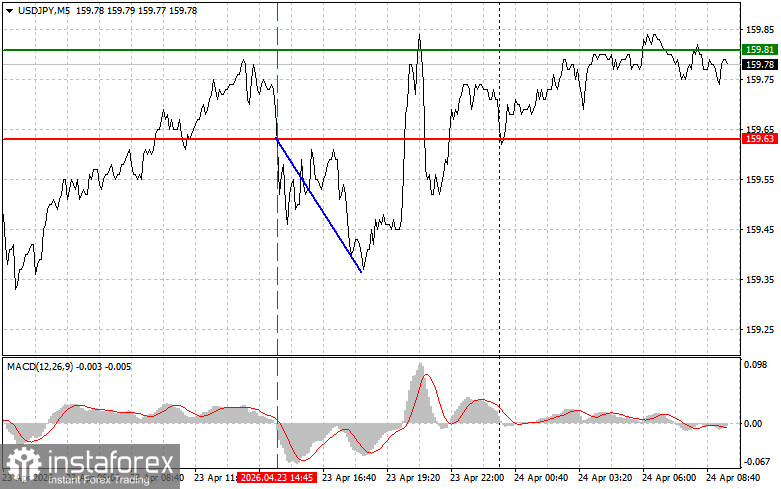
The price test at 159.63 coincided with the moment when the MACD indicator was just starting to move downward from the zero mark, confirming it as a good entry point to sell the dollar. As a result, the pair decreased by nearly 230 pips.
Yesterday's encouraging data, indicating growth in both the manufacturing and services sectors in the United States for April, rekindled demand for the U.S. dollar against the yen. The business activity indices for both the manufacturing and services sectors exceeded economists' forecasts, indicating sustained consumer interest and confidence among companies.
However, today the Japanese yen exhibited remarkable resilience, despite positive news that the consumer price index rose to 1.5%, surpassing economists' expectations. This increase should have served as a catalyst for strengthening the national currency, as it inevitably raises the question for the Bank of Japan about the possibility of further monetary policy tightening. Traditionally, interest rate hikes are seen as a factor attracting investments and consequently stimulating demand for the national currency.
Nonetheless, despite such encouraging economic signals, traders remain reluctant to increase their positions in the Japanese yen. This behavior stems from a far more powerful force currently shaping sentiment in financial markets—the geopolitical tension in the Middle East. Rising risks in this region are driving global uncertainty and increasing demand for safe-haven assets, with the U.S. dollar the primary beneficiary.
In conditions of heightened international tensions, investors tend to minimize risks by choosing more secure and liquid instruments. Therefore, even with positive internal economic data, the Japanese yen finds itself overshadowed by stronger competitors.
As for the intraday strategy, I will rely more on scenarios 1 and 2.
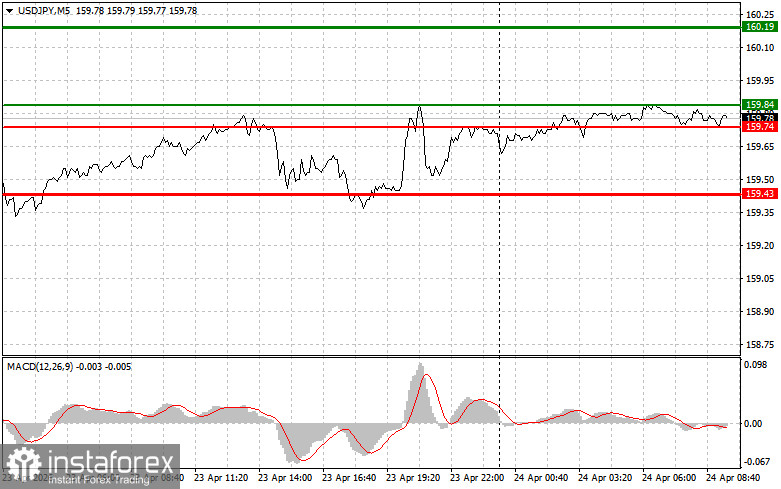
Scenario #1: I plan to buy USD/JPY today when the price reaches around 159.84 (green line on the chart), targeting an increase to 160.19 (thicker green line on the chart). At around 160.19, I will exit the long positions and open short positions in the opposite direction (expecting a movement of 30-35 pips in the opposite direction from this level). It is best to return to buying the pair on corrections and significant pullbacks in USD/JPY. Important! Before buying at a breakout, ensure that the MACD indicator is above the zero mark and is just beginning its upward movement from there.
Scenario #2: I also plan to buy USD/JPY today in the event of two consecutive tests of the price at 159.74 when the MACD indicator is in the oversold area. This will limit the pair's downside potential and may lead to an upward market reversal. An increase can be expected toward the opposite levels of 159.84 and 160.19.
Scenario #1: I plan to sell USD/JPY today after it drops below 159.74 (red line on the chart), which will trigger a rapid decline in the pair. The key target for sellers will be the 159.43 level, where I will exit the shorts and immediately buy back in the opposite direction (expecting a 20-25-pip move in the opposite direction from this level). It is best to sell as high as possible, near the 160 yen level. Important! Before selling at a breakout, ensure that the MACD indicator is below the zero mark and is just beginning its downward movement from there.
Scenario #2: I also plan to sell USD/JPY today in the case of two consecutive tests of the price at 159.84 when the MACD indicator is in the overbought area. This will limit the pair's upward potential and may lead to a market reversal downward. A decrease can be expected toward the opposite levels of 159.74 and 159.43.
Important: Beginner traders in the Forex market need to be very cautious when making entry decisions. It is best to be out of the market before important fundamental reports are released to avoid being caught in sharp price fluctuations. If you choose to trade during news releases, always set stop orders to minimize losses. Without setting stop orders, you can quickly lose your entire deposit, especially if you do not use money management and trade large volumes.
And remember, for successful trading, it is essential to have a clear trading plan, like the one presented above. Spontaneous trading decisions based on the current market situation are inherently a losing strategy for intraday traders.
*El análisis de mercado publicado aquí tiene la finalidad de incrementar su conocimiento, más no darle instrucciones para realizar una operación.
¡Los informes analíticos de InstaSpot lo mantendrá bien informado de las tendencias del mercado! Al ser un cliente de InstaSpot, se le proporciona una gran cantidad de servicios gratuitos para una operación eficiente.


