




¡Nuestro equipo cuenta con más de 7,000,000 operadores!
Cada día, trabajamos juntos para mejorar las operaciones. Obtenemos grandes resultados y seguimos adelante.
El reconocimiento de millones de operadores en todo el mundo es el mejor agradecimiento a nuestro trabajo! ¡Usted hizo su elección y haremos todo lo que esté a nuestro alcance para satisfacer sus expectativas!
¡Juntos somos un gran equipo!
InstaSpot. ¡Orgulloso de trabajar para usted!





¡Actor, 6 veces ganador del torneo UFC y un verdadero héroe!
El hombre que se hizo a sí mismo. El hombre que sigue nuestro camino.
El secreto detrás del éxito de Taktarov es el constante movimiento hacia el objetivo.
¡Revele todo los lados de su talento!
Descubra, intente, fracase, ¡pero nunca se rinda!
InstaSpot. ¡Su historia de éxito comienza aquí!
The yen reacted positively to reports of a two-week ceasefire between the warring parties in the Persian Gulf; however, the strengthening of the yen was limited and quickly halted.
The rise in oil prices is contributing to higher prices across a range of components in Japan's consumer basket—specifically energy sources, as well as food, industrial goods, and services. Typically, it takes three to five months for rising oil prices to reflect in inflation, so the main consequences will likely come to the forefront in the summer. According to calculations by Mizuho Bank, core inflation could rise above 2.5% again by autumn if oil prices remain above $90 during the second quarter.
The Bank of Japan recently published new estimates of the gap between actual and potential output in the Japanese economy, indicating that it has been in positive territory for the past few years rather than negative as previously assumed. Accordingly, the factors holding back further rate increases are fewer in number. At the beginning of this year, the neutral rate was expected to be around 1.0%, but now it is more likely closer to 1.25%, or even 1.50%.
Given Japan's threat of stagflation, the Bank of Japan must choose between curbing inflation and stimulating demand. It is commonly believed that uncontrolled inflation poses greater risks than an economic slowdown, and, following this reasoning, if inflation accelerates, we should also expect higher interest rates. This is also a bullish factor for the yen.
At present, the market probability of a rate hike at the BoJ meeting on April 27-28 is about 50%. It is evident that much, if not everything, will depend on the further developments in the Persian Gulf, as two main threats to Japan arise from there: physical limitations on oil supplies and, consequently, an impact on the economy, as well as price levels and the resulting risk of rapid inflation growth.
The net short position on the yen increased by $0.57 billion over the reporting week to -$5.74 billion; speculative positioning remains bearish while the calculated price remains above the long-term average, although attempts at a downward reversal are observed.
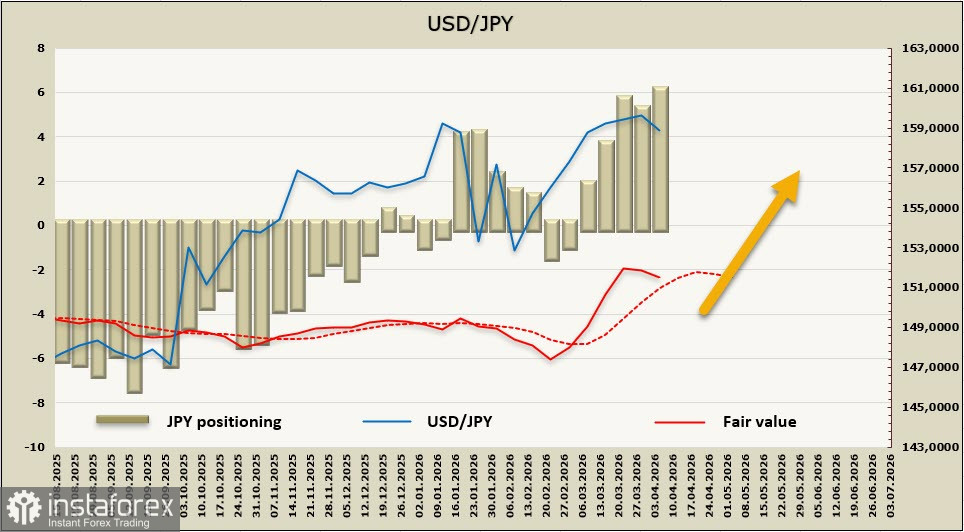
Market prospects for the yen remain somewhat clear and depend directly on developments in the Persian Gulf. If the established ceasefire maintains real continuity and oil transit through the strait resumes, the yen will begin to strengthen as the threat of a rapid economic downturn into recession decreases. Conversely, if the situation around the strait remains tense, the yen will have no choice but to weaken further. In the first case, we should expect USD/JPY to move to support at 152, while in the second case, a breakout above 171.96 may occur; however, further growth will be actively restrained by the threat of currency intervention.
*El análisis de mercado publicado aquí tiene la finalidad de incrementar su conocimiento, más no darle instrucciones para realizar una operación.
¡Los informes analíticos de InstaSpot lo mantendrá bien informado de las tendencias del mercado! Al ser un cliente de InstaSpot, se le proporciona una gran cantidad de servicios gratuitos para una operación eficiente.


