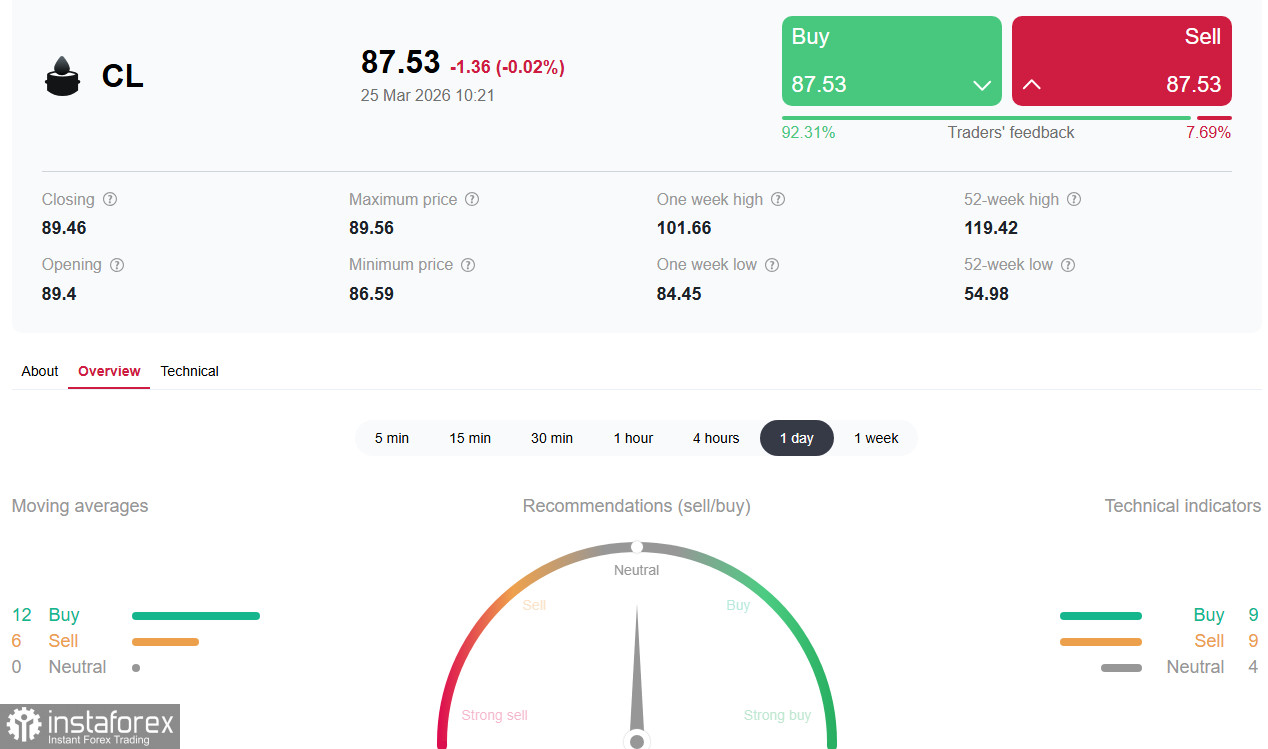
Wednesday, 25 March 2026, may be the day of a sharp reversal in the oil market. West Texas Intermediate (WTI) futures plunged more than 5%, falling below $87/bbl, after reports of diplomatic progress between the US and Iran. But behind the rapid drop lies a complex picture: the market is caught between hopes for de-escalation and ongoing military tensions, between rising US inventories and real supply disruptions through the Strait of Hormuz.
Current situation: the geopolitical premium is evaporating
On Monday, US President Donald Trump announced a five-day postponement of strikes against Iranian energy infrastructure, calling recent talks with Iran "very good and productive." On Tuesday, reports emerged that Trump's administration had presented Tehran with a 15-point peace plan aimed at ending the Middle East conflict.
The market reacted immediately: on Monday, Brent fell below $100/bbl for the first time since the active phase of the conflict began, and WTI lost more than 5% within hours. Traders began to rapidly remove the geopolitical premium from prices.
But optimistic headlines mask a harsh reality. Iranian officials denied any formal breakthrough, while acknowledging that indirect communication channels remain active. Tehran also signalled it does not trust Trump's desire for a peaceful solution.
Military tension persists: Israel continues strikes, the US is sending additional troops to the region, and Iran launched a new rocket attack on Israel. Gulf countries report repeated interceptions of drones and missiles.
Key factors: between reality and expectations Iran has told the UN Security Council and the IMO that "non?hostile vessels" may transit the Strait of Hormuz subject to coordination with Iranian authorities. In practice, traffic remains at historic lows: in recent weeks, there have been at least 20 incidents involving tankers and warships.
Saudi Arabia has ramped up oil exports from the Red Sea port of Yanbu to almost 4 million b/d — significantly above pre-conflict levels — in an effort to bypass the blocked strait.
Against this geopolitical backdrop, US inventory data adds further pressure. The American Petroleum Institute (API) reported on Tuesday evening that crude stocks rose by 2.3 million barrels for the week ending 20 March, versus an expected draw of 1.3 million barrels. This was the third consecutive weekly stock build.
According to the EIA, US production continues to fall (for the fourth straight week) but remains high at 13.668 million b/d. Stocks at Cushing, the key WTI hub, rose by 4 million barrels.
Today (14:30 GMT), the official EIA weekly petroleum status report is released. Confirmation of rising inventories would increase downward pressure on prices. Any surprise relative to forecasts will trigger heightened volatility.
Forecasts and scenarios
Major financial institutions have sharply raised their oil price forecasts amid the conflict, but warn that volatility will persist.
| Bank / think tank | Brent 2026 ($ per barrel) | WTI 2026 ($ per barrel) | Basic forecast |
| Goldman Sachs | 85 | 79 | Prices could surge to $110 in March–April |
| Morgan Stanley | ~80 | — | Analysts expect sustained gains above $80 |
| Standard Chartered | 85,5 | — | $78 (Q1), $98 (Q2) |
| Barclays | 85 | — | Prices could reach $100 if disruptions last 4–6 weeks |
| Macquarie | — | — | Prices could top $150 on the condition of a prolonged blockade |
| J.P. Morgan | 72 | — | $100 (Q2), $90 (Q3), $80 (Q4) |
| Bank of America | 77,5 | — | $80 (Q2), $76 (Q3) |
| HSBC | 80 | 76 | Moderate outlook with a slight easing in 2027 |
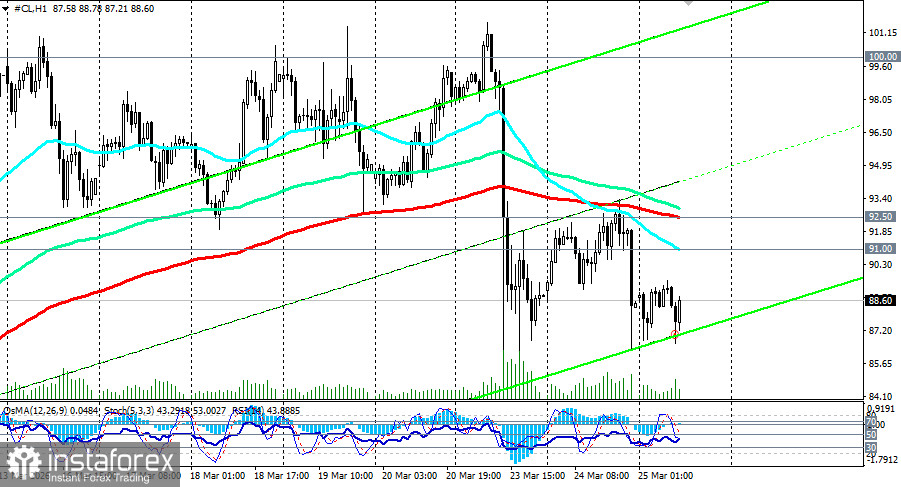
Scenario A (bearish): continuation of the correction Plays out if diplomatic progress is confirmed and normal shipping through the strait resumes. Targets: a break of $86.60 (today's low) would open the way to the weekly low at $84.50 and then to support in the $83 (local support)–81.20 (200-EMA on the 4?hour chart) zone. $80.00 becomes the next objective.
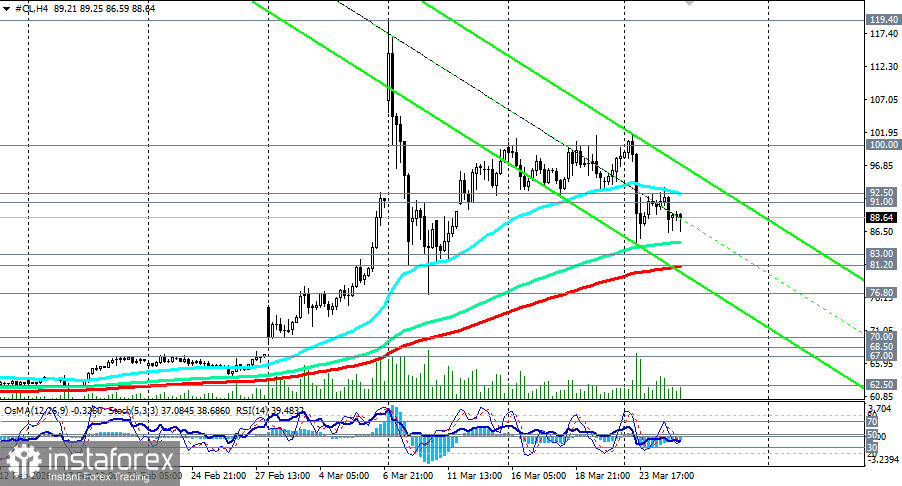
Scenario B (base case): consolidation in the $84.50–92.50 range The most likely near-term scenario. The market will oscillate between hopes for peace and the reality of continued fighting. The $84.50–92.50 zone will remain the focus.
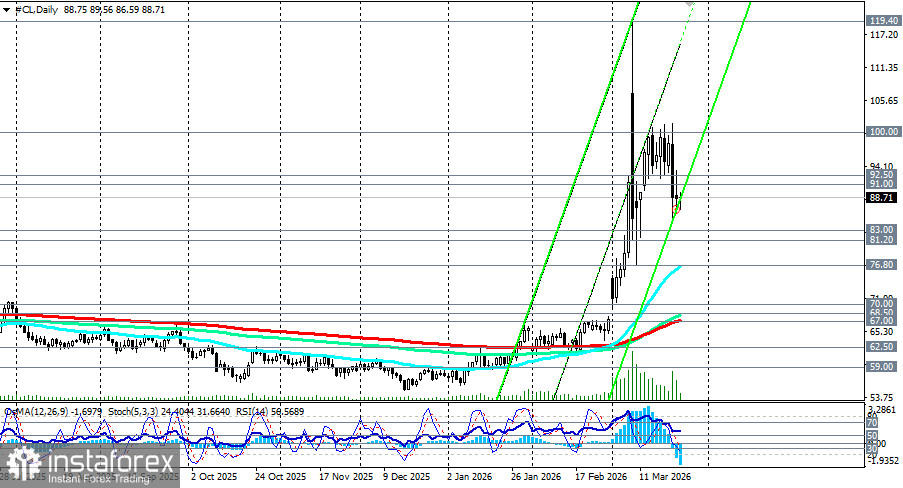
Scenario C (bullish): rebound to $100+ Possible if negotiations collapse and full-scale hostilities resume. Market experts say that if interruptions through the Strait of Hormuz last 4–6 weeks, WTI could reach $100, and could exceed $150 in the event of a full blockade.
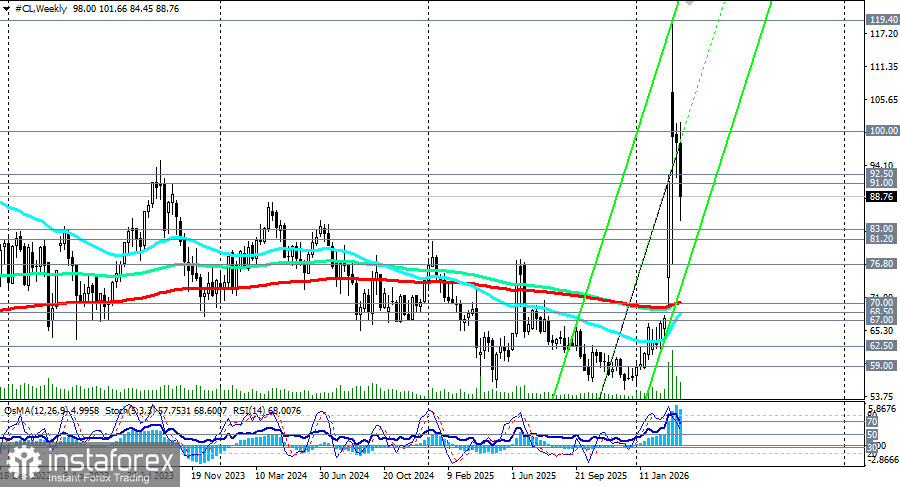
Conclusion WTI is at a critical juncture where diplomatic signals collide with harsh geopolitical reality. A short?term correction driven by hopes of a diplomatic settlement pushed prices below 88.00, but fundamental risks remain elevated.
Key zones $87.00–89.00 and the wider $84.50–92.50 will be the arena of decisive moves in the coming days. Holding above $90.00 keeps recovery chances intact, but a break below $84.00 would open the door to a deeper correction.
Volatility will remain high under any scenario. Investors should closely monitor diplomatic developments, the outcome of talks in Pakistan (where, according to media reports, the US delegation could be led by Vice President J.D. Vance), the EIA data, and — most importantly — the actual state of shipping through the Strait of Hormuz. The oil market remains extremely sensitive to any news that affects the supply-demand balance. Success will favour those who can separate short-term noise from long-term trends — structural deficits and supply disruptions persist, but any real de-escalation could quickly slam prices down.
*El análisis de mercado publicado aquí tiene la finalidad de incrementar su conocimiento, más no darle instrucciones para realizar una operación.
¡Los informes analíticos de InstaSpot lo mantendrá bien informado de las tendencias del mercado! Al ser un cliente de InstaSpot, se le proporciona una gran cantidad de servicios gratuitos para una operación eficiente.