




¡Nuestro equipo cuenta con más de 7,000,000 operadores!
Cada día, trabajamos juntos para mejorar las operaciones. Obtenemos grandes resultados y seguimos adelante.
El reconocimiento de millones de operadores en todo el mundo es el mejor agradecimiento a nuestro trabajo! ¡Usted hizo su elección y haremos todo lo que esté a nuestro alcance para satisfacer sus expectativas!
¡Juntos somos un gran equipo!
InstaSpot. ¡Orgulloso de trabajar para usted!





¡Actor, 6 veces ganador del torneo UFC y un verdadero héroe!
El hombre que se hizo a sí mismo. El hombre que sigue nuestro camino.
El secreto detrás del éxito de Taktarov es el constante movimiento hacia el objetivo.
¡Revele todo los lados de su talento!
Descubra, intente, fracase, ¡pero nunca se rinda!
InstaSpot. ¡Su historia de éxito comienza aquí!
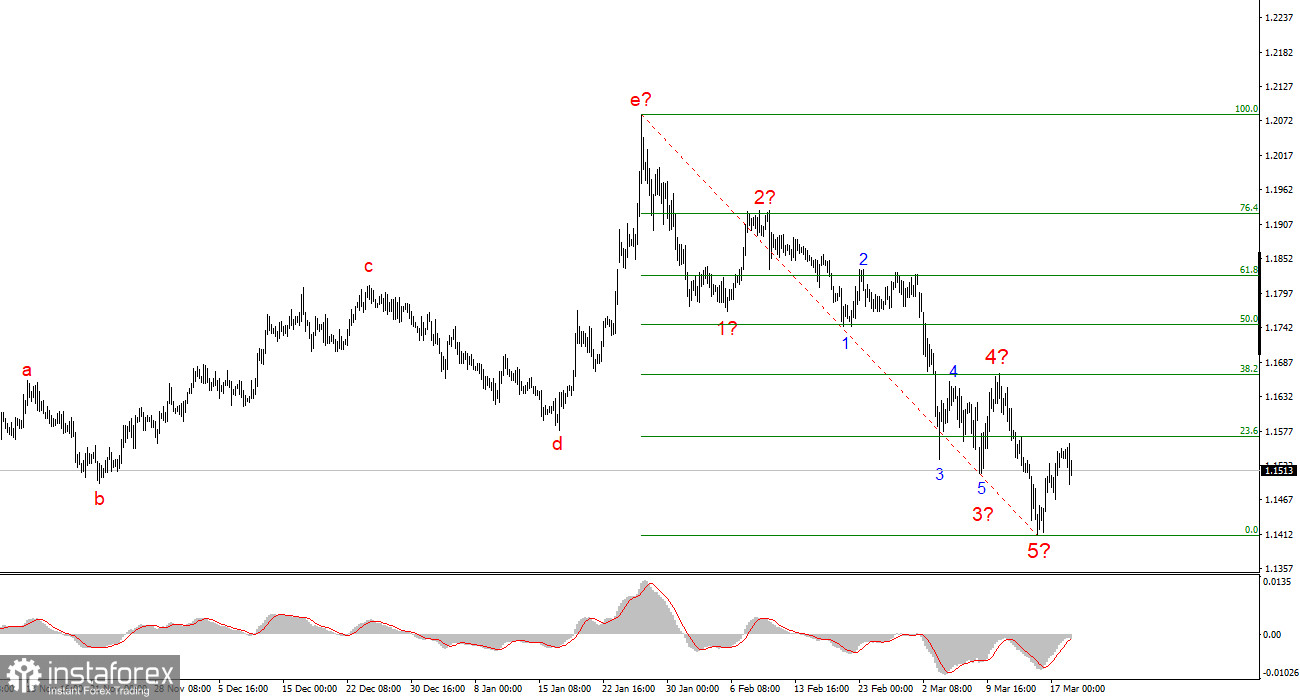
The wave structure on the 4-hour chart for EUR/USD has changed. There is still no talk of canceling the upward trend that began in January of last year, but the current wave structure now appears highly ambiguous. In such situations, I always recommend switching to a lower timeframe and focusing on the simplest and smallest wave structures in order to form a short-term forecast, which is sufficient for opening trades.
In the chart above, I can identify a classic five-wave impulse structure with an extended third wave. If this interpretation is correct, then the formation of this structure has been completed, and we should expect a corrective phase consisting of at least three waves. Therefore, in the near term, a rise in the pair is likely, but within a corrective move relative to the latest trend segment. For now, recent wave formations do not fit well into the higher-level structure, but this should become clearer over time. In the near future, the euro may recover toward the 1.1568 and 1.1666 levels.
The EUR/USD pair declined by 30 basis points on Wednesday, but the most significant events are still ahead. Within the next hour, the Federal Reserve will announce the decisions from its second meeting of 2026, which will likely trigger strong volatility in the currency market. Overall, the market does not doubt that the interest rate will remain unchanged at 3.75%, but attention is focused on other aspects of the decision and on Jerome Powell's tone, which will be discussed in a separate review.
For now, I can say that the wave structure of the latest downward segment for EUR/USD looks clear and convincing. If it is correct, the decline should end near the 1.1400 level, at least temporarily. However, the current news background is so strong that markets are effectively ignoring technical, wave-based, and even economic factors. Therefore, if not for geopolitics and the consequences of the Middle East conflict—which will influence the decisions of all three central banks today and tomorrow—I would estimate the probability of growth in EUR/USD and GBP/USD over the coming weeks at no less than 90%. However, the Fed meeting could trigger another strengthening of the dollar if Jerome Powell's tone is more hawkish than earlier this year.
So far today, reports on Eurozone inflation and U.S. producer prices have been released. Inflation in the EU came in at 2.4% for February, as expected, while the U.S. Producer Price Index rose by 0.7% month-over-month, significantly exceeding market expectations. Producer prices have been rising at an accelerated pace for several consecutive months, which is an additional factor pointing to higher headline and core inflation, and a reason for the FOMC to maintain interest rates at current levels.
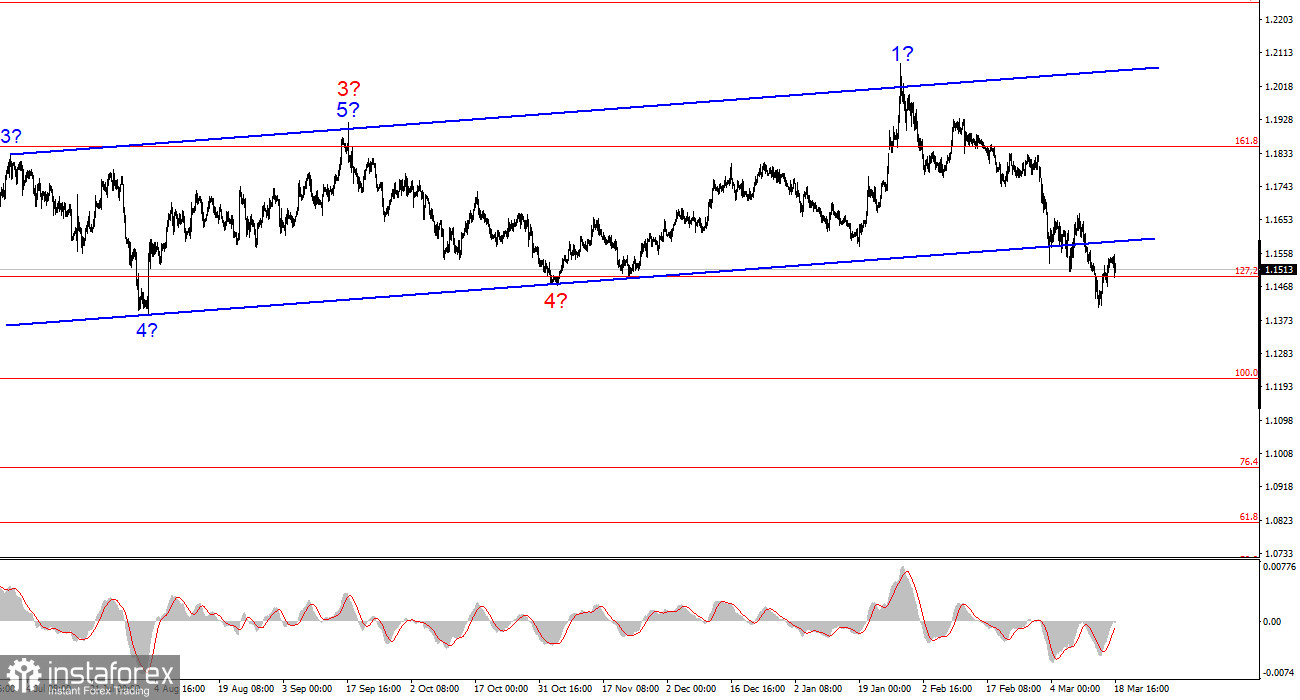
Based on the analysis of EUR/USD, I conclude that the pair remains within an upward trend (as shown in the lower chart), but has begun forming a short-term downward segment. Since the five-wave impulse structure appears complete, readers may expect a rise in prices over the next one to two weeks, with targets near 1.1568 and 1.1666, corresponding to the 23.6% and 38.2% Fibonacci levels. Further movement will depend entirely on developments in the Middle East.
On a smaller timeframe, the entire upward trend segment is visible. The wave structure is not entirely typical, as corrective waves differ in size. For example, the higher-degree wave 2 is smaller than the internal wave 2 within wave 3. This can occur. I would emphasize that it is more important to identify clear and understandable structures rather than strictly adhering to labeling every wave. The trend may reverse in the near future.
Key principles of my analysis:
*El análisis de mercado publicado aquí tiene la finalidad de incrementar su conocimiento, más no darle instrucciones para realizar una operación.
¡Los informes analíticos de InstaSpot lo mantendrá bien informado de las tendencias del mercado! Al ser un cliente de InstaSpot, se le proporciona una gran cantidad de servicios gratuitos para una operación eficiente.


