




¡La leyenda en el equipo de InstaSpot!
¡Leyenda! ¿Cree que es una retórica grandilocuente? Pero, ¿cómo deberíamos llamar a un hombre, que se convirtió en el primer asiático en ganar el campeonato mundial de ajedrez júnior a los 18 años y en el primer Gran Maestro indio a los 19 años? Ese fue el comienzo de un camino difícil hacia el título de Campeón del Mundo para Viswanathan Anand, el hombre que se convirtió en parte de la historia del ajedrez para siempre. ¡Ahora una leyenda más en el equipo de InstaSpot!





Borussia es uno de los clubes de fútbol con más títulos en Alemania, que ha demostrado repetidamente a los fanáticos: el espíritu de competencia y liderazgo que ciertamente conducirán al éxito. Opere de la misma manera que los profesionales del deporte: con confianza y de forma activa. ¡Mantenga un "pase" del Borussia FC y lidere con InstaSpot!
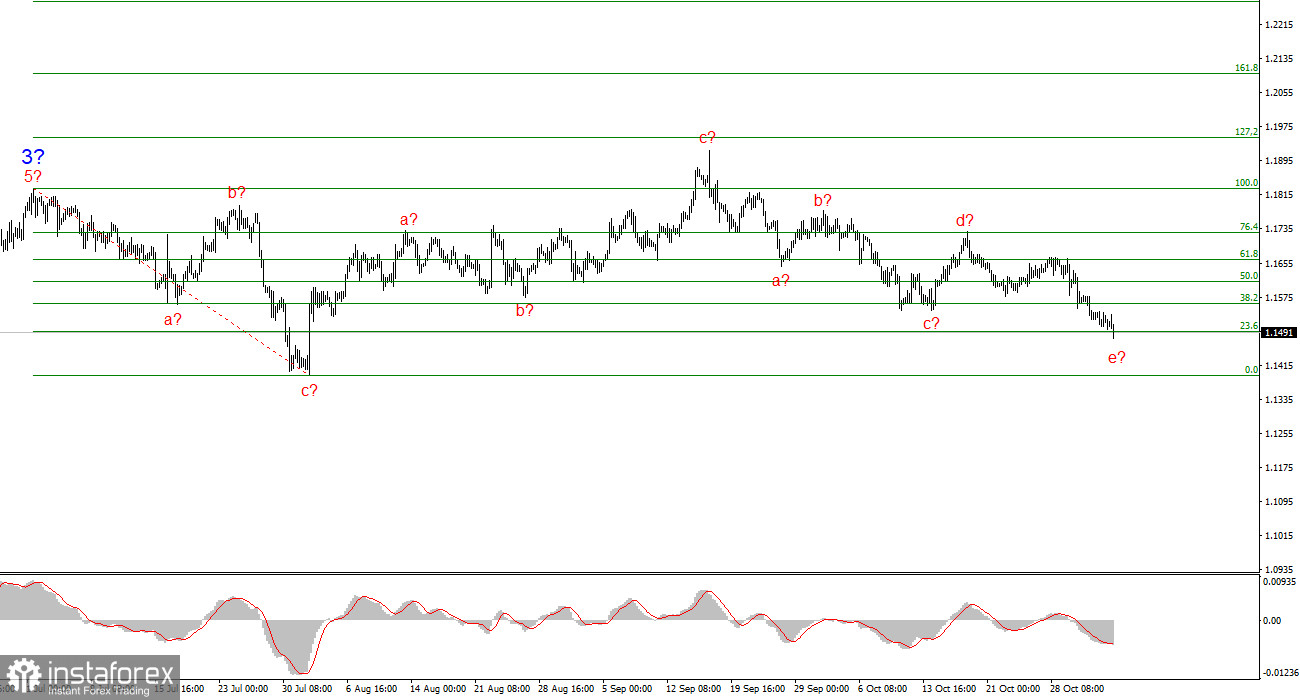
The 4-hour chart wave structure for EUR/USD has changed — unfortunately, not for the better. It's still too early to conclude that the upward section of the trend has been canceled, but the latest decline in the euro has made it necessary to refine the wave pattern.
Now we see a series of corrective structures, which may be part of the global wave 4 within the upward trend section. In this case, wave 4 has taken on an unnaturally extended form, but overall, the wave pattern remains internally consistent.
The upward trend section continues to develop, and the news background still largely supports everything but the dollar. The trade war started by Donald Trump continues. The confrontation between the president and the Federal Reserve also continues. The market's "dovish" expectations for the Fed's rate policy remain high, especially for 2026. In the U.S., the government shutdown is ongoing. The labor market is "cooling down."
I believe the recent strengthening of the dollar is, to some extent, a paradox. But paradoxes do happen in financial markets.
In my view, the upward trend section is not yet complete, and its targets extend up to the 1.25 level. Based on this, the euro may continue to decline for some time — even without strong reasons (as has been the case over the past month) — but the wave pattern still implies a continuation of the upward trend.
The EUR/USD pair fell by only 10 basis points on Monday and lost another 30 points on Tuesday. Once again, I draw readers' attention to the fact that market volatility is very weak, and the euro's decline is even weaker. In other words, sellers do not currently have extraordinary strength, but their efforts are still enough to push the pair lower almost every day — often in the complete absence of news, and sometimes even contrary to the news background.
Monday was quite an interesting day. Traders completely ignored the final October manufacturing PMI figures in the morning. However, they did notice the U.S. ISM Manufacturing Index... for about five minutes.
The index for October fell from 49.1 to 48.7 points, while the market had expected 49.5 points. Thus, the indicator worsened and came in below expectations. Is that good or bad for the U.S. economy and the dollar? To me, the answer is obvious — but apparently not for most market participants, who reduced their demand for the U.S. currency for just 5–10 minutes, and then continued to push the pair downward.
On Tuesday, there was no news background at all, yet sellers continued to pressure the euro. Another corrective wave sequence is still forming.
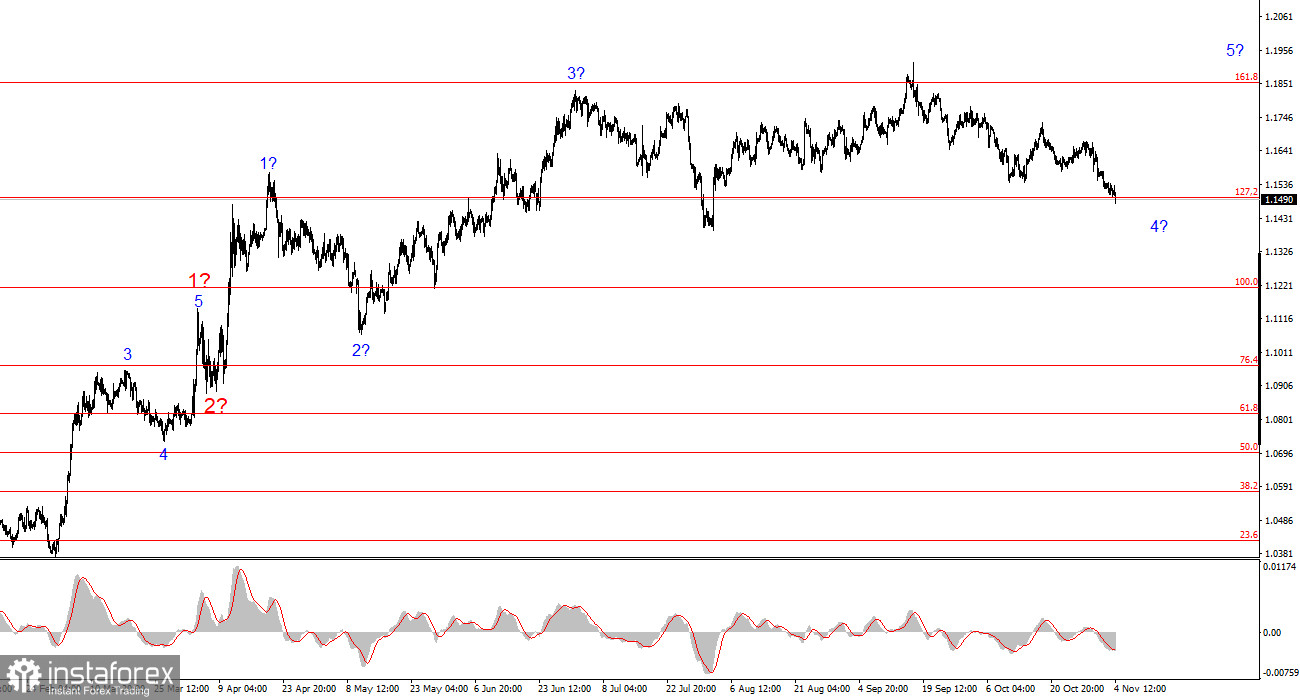
Based on the analysis of EUR/USD, I conclude that the pair is still building an upward trend section. The market is currently in a pause, but Donald Trump's policies and the Federal Reserve's stance remain significant factors that could lead to a future decline in the U.S. dollar.
The targets of the current trend section may extend up to the 1.25 level. At present, we are likely observing the formation of corrective wave 4, which is taking on a complex and extended form.
Therefore, in the near term, I still consider only buy trades, as all downward structures appear to be corrective. The latest a–b–c–d–e pattern may be approaching completion.
On a smaller scale, the entire upward trend structure is visible. The wave pattern is not entirely standard, as the corrective waves differ in size. For example, the larger wave 2 is smaller than the internal wave 2 within wave 3 — but such cases do occur.
I'd like to remind readers that it's best to identify clear and understandable structures on charts rather than trying to label every single wave. The current upward pattern is generally not in doubt.
Key Principles of My Analysis
*El análisis de mercado publicado aquí tiene la finalidad de incrementar su conocimiento, más no darle instrucciones para realizar una operación.
¡Los informes analíticos de InstaSpot lo mantendrá bien informado de las tendencias del mercado! Al ser un cliente de InstaSpot, se le proporciona una gran cantidad de servicios gratuitos para una operación eficiente.


