




¡La leyenda en el equipo de InstaSpot!
¡Leyenda! ¿Cree que es una retórica grandilocuente? Pero, ¿cómo deberíamos llamar a un hombre, que se convirtió en el primer asiático en ganar el campeonato mundial de ajedrez júnior a los 18 años y en el primer Gran Maestro indio a los 19 años? Ese fue el comienzo de un camino difícil hacia el título de Campeón del Mundo para Viswanathan Anand, el hombre que se convirtió en parte de la historia del ajedrez para siempre. ¡Ahora una leyenda más en el equipo de InstaSpot!





Borussia es uno de los clubes de fútbol con más títulos en Alemania, que ha demostrado repetidamente a los fanáticos: el espíritu de competencia y liderazgo que ciertamente conducirán al éxito. Opere de la misma manera que los profesionales del deporte: con confianza y de forma activa. ¡Mantenga un "pase" del Borussia FC y lidere con InstaSpot!
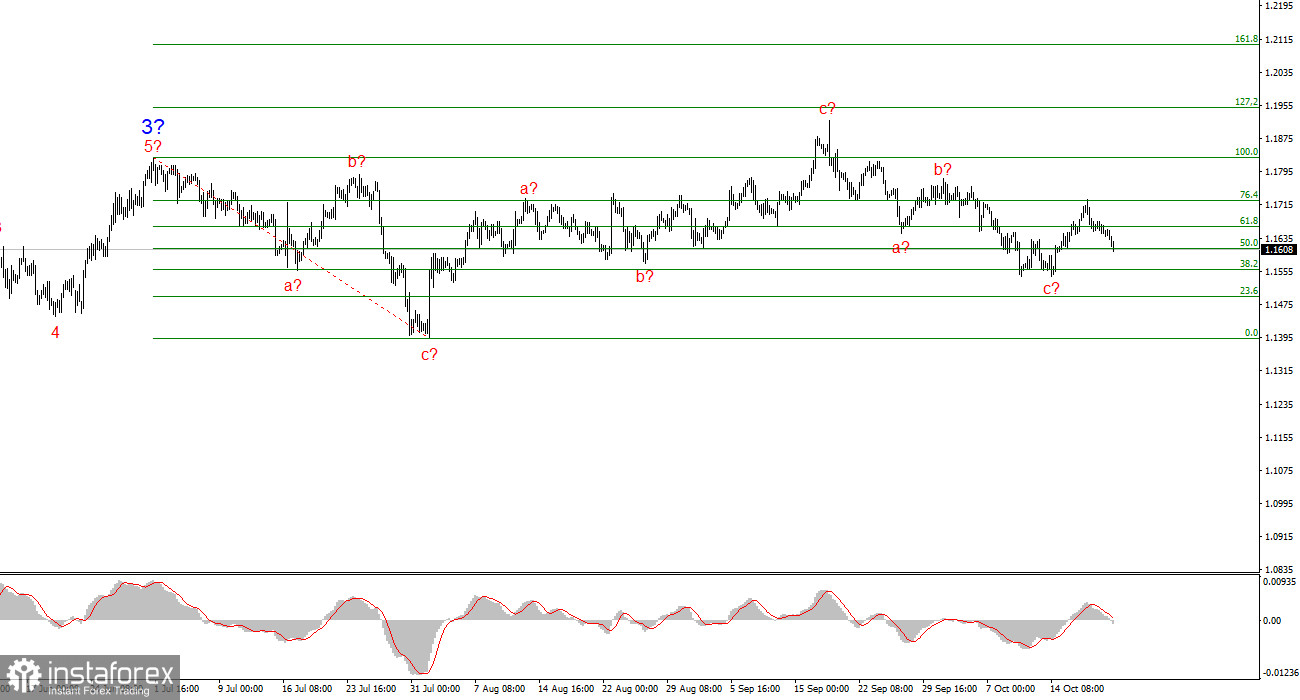
The 4-hour wave pattern for EUR/USD has changed — unfortunately, not for the better. It's still too early to conclude that the upward phase of the trend is over, but the latest decline in the euro has made it necessary to adjust the wave count. We now see a series of three-wave structures (a-b-c), which can be assumed to be part of the larger wave 4 within the broader uptrend. In this case, wave 4 has taken on an unnaturally extended form, but overall, the wave structure remains coherent.
The upward trend continues to form, while the fundamental background still largely fails to support the U.S. dollar. The trade war launched by Donald Trump continues. The confrontation with the Federal Reserve continues as well. The market's dovish expectations regarding Fed rate cuts are increasing. Meanwhile, the U.S. government shutdown persists. The market remains unimpressed with the results of Trump's first nine months in office, despite the fact that economic growth reached nearly 4% in the second quarter.
In my view, the formation of the upward section of the trend is not yet complete, with potential targets extending as high as the 1.25 level. Based on this, the euro may continue to decline for a while longer — even without any fundamental justification (as has been the case over the past three weeks) — while the wave structure will still maintain its overall integrity.
The EUR/USD rate fell by 30 basis points on Tuesday morning, once again raising some questions. Let me remind you that there are still plenty of reasons to expect growth in this pair. First, the wave pattern suggests the formation of a new upward sequence following another three-wave corrective structure. Second, the upcoming Federal Reserve meeting, where the FOMC is almost certain to cut interest rates, supports this outlook. Third, the ongoing U.S. government shutdown, which shows no signs of ending anytime soon. Fourth, the continued trade tensions between the U.S. and China. And fifth, the protests and rallies against Donald Trump, which over the weekend spread across half of America.
Although we have not yet seen the expected decline in the U.S. dollar, we also haven't observed any strong appreciation in recent months. The last trading peak of 2025 was recorded at 1.1917, while the current rate is hovering around the 1.16 area. Thus, from its 2025 high, the dollar has regained about 3 cents, having lost roughly 16–17 cents over the course of the year. From this, we can conclude that the market is in no hurry to buy or sell, but rather waiting for direction.
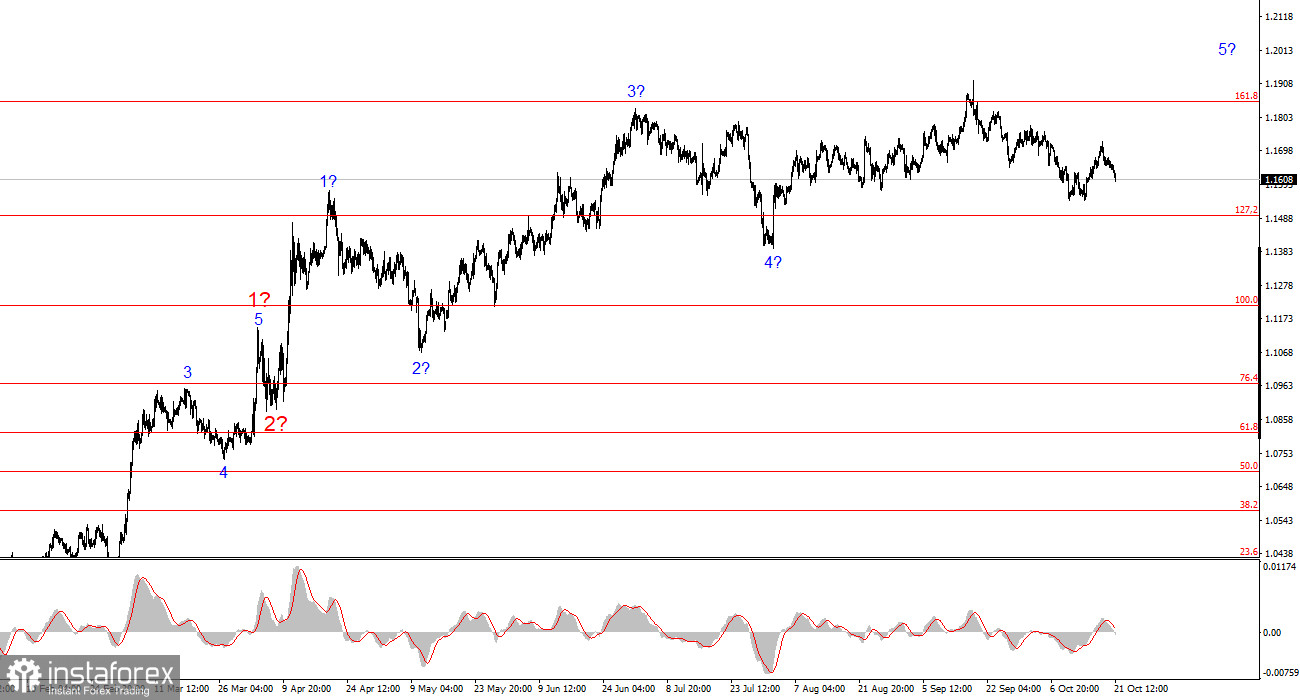
Based on the current EUR/USD analysis, I conclude that the pair is still building its upward trend segment. The wave structure remains highly dependent on the news background, particularly on Trump's policy decisions and the foreign and domestic agenda of the new U.S. administration. The targets of the current trend may extend up to the 1.25 level. At the moment, we are likely witnessing the formation of a corrective wave 4, which is nearing completion but has taken on a complex and extended shape. Therefore, in the near term, I continue to focus only on buy positions. By the end of the year, I expect the euro to rise toward 1.2245, corresponding to 200% on the Fibonacci scale.
At a smaller scale, the entire upward section of the trend is clearly visible. The wave pattern is not perfectly standard, as the corrective waves vary in length — for example, the larger wave 2 is smaller than the inner wave 2 within wave 3. However, such cases are not uncommon. I remind traders that it's best to identify clear and simple structures on the chart rather than trying to label every single sub-wave. Currently, the upward structure looks almost flawless.
Key Principles of My Analysis
*El análisis de mercado publicado aquí tiene la finalidad de incrementar su conocimiento, más no darle instrucciones para realizar una operación.
¡Los informes analíticos de InstaSpot lo mantendrá bien informado de las tendencias del mercado! Al ser un cliente de InstaSpot, se le proporciona una gran cantidad de servicios gratuitos para una operación eficiente.


