




¡Nuestro equipo cuenta con más de 7,000,000 operadores!
Cada día, trabajamos juntos para mejorar las operaciones. Obtenemos grandes resultados y seguimos adelante.
El reconocimiento de millones de operadores en todo el mundo es el mejor agradecimiento a nuestro trabajo! ¡Usted hizo su elección y haremos todo lo que esté a nuestro alcance para satisfacer sus expectativas!
¡Juntos somos un gran equipo!
InstaSpot. ¡Orgulloso de trabajar para usted!





¡Actor, 6 veces ganador del torneo UFC y un verdadero héroe!
El hombre que se hizo a sí mismo. El hombre que sigue nuestro camino.
El secreto detrás del éxito de Taktarov es el constante movimiento hacia el objetivo.
¡Revele todo los lados de su talento!
Descubra, intente, fracase, ¡pero nunca se rinda!
InstaSpot. ¡Su historia de éxito comienza aquí!
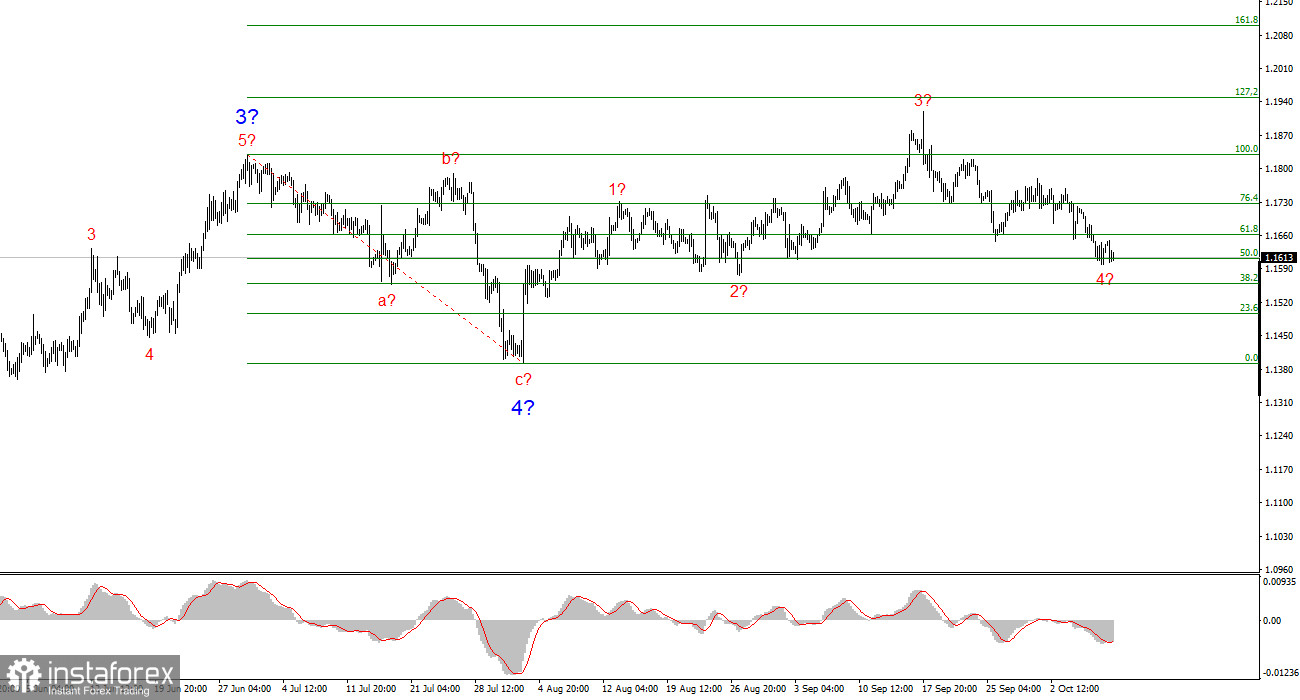
The wave pattern on the 4-hour chart of EUR/USD has not changed for several months, but in recent weeks it has taken on a more complex form. It is still too early to conclude that the upward trend section has been canceled, but a new decline in the euro will require adjustments.
The upward trend construction continues, while the news background mostly supports not the dollar. The trade war initiated by Donald Trump is ongoing. The confrontation with the Fed continues. The market's "dovish" expectations for the Fed rate are growing. The U.S. government shutdown is still in place. The market evaluates the first 7–8 months of Trump's presidency very poorly, even though economic growth in Q2 reached nearly 4%.
At the moment, it can be assumed that the construction of impulse wave 5 is continuing, with targets stretching up to the 1.25 level. Inside this wave, the structure is rather complex and ambiguous, but its higher degree scale does not raise major questions. Currently, three upward waves are visible, which means the pair is forming wave 4 within wave 5, which is taking a three-wave form and may already be close to completion.
On Thursday, EUR/USD declined another 70 basis points, though the pace of the euro's fall is slowing. Recall that this week, the European currency came under selling pressure due to France's political crisis, expressed by the resignation of the fifth prime minister in the past two years. In addition, German industrial production data disappointed sharply, falling back to 2005 levels. However, these factors are already priced in by the market. For euro demand to continue declining, new negative factors are required.
Last night, the Fed released the minutes of its September 17 meeting, which largely reflected the alignment between market expectations and the FOMC policymakers. Fed officials are prepared to keep voting for rate cuts, as risks of labor market "cooling" remain, and the U.S. economy may slow in the coming quarters. At the same time, most officials keep in mind the consumer price index, which keeps rising month by month in response to Trump's ever-increasing tariffs.
The Fed's current position is unenviable. The interest rate needs both to be lowered and raised at the same time. Therefore, the base case scenario for now remains two rounds of monetary easing at the end of 2025 and one round at the beginning of 2026. Trump wants more, Bessent wants more, and even Steven Miran believes the rate should be cut much more aggressively. However, most Fed officials are sticking to a balanced approach that does not imply aggressive easing.
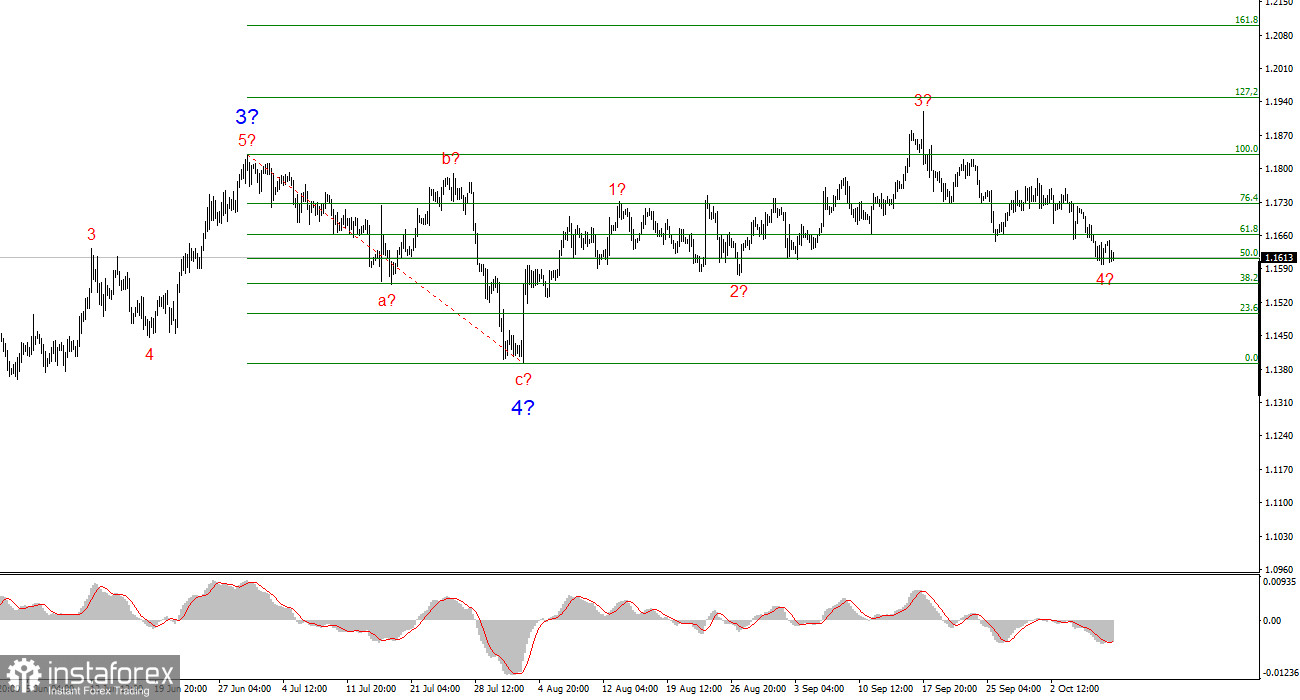
Based on the EUR/USD analysis, I conclude that the instrument continues to form an upward trend section. The wave pattern still fully depends on the news background linked to Trump's decisions and the foreign and domestic policies of the new White House Administration. The targets of the current trend section may extend up to the 1.25 level. At present, a corrective wave 4 is being formed, which may be nearing completion. The upward wave structure remains valid. Accordingly, in the near term I am considering only buying opportunities. By the end of the year, I expect the euro to rise to 1.2245, which corresponds to 200.0% Fibonacci.
On a smaller scale, the entire upward trend section is clearly visible. The wave pattern is not the most standard, as the corrective waves differ in size. For example, the higher-degree wave 2 is smaller than the internal wave 2 of wave 3. But such cases do happen. It's important to remember that it is best to single out clear structures on the charts, rather than trying to account for every wave. The current upward structure is nearly unquestionable.
Key principles of my analysis:
*El análisis de mercado publicado aquí tiene la finalidad de incrementar su conocimiento, más no darle instrucciones para realizar una operación.
¡Los informes analíticos de InstaSpot lo mantendrá bien informado de las tendencias del mercado! Al ser un cliente de InstaSpot, se le proporciona una gran cantidad de servicios gratuitos para una operación eficiente.


