




¡La leyenda en el equipo de InstaSpot!
¡Leyenda! ¿Cree que es una retórica grandilocuente? Pero, ¿cómo deberíamos llamar a un hombre, que se convirtió en el primer asiático en ganar el campeonato mundial de ajedrez júnior a los 18 años y en el primer Gran Maestro indio a los 19 años? Ese fue el comienzo de un camino difícil hacia el título de Campeón del Mundo para Viswanathan Anand, el hombre que se convirtió en parte de la historia del ajedrez para siempre. ¡Ahora una leyenda más en el equipo de InstaSpot!





Borussia es uno de los clubes de fútbol con más títulos en Alemania, que ha demostrado repetidamente a los fanáticos: el espíritu de competencia y liderazgo que ciertamente conducirán al éxito. Opere de la misma manera que los profesionales del deporte: con confianza y de forma activa. ¡Mantenga un "pase" del Borussia FC y lidere con InstaSpot!
The market has seen a ton of news over the past two weeks that can be characterized as "like a bolt from the blue." However, it came out that this is not all, especially because as many as four banks in the US and the EU collapsed. Today, it was revealed that the UK's inflation rate rose once more in February rather than decreasing. We should instantly think back to how inflation dynamics have changed over the last 15 months. It has been steadily increasing over the past 18 months, reaching a peak of 11.1% in October of last year. Following three consecutive declines to 10.1%, inflation increased once more to 10.4% in February. If the Bank of England had maintained a neutral or dovish stance throughout this period, such inflation would be regarded as normal. However, the British regulator has been actively raising the interest rate during this time (nearly a year and a half), and it has now reached 4%. Additionally, the consumer price index essentially showed no reaction at all. The regulator is therefore faced with a crucial decision: what to do next if the recession is already at the door and inflation isn't going down?
From my perspective, the Bank of England is in a losing position. It's impossible to explain what brought them to this point, but I do not doubt that it's the result of Brexit and the epidemic. The UK itself initiated the first, which no one attempted to expel from the European Union. The second is the British government led by Boris Johnson, who for a long time thought the "coronavirus" to be a "runny nose." The consequences of Brexit are so severe that the new Prime Minister, Rishi Sunak, has already publicly stated that the 2016 referendum result was a grave error and that the country will now re-establish ties with the European Union. Britain has suffered the worst economic and human losses from the pandemic. The Bank of England's situation is not made any easier by this either. Inflation is not declining, the economy will unavoidably enter a recession, the pound has recently reached its all-time low, and future rate increases would only make the decline worse. With these outcomes, Rishi Sunak's administration may swiftly follow in the footsteps of Liz Truss and Boris Johnson.
I think the British central bank should now adopt a wait-and-see approach and rely on a variety of external factors. It is still conceivable to raise the rate by another 1% to 2%, but at that point, it would have reached its highest level. How much will inflation decrease as a result? By 2-3%? The "Taylor rule" in the US states that for inflation to decrease by 2%, the rate must be increased to 7%. As a result, the rate in Britain needs to be raised to 8–9%. The Bank of England will, of course, not take such action. Due to the economy's deteriorating state and potential for long-term decline, the British pound may soon start to depreciate once more.
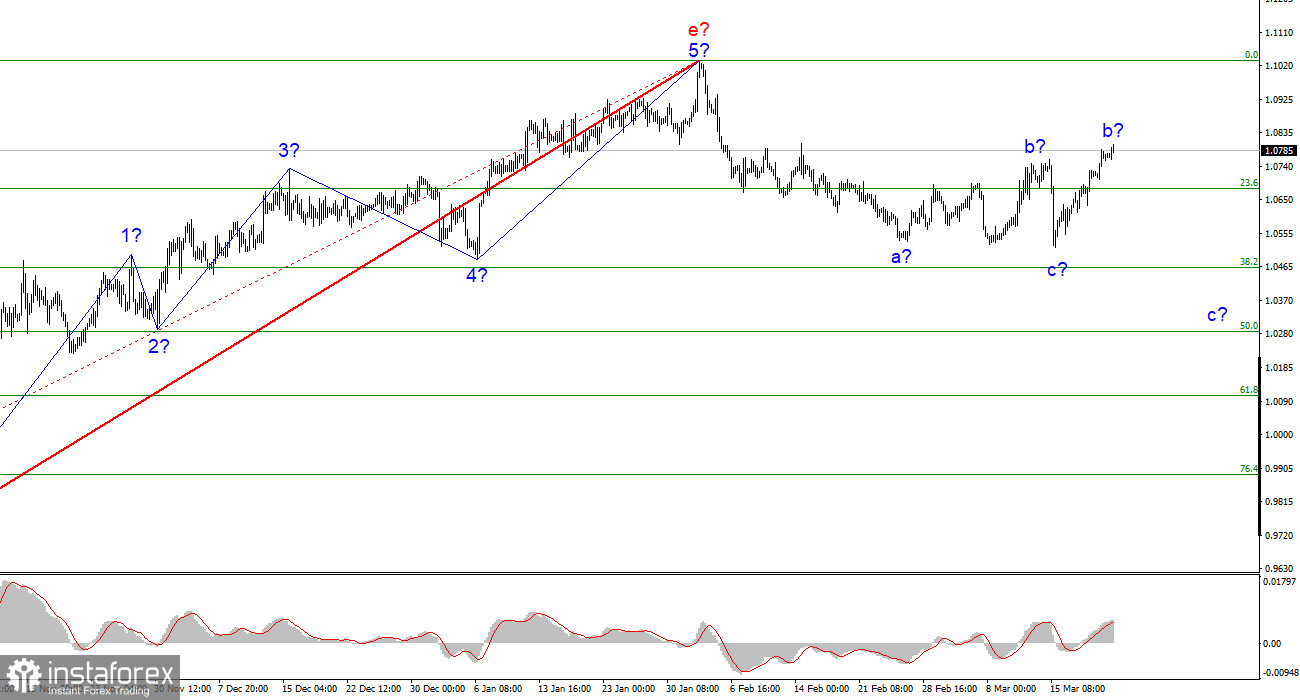
I draw the conclusion that the upward trend section's development is finished based on the analysis. As a result, it is now allowed to take into account sales with targets close to the predicted mark of 1.0284, or 50.0% Fibonacci. A corrective wave 2 or wave b can still be developed at this point; however, it will now take a longer form. Opening sales now on MACD "down" signals is advised.
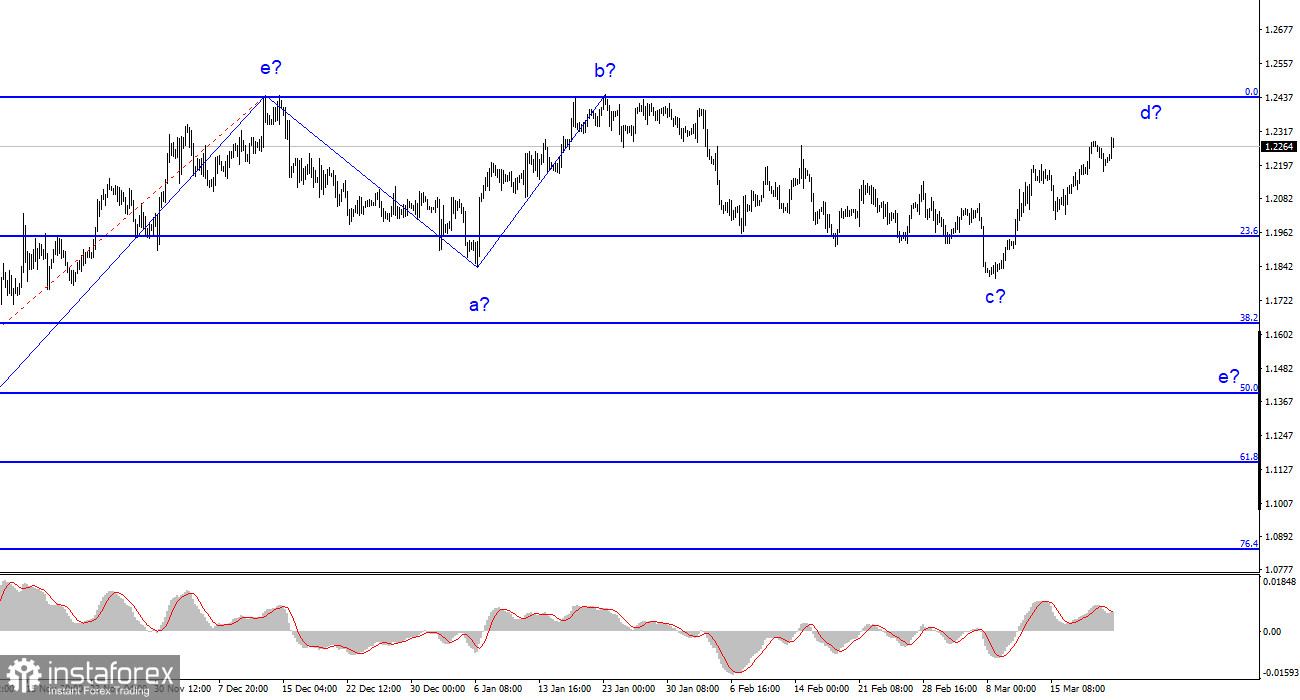
The development of a downward trend section is implied by the wave pattern of the pound/dollar pair. When the MACD signal reverses to the "down" position, it is reasonable to consider sales with targets around the 1.1641 level, or 38.2% per Fibonacci. The peaks of waves e and b could be used to place a stop-loss order. Although wave c might already be finished, in this case, I anticipate the formation of a downward wave e with targets once again 400–500 points below the current levels.
*El análisis de mercado publicado aquí tiene la finalidad de incrementar su conocimiento, más no darle instrucciones para realizar una operación.
¡Los informes analíticos de InstaSpot lo mantendrá bien informado de las tendencias del mercado! Al ser un cliente de InstaSpot, se le proporciona una gran cantidad de servicios gratuitos para una operación eficiente.


