




The legend in the InstaSpot team!
Legend! You think that's bombastic rhetoric? But how should we call a man, who became the first Asian to win the junior world chess championship at 18 and who became the first Indian Grandmaster at 19? That was the start of a hard path to the World Champion title for Viswanathan Anand, the man who became a part of history of chess forever. Now one more legend in the InstaSpot team!





Borussia is one of the most titled football clubs in Germany, which has repeatedly proved to fans: the spirit of competition and leadership will certainly lead to success. Trade in the same way that sports professionals play the game: confidently and actively. Keep a "pass" from Borussia FC and be in the lead with InstaSpot!

The US dollar remains resilient, continuing to serve as a key instrument for investors against the backdrop of rising geopolitical tensions. Its traditional role as a "safe haven" supports demand; however, structural issues—particularly the US twin deficits (budget and current account)—continue to loom over the currency as a long-term risk.
Currently, the dollar is trading near its March high—the highest level since the beginning of the year—supported by concerns about rising inflation amid the conflict in Iran and stable macroeconomic data from the United States. High inflation and the Federal Reserve's cautious stance, as it is in no rush to cut rates, provide short-term support for the US currency. Nevertheless, these factors are unlikely to offset fundamental vulnerabilities for long. As geopolitical tensions ease and the risk premium declines, the market expects the dollar to resume a downward trend toward the end of the year.
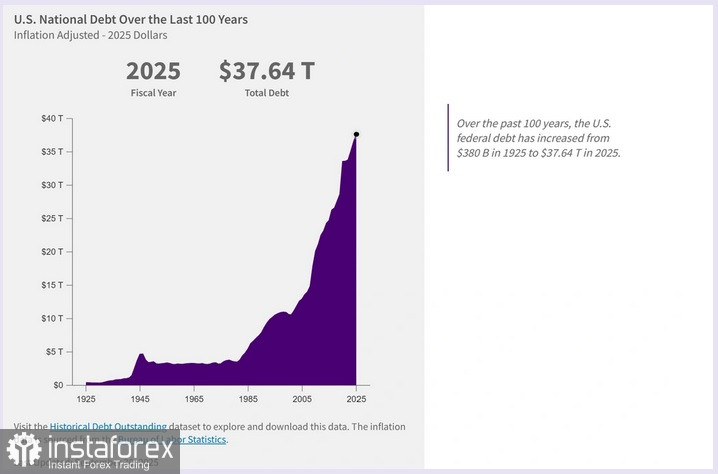
The issue of the twin deficit is gradually coming to the forefront. The United States faces two simultaneous gaps—fiscal and trade—which traditionally put pressure on the currency. According to the US Treasury, the budget deficit for the current fiscal year has already exceeded $1 trillion, while total national debt has surpassed $38 trillion, corresponding to a debt-to-GDP ratio of over 120%. Rising interest payments on government debt reduce fiscal flexibility and limit the ability to invest productively, increasing the risks of weakening monetary policy independence.
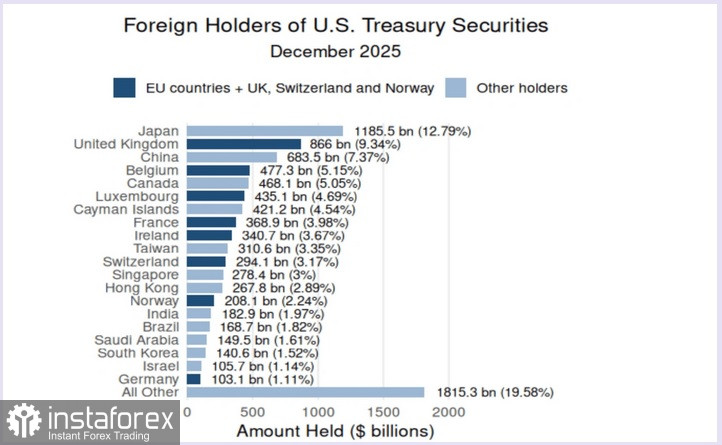
At the same time, the US remains heavily dependent on external financing: about a quarter of Treasury bills are held by foreign investors, with China and Japan remaining the largest holders (according to a European Parliament report on US debt). Although Washington is not facing a liquidity crisis, maintaining the confidence of international investors is becoming a key condition for stability.
Today, the dollar largely maintains its position due to the lack of a real alternative as the world's reserve currency and the relatively hawkish stance of the Federal Reserve. However, if the conflict in the Middle East subsides, market focus will shift from short-term risks to fundamental imbalances. In this case, a worsening fiscal position and potential acceleration of rate cuts could lead to a noticeable correction in the dollar, returning it to a downward trend after a period of relative strength.
From a technical perspective, the US Dollar Index (DXY), which tracks the dollar against a basket of currencies, has been fluctuating within a familiar range over the past five weeks and does not show bullish confidence. A breakout and consolidation below the 200-week simple moving average in April 2025— for the first time since November 2021—favors long-term bears. On the daily chart, oscillators are positive. The index is trading above key moving averages, so in the near term prices are not ready for a significant decline.
*Analiza tržišta koja se ovde nalazi namenjena je boljem razumevanju tržišta i ne pruža instrukcije za vršenje trgovanja.
Uz InstaSpot-ove analitičke preglede uvek ćete biti u toku sa tržišnim trendovima! Klijentima InstaSpot-a su dostupni mnogobrojni besplatni servisi za uspešno trgovanje.


