




Kumpulan kami mempunyai lebih daripada 7,000,000 pedagang!
Setiap hari kami bekerjasama untuk meningkatkan perdagangan. Kami mendapat keputusan yang tinggi dan bergerak ke hadapan.
Pengiktirafan oleh berjuta-juta pedagang di seluruh dunia adalah penghargaan terbaik untuk kerja kami! Anda membuat pilihan anda dan kami akan melakukan segalanya yang diperlukan untuk memenuhi jangkaan anda!
Kami adalah kumpulan yang terbaik bersama!
InstaSpot. Berbangga bekerja untuk anda!





Pelakon, juara kejohanan UFC 6 dan seorang wira sebenar!
Lelaki yang membuat dirinya sendiri. Lelaki yang mengikut cara kami.
Rahsia di sebalik kejayaan Taktarov adalah pergerakan berterusan ke arah matlamat.
Dedahkan semua segi bakat anda!
Cari, cuba, gagal - tetapi tidak pernah berhenti!
InstaSpot. Kisah kejayaan anda bermula di sini!

Something strange is happening with oil. It doesn't rally on escalations in the Middle East and falls when the fires in the region calm. That was the case with the Israel–Iran confrontation and then the US–Iran standoff. Yet Rystad Energy warns Brent could jump to $150/bbl if Tehran responds to Washington tit for tat. It's no wonder investors are watching Iran closely.
Brent (North Sea) price dynamics
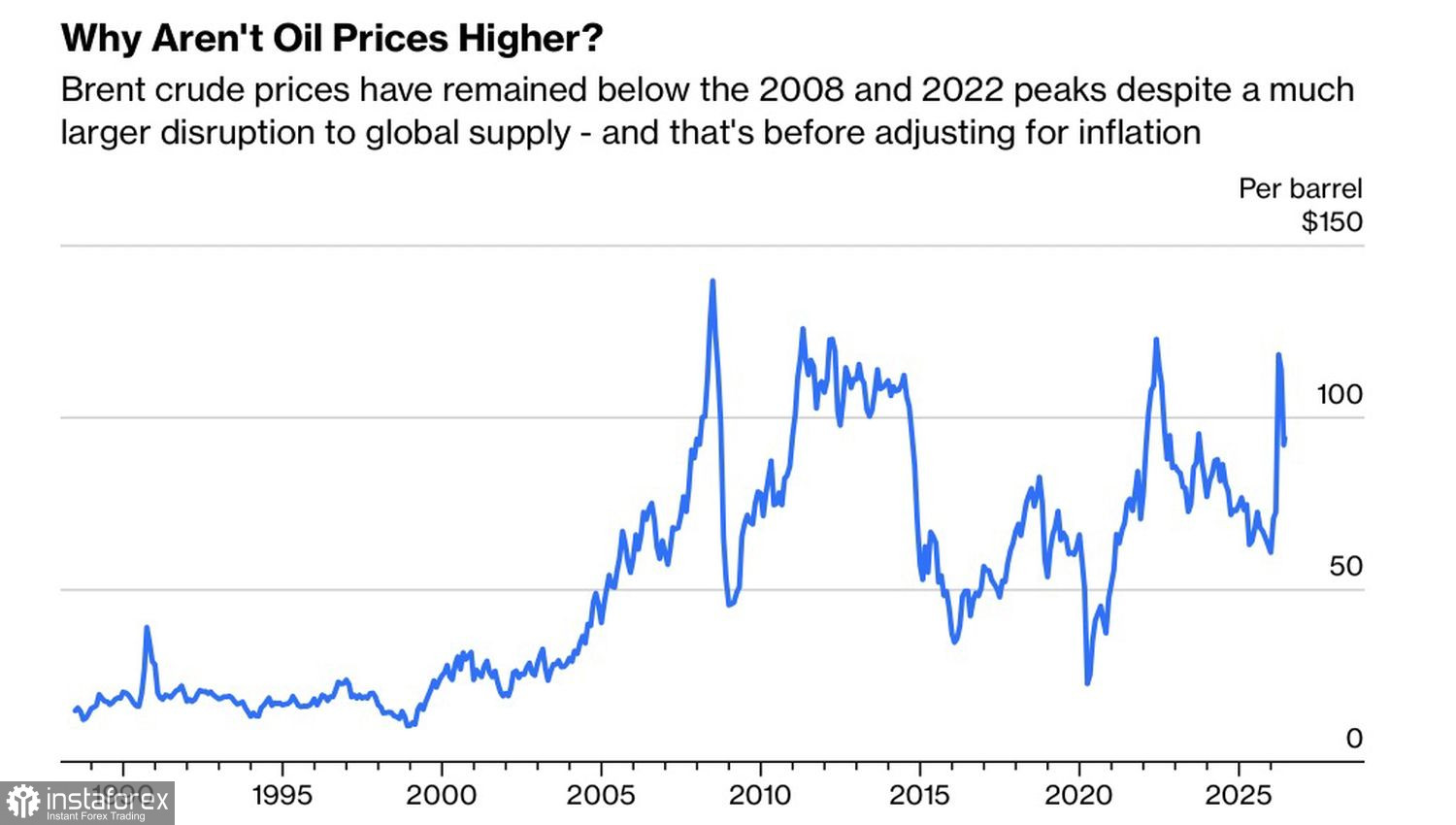
What actually happened is what should have happened: the period of fear passed. At the start of the Middle East conflict, there was a lot of talk about Brent hitting $200/bbl, since a closure of the Strait of Hormuz would have seemed catastrophic — roughly 20 million b/d transited it in peacetime. Even if Saudi Arabia managed to reroute 5 million b/d, the gap is still striking.
In practice, it wasn't as bad. After 100 days of confrontation in the Middle East, Brent is trading below $100/bbl. Flows are one thing, balance is another. Before the conflict, the oil market was in a record surplus of 3–4 million b/d, and that helped restrain the North Sea rally.
China's oil imports
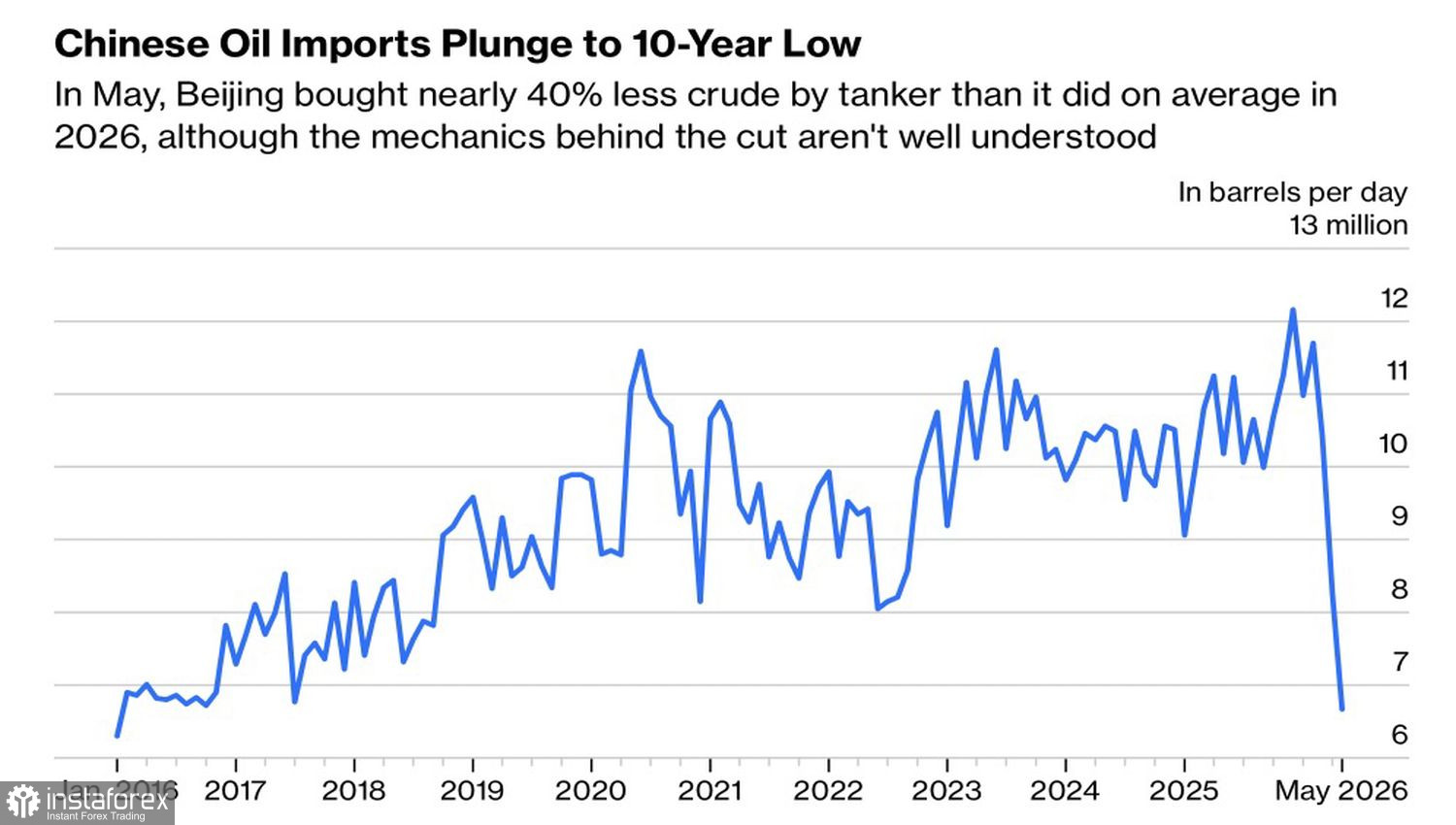
China played an important role in preventing a recession tied to the biggest oil shock. Before the conflict, the country was supporting prices by importing about 11 million b/d. Now it is preventing prices from rising, cutting purchases to a ten-year low of 7.8 million b/d in May.
The crude market is cyclical: price increases lead to lower global demand and a fall in Brent. Similar dynamics are visible outside China. Bloomberg estimates refinery crude runs have fallen by 5 million b/d.
Don't forget alternatives: Gulf countries have been finding alternate routes, throughput in the Strait of Hormuz has recovered from March lows, US exports have risen to a record 5.6 million b/d from about 4 million b/d, and inventories are being actively drawn down. US stocks have declined for nine consecutive weeks.
It becomes clear the oil market has adapted, and news of renewed US–Iran talks serves as a catalyst for selling Brent. At least three Reuters sources in Tehran said the sticking point in the dialogue is the scale of Western unfreezing of Iranian assets.
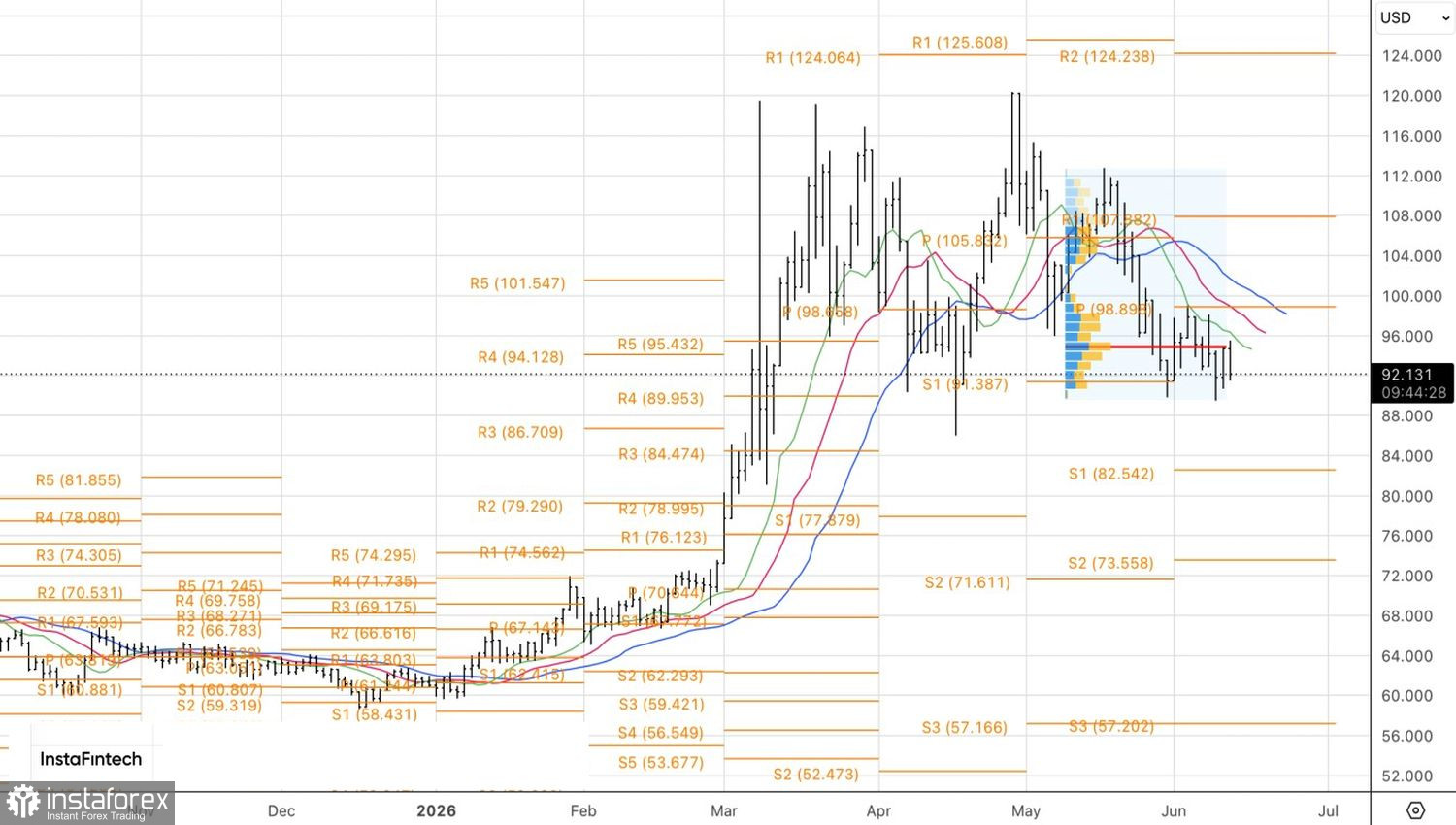
Technically, on the daily chart, Brent has bounced off fair value at $95/bbl. That increases the risk of a continued corrective move into the uptrend, which could develop into a new trend. A break of pivot supports at $91.35 and $89.55/bbl would allow the formation of short positions in the North Sea grade.
* Analisis pasaran yang disiarkan di sini adalah bertujuan untuk meningkatkan kesedaran anda, tetapi tidak untuk memberi arahan untuk membuat perdagangan.
Kajian analisis InstaSpot akan membuat anda mengetahui sepenuhnya aliran pasaran! Sebagai pelanggan InstaSpot, anda disediakan sejumlah besar perkhidmatan percuma untuk dagangan yang cekap.


