




Kumpulan kami mempunyai lebih daripada 7,000,000 pedagang!
Setiap hari kami bekerjasama untuk meningkatkan perdagangan. Kami mendapat keputusan yang tinggi dan bergerak ke hadapan.
Pengiktirafan oleh berjuta-juta pedagang di seluruh dunia adalah penghargaan terbaik untuk kerja kami! Anda membuat pilihan anda dan kami akan melakukan segalanya yang diperlukan untuk memenuhi jangkaan anda!
Kami adalah kumpulan yang terbaik bersama!
InstaSpot. Berbangga bekerja untuk anda!





Pelakon, juara kejohanan UFC 6 dan seorang wira sebenar!
Lelaki yang membuat dirinya sendiri. Lelaki yang mengikut cara kami.
Rahsia di sebalik kejayaan Taktarov adalah pergerakan berterusan ke arah matlamat.
Dedahkan semua segi bakat anda!
Cari, cuba, gagal - tetapi tidak pernah berhenti!
InstaSpot. Kisah kejayaan anda bermula di sini!

On Tuesday, the EUR/USD pair reversed in favor of the euro, and for two full days bulls pushed higher, giving hope for a resumption of the bullish trend. That hope has not yet been destroyed, as the "bullish" imbalance 12 is currently being worked off, and trader activity on Friday is at a minimum. However, from current levels, the pair could make a sharp move at any moment and in either direction. First, no one knows how events in the Middle East will unfold. Second, no one knows when Donald Trump will speak again or what he will say. Third, just a few hours ago, important U.S. reports—Nonfarm Payrolls and the unemployment rate—were released, and traders did not react at all, despite very unexpected data. Thus, it feels as though a spring is being compressed and could release at any moment. Or traders are simply prepared to trade only on geopolitical factors.
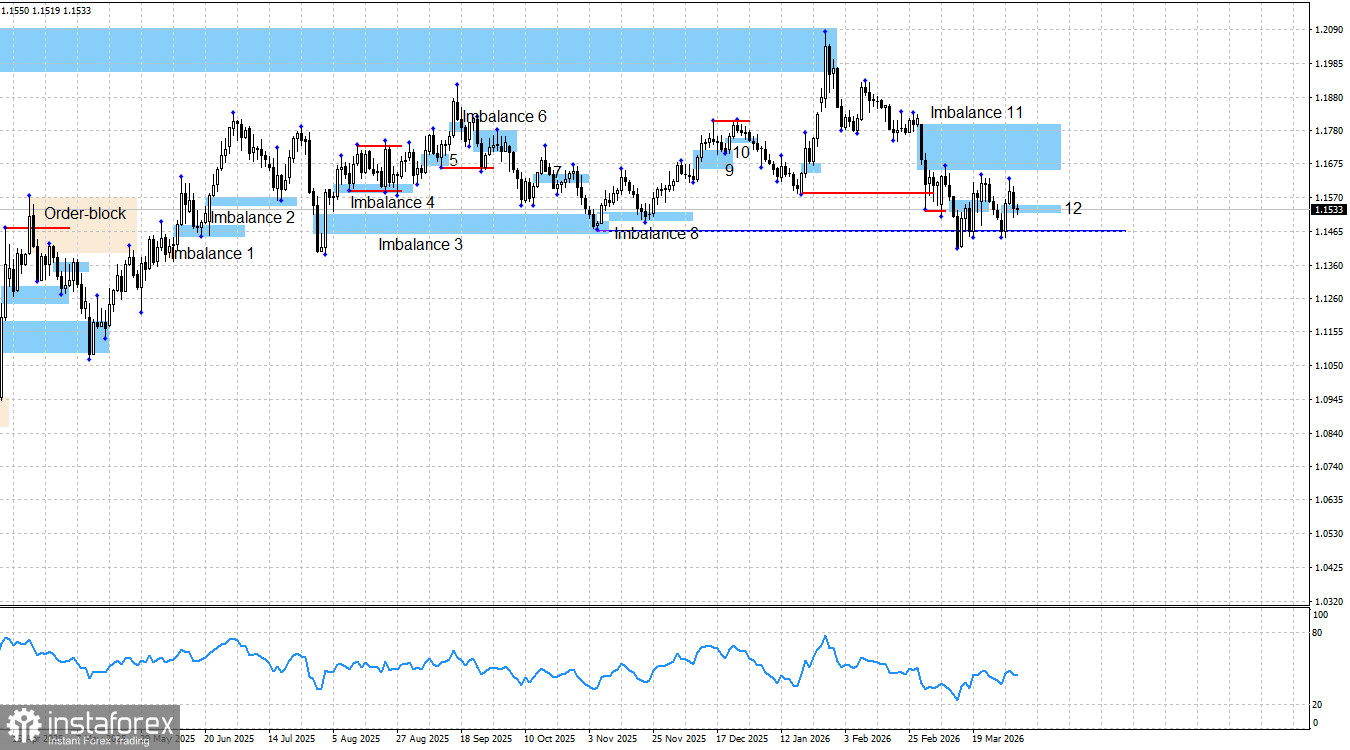
All of the U.S. dollar's growth over the past 4–5 weeks has been driven by geopolitics. Now, traders are moving back and forth, unsure of what to do. Trump alternates between wanting to unblock the Strait of Hormuz and shifting responsibility to other countries; between speaking about successful negotiations with Iran and promising to destroy it. We see the reflection of these events on the chart. I have repeatedly said that I do not believe in the end of the bullish trend, despite the break of important trend-forming lows. The movement of the past two months could turn into a bearish trend if geopolitics continues to strongly support the dollar. However, at this moment, I still doubt the bears' ability to sustain a prolonged offensive. Further growth of the U.S. dollar is possible only if geopolitics continues to provide strong support to the bears. And, as I have said before, this would require the situation in the Middle East not just to remain difficult, but to worsen further.
The chart picture is beginning to transform and is becoming very interesting. First, the price may soon react to imbalance 11. This would already be the second reaction, which could be weaker—or may not occur at all. However, let me remind you that the bullish trend remains, and near imbalance 11 only a sell signal could form. Second, today the price may react to imbalance 12, thereby forming a bullish signal within a bullish trend. Another important point is the potential liquidity grabs from the last two bullish swings, which may coincide with the processing of imbalance 11. Thus, it is still too early to say that the bulls are launching a full-scale offensive, but the probability exists. The key factor is that a truce between Washington and Tehran must be achieved.
The news background on Friday was very strong, but traders ignored (at the time of writing) even these reports. If the figures had been mediocre and neutral, I would not be surprised by the lack of reaction. However, the unemployment rate unexpectedly fell to 4.3% in March, and Nonfarm Payrolls came in at 178,000 versus traders' expectations of 60,000. At the same time, February's figure was revised from -92,000 to -133,000. U.S. data certainly did not add clarity.
There are still many reasons for the bulls to attack, and even the outbreak of war in the Middle East has not reduced their number. Structurally and globally, Trump's policies—which led to a significant decline of the dollar last year—have not changed. In the near term, the U.S. currency may strengthen amid a flight to safety, but this factor cannot support it indefinitely and requires ongoing escalation of the conflict in the Middle East. There are no other strong supporting factors for the dollar. I still do not believe in a sustained bearish trend. The dollar has received temporary support from the market, but what will drive the bears further?
News calendar for the U.S. and the Eurozone:
On April 6, the economic calendar contains one fairly important entry. The influence of the news background on market sentiment on Monday may be noticeable in the second half of the day—unless traders ignore this report as well.
EUR/USD forecast and trading advice:
In my opinion, the pair remains in the stage of forming a bullish trend. The news background sharply changed direction four weeks ago, but the trend itself cannot yet be considered fully canceled or completed. Thus, in the near term, traders need new patterns and signals to form short-term forecasts and open positions.
In the near future, bears may receive a signal at imbalance 11, but if geopolitics does not worsen further, the signal may not form. Bulls, on the other hand, can look for a signal within imbalance 12, which would allow opening buy positions with a target around the 1.1670 level.
* Analisis pasaran yang disiarkan di sini adalah bertujuan untuk meningkatkan kesedaran anda, tetapi tidak untuk memberi arahan untuk membuat perdagangan.
Kajian analisis InstaSpot akan membuat anda mengetahui sepenuhnya aliran pasaran! Sebagai pelanggan InstaSpot, anda disediakan sejumlah besar perkhidmatan percuma untuk dagangan yang cekap.


