




Nella nostra squadra ci sono più di 7.000.000 trader! Ogni giorno ci impegniamo a far sì che il trading migliori. Conseguiamo grandi risultati e ci muoviamo in avanti.
Il riconoscimento da parte di milioni di trader in tutto il mondo rappresenta l'alta valutazione della nostra attività! Voi avete fatto la vostra scelta e noi faremo la nostra al fine di soddisfare le vostre aspettative!
Assieme siamo una grande squadra!
InstaSpot. Siamo orgogliosi di lavorare per voi!





Attore, campione del mondo di lotta libera e semplicemente un vero maciste russo! Persona venuta dal nulla. Persona che rispecchia i nostri obiettivi. Il segreto del successo di Taktarov consiste nel mirare continuamente al suo scopo.
Dischiudi anche tu tutti gli aspetti del tuo talento! Impara, prova, sbaglia, ma non fermarti!
InstaSpot - la storia delle tue vittorie inizia qui!

The wave count on the four-hour chart for EUR/USD has become more complex. On the higher timeframe (lower chart), the downward trend segment has taken the form of a five-wave structure, A-B-C-D-E, which could be complete at any moment, as it appears to be well-developed. All the waves in this segment are approximately equal in size, so this structure is considered corrective. If this assumption is correct, an impulsive upward trend segment will begin to develop once it is complete, with targets located well above the 20th level.
On the lower timeframe (upper chart), an impulsive wave sequence continues to develop, which may belong to wave E on the higher timeframe. If this is indeed the case, the dollar's strengthening is nearing its end, no matter how strongly it rises. A fifth wave of the downward structure may form, as it appears to be impulsive. However, in any case, the current wave structure suggests that the downward wave sequence is nearing completion on both charts. News developments and a sharp shift in market sentiment have driven a strong rise in the US currency, but each day it becomes increasingly difficult for the dollar to continue rising.
The EUR/USD exchange rate fell by another 50 basis points on Monday. Euro selling in the foreign exchange market continues, and a wide range of explanations is being offered. Most of them do not stand up to scrutiny. It is worth recalling that the most surprising aspect is not the dollar's rise amid the very challenging economic conditions facing the United States and the global political and geopolitical uncertainty. What is surprising is the near-complete absence of corrections and pullbacks. In other words, market participants are simply selling euros and buying dollars almost every day. Such activity requires very compelling reasons. Yet with each further decline, it becomes increasingly difficult to identify those reasons.
Why did the euro fall on Monday? The reasons cited include France's budget crisis, a new political crisis in Germany, persistently high European bond yields, and the European Union's dependence on imported energy, which makes its economy highly sensitive to rising prices. Other explanations include the Federal Reserve's monetary policy tightening, the higher Fed interest rate compared with the ECB's, rising geopolitical tensions, new Houthi and Iranian attacks in the Middle East, and the collapse of another round of negotiations between Washington and Tehran before they had even begun. The list could go on indefinitely.
However, no one seems willing to consider the ECB's monetary policy tightening, rising US Treasury yields, the United States' budget and national debt problems, Donald Trump's trade war, high fuel prices in the United States, the considerable likelihood of the Republican Party losing the election, further Democratic efforts to remove Trump from power, or attempts to block the war against Iran. And so on. The point is that if inconvenient facts are not ignored, the dollar currently has no more reasons to rise than the euro does.
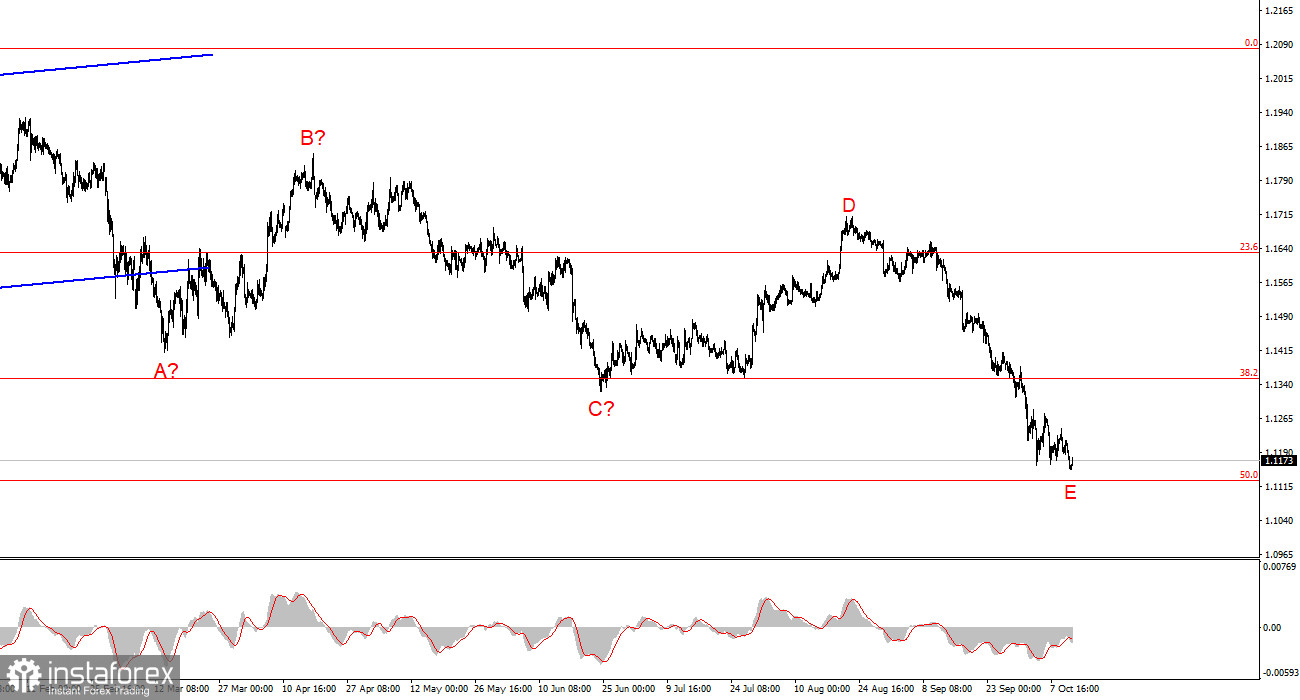
Based on the EUR/USD analysis, the conclusion is that the instrument remains within a global corrective trend segment, A-B-C-D-E. If this assumption is correct, the decline will continue, with targets below the low of wave C at 1.1325. This scenario was considered an alternative, and had it not been for the Fed meeting, it would have remained a backup scenario. However, the Fed delivered a surprise, leaving the market with no other options but to launch another wave of US dollar buying. Yet buying has continued for several consecutive weeks, even though the dollar has no new supporting factors. Opening short positions would be inadvisable amid the current news backdrop; instead, preparations would be made for a reversal.
On the higher timeframe, a downward trend segment is visible, taking the form of A-B-C-D-E. Consequently, EUR/USD may continue to decline below the low of wave C, while the internal wave structure of wave E may develop into a five-wave impulsive structure.
Key Principles of the Analysis:
1) Wave structures should be simple and easy to understand. Complex structures are difficult to trade and often involve changes.
2) If there is no confidence in what is happening in the market, it is better to stay out.
3) There can never be absolute certainty about the direction of price movement. Do not forget to use protective Stop Loss orders.
4) Wave analysis can be combined with other forms of analysis and trading strategies.
*La presente analisi del mercato ha un carattere esclusivamente informativo e non rappresenta una guida per l`effettuazione di una transazione.
Le recensioni analitiche di InstaSpot ti renderanno pienamente consapevole delle tendenze del mercato! Essendo un cliente InstaSpot, ti viene fornito un gran numero di servizi gratuiti per il trading efficiente.


