




Nella nostra squadra ci sono più di 7.000.000 trader! Ogni giorno ci impegniamo a far sì che il trading migliori. Conseguiamo grandi risultati e ci muoviamo in avanti.
Il riconoscimento da parte di milioni di trader in tutto il mondo rappresenta l'alta valutazione della nostra attività! Voi avete fatto la vostra scelta e noi faremo la nostra al fine di soddisfare le vostre aspettative!
Assieme siamo una grande squadra!
InstaSpot. Siamo orgogliosi di lavorare per voi!





Attore, campione del mondo di lotta libera e semplicemente un vero maciste russo! Persona venuta dal nulla. Persona che rispecchia i nostri obiettivi. Il segreto del successo di Taktarov consiste nel mirare continuamente al suo scopo.
Dischiudi anche tu tutti gli aspetti del tuo talento! Impara, prova, sbaglia, ma non fermarti!
InstaSpot - la storia delle tue vittorie inizia qui!

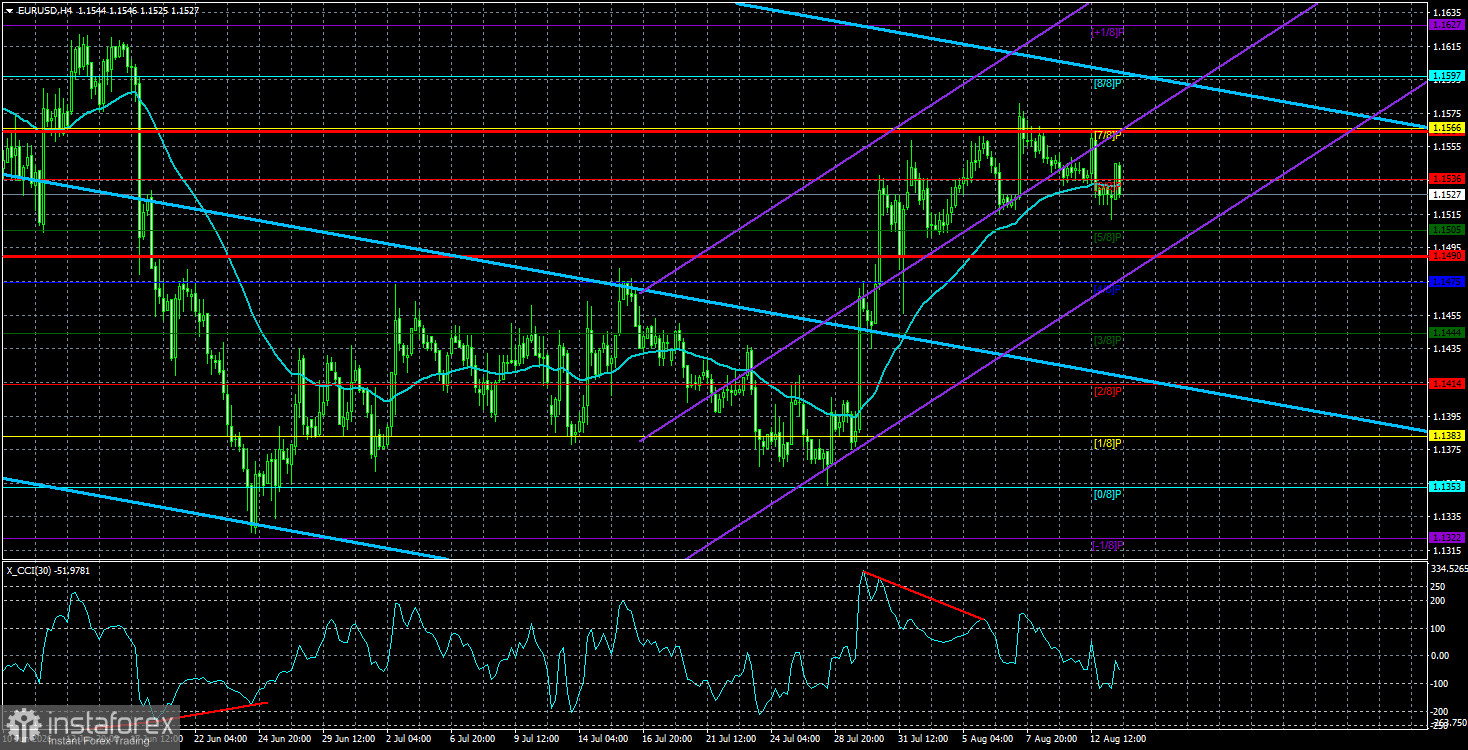
The EUR/USD currency pair showed no notable movement on Thursday (as was the case on Wednesday, Tuesday, or Monday). It is enough to glance at the chart below to see that volatility remains low and the market is practically not reacting to what is happening in the world and the economy. This week, essentially, there was only one important event — the US inflation report. This report was supposed to tell the market what to expect from the Federal Reserve at the September meeting. And here, it is important to immediately and correctly understand what we expected from that report. Any report can be bland, boring, and uninteresting, or strong and resonant. Inflation in the U.S. this week was bland, as the actual value matched forecasts. However, did we see a strong market reaction to the resonant and no less important Nonfarm Payrolls report on Friday? Recall that the total volatility that day was 63 pips, and the US dollar lost at best about 40 pips after the poor labor market data.
Thus, the problem is not in the reports themselves or their values. The market has again entered a phase of low activity, so any events cannot move the price from a dead point. Since the Nonfarm Payrolls and inflation levels had practically no influence on the EUR/USD pair's movement, what can we say about other macroeconomic events, which obviously had a lesser degree of significance?
Also note that movements can be weak but trending. Let's be honest: the Nonfarm Payrolls report implied a stronger dollar decline; the inflation report implied a dollar decline. Both reports significantly reduced the probability of a Fed monetary policy tightening at the September meeting. At that meeting, two months ago, the market was still confident — the Fed would raise the key rate. It is now clear that tightening monetary policy under the current circumstances is absolutely unreasonable. Suppose inflation begins to rise again, but what about the labor market, which has been falling for 4 months in a row?
The Fed cut the key rate three times last year to support the US labor market. And it managed to do that — at the beginning of the year, Nonfarm Payrolls showed quite decent values. But what can you do if Donald Trump cannot sit still and does not live peacefully? A war with Iran began, and US macroeconomic indicators are again flying not in the direction that would correspond to the concept of "Make America Great Again." It is unlikely that with such a policy the verb "make" will ever turn into "made."
The dollar, together with the euro, continues to show only one thing — convulsions. The market sometimes moves, sometimes stands still. And usually there is no correlation with fundamental, geopolitical, and macroeconomic events—pure randomness. On Wednesday, the pair showed a decline that should not have occurred; on Thursday — already a rise that also should not have occurred.
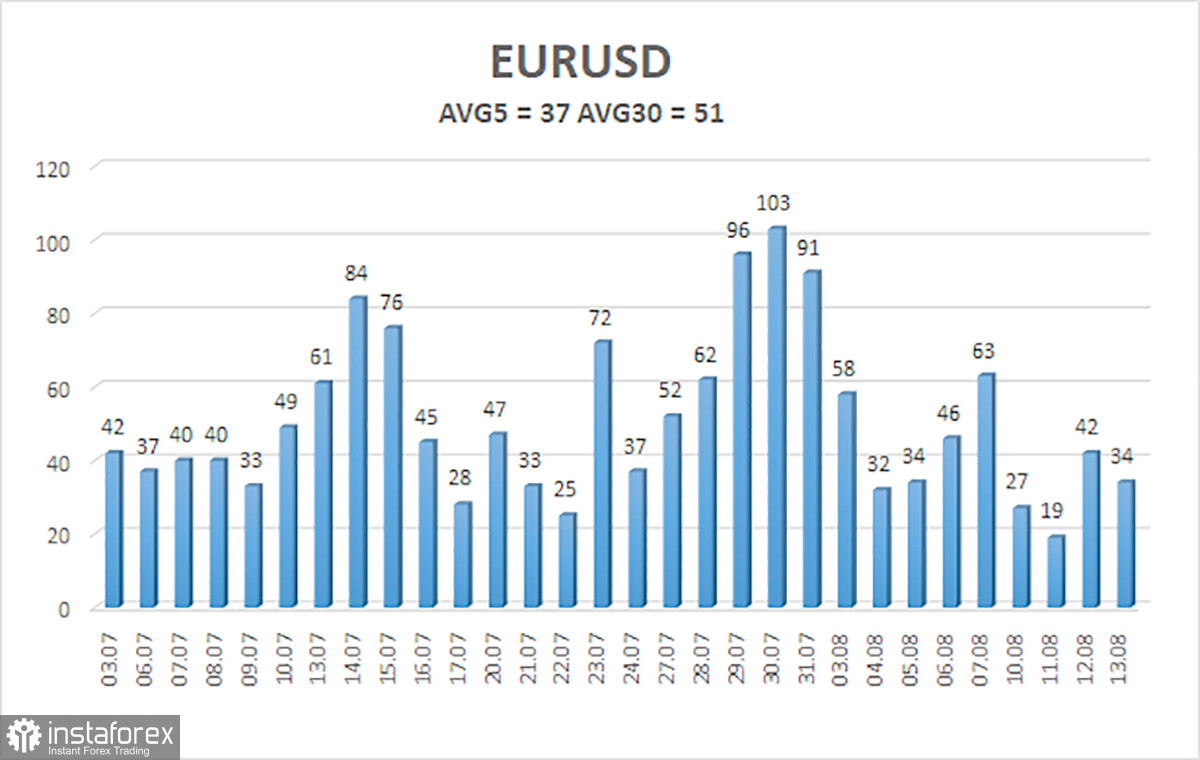
The average volatility of the EUR/USD currency pair over the last 5 trading days as of August 14 is 37 pips, which is characterized as "low." We expect the pair to move between the levels 1.1490 and 1.1564 on Friday. The higher linear regression channel is directed downward, indicating the preservation of the downward trend. The CCI indicator entered the overbought area and formed a "bearish" divergence, which warns of a possible downward retracement.
S1 – 1.1505
S2 – 1.1475
S3 – 1.1444
R1 – 1.1536
R2 – 1.1566
R3 – 1.1597
The EUR/USD pair continues its upward trend on the 4-hour TF, which may mark the beginning of a new phase of a global upward trend on higher TFs. The global fundamental backdrop for the dollar remains negative, but in 2026, geopolitics and then the Fed's "hawkish" stance provided strong support for the US currency. However, at present, these factors no longer support the dollar. When the price is positioned below the moving average, shorts can be considered with targets at 1.1505 and 1.1490. Above the moving average line, long positions are relevant with targets at 1.1566 and 1.1597.
Linear regression channels help determine the current trend. If both are directed in the same direction, the trend is currently strong.
The moving average line (settings: 20, 0, smoothed) defines the short-term trend and the direction in which trading should currently be conducted.
Murray levels are target levels for moves and corrections.
Volatility levels (red lines) indicate the likely price channel the pair will spend the next day in, based on current volatility readings.
The CCI indicator — its entry into the oversold area (below -250) or into the overbought area (above +250) means a trend reversal in the opposite direction is approaching.
*La presente analisi del mercato ha un carattere esclusivamente informativo e non rappresenta una guida per l`effettuazione di una transazione.
Le recensioni analitiche di InstaSpot ti renderanno pienamente consapevole delle tendenze del mercato! Essendo un cliente InstaSpot, ti viene fornito un gran numero di servizi gratuiti per il trading efficiente.


