




Yesterday, the Federal Reserve raised the policy rate by 25 basis points, but the decision was initially almost unnoticed by the market: the probability of exactly such an outcome had already exceeded 90%, so the main surprise was not the hike itself but the unanimous 12–0 vote. In July, three committee members voted against keeping the funds rate unchanged, insisting on an immediate increase. So, the fact that every single member now backed the decision shows the consensus within the Fed has shifted noticeably toward a hawkish stance in the past two months.
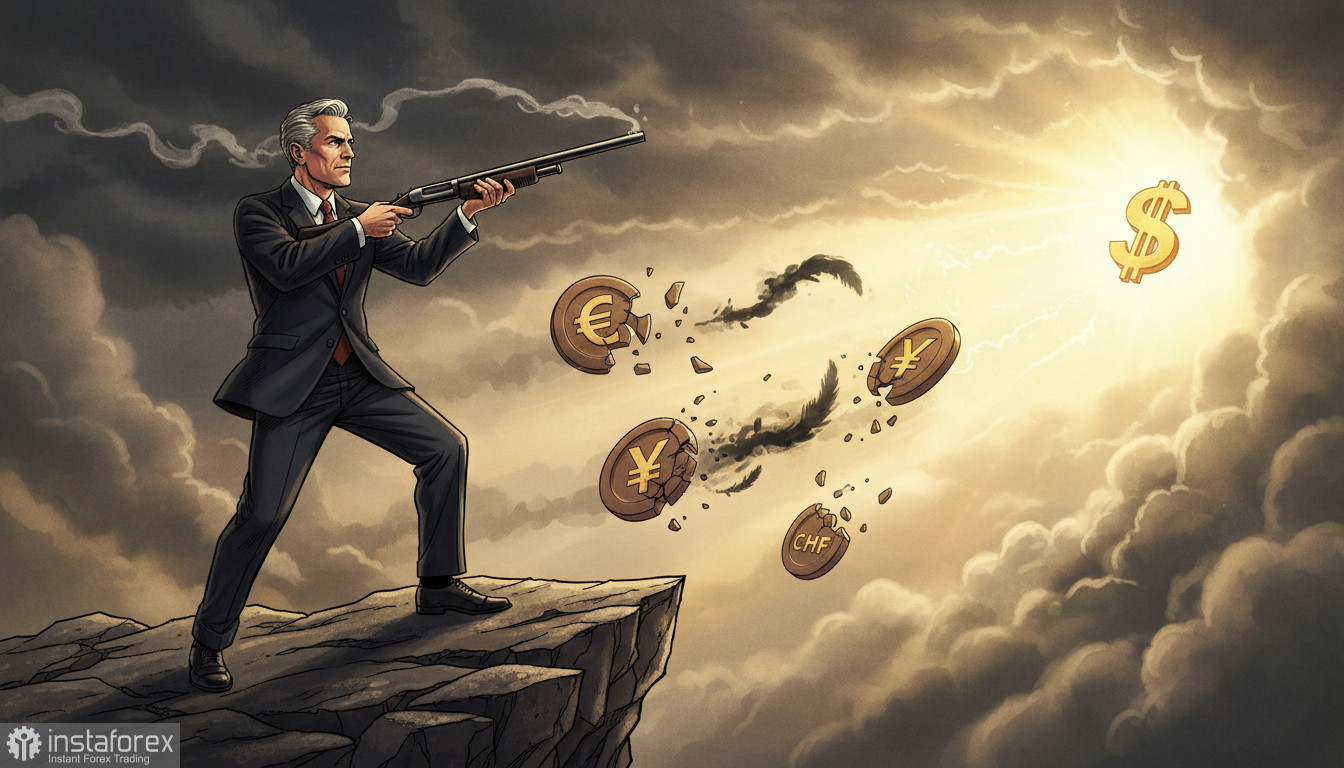
Kevin Warsh explained the change in the committee's tone by three factors that have changed since July: the economy and employment have shown stronger dynamics, the pace of disinflation has proved insufficient, and the assessment of geopolitical risks has shifted. It was that combination—rather than any single indicator—that determined the decision, since, according to Warsh, summer macroeconomic data did not show a decline in inflation and too many categories of goods and services are still outpriced, with headline inflation rising faster than 3% over both the six- and twelve-month horizons. That argument benefits the dollar, which receives additional confirmation of a tightening path, while borrowers and the stock market lose out because more expensive money means higher debt servicing costs.
The Federal Reserve did not stop at a one-off rate increase; it immediately revised its projections several years ahead. The median year-end rate estimate rose to 4.125% from the 3.75% expected in June, and 16 of 18 committee members foresee at least one more rate hike this year: 12 Fed policymakers expect another 25-basis-point move, four members expect two more, and only two see no need for further tightening. Does this mean the hiking cycle is almost over? Not quite: according to the updated dot plot, the funds rate will remain at 4.125% through 2027, and rate cuts will begin only in 2028—to 3.875%—followed by 3.625% in 2029 and 3.25% in the long run.
This trajectory differs markedly from previous market expectations, which in June envisioned one rate hike by year-end followed by quarter-point cuts in each of the next three years. Because of the forecast revision, long rates in the economy now have reason to stay higher for longer than the market assumed even a week ago, and that is why the updated dot plot matters for bonds and the dollar at least as much as today's policy decision.
The economic block of the projections was also revised up: US GDP growth for 2026 was raised to 2.3% from 2.2%, the anticipated unemployment rate was lowered to 4.1% from 4.3%, headline PCE inflation was raised to 3.7% from 3.6%, and core PCE to 3.4% from 3.3%. Warsh emphasized that the unemployment rate remains low, job openings and hours worked are rising, and the labor market is generally healthy; it is this resilience, he said, that allows the Federal Reserve to focus on price stability without fearing serious harm to employment. The economy, he continued, appears to be strengthening and key indicators have improved in recent months, and "financial conditions are hard to call tight," the Fed chair added, noting that this view is widely shared across the committee.
Separately, the Fed confirmed readiness, if necessary, to increase its holdings of Treasury securities by buying bills and notes with maturities up to three years to maintain adequate reserve levels in the system. Formally, this is a technical measure for banking liquidity rather than a full-blown new quantitative easing, but in the current environment of rising yields such an option becomes an additional tool capable of smoothing pressure on the short end of the curve even while the policy rate continues to rise.
Kevin Warsh said inflation risks are skewed to the upside while labor market risks remain balanced, and it is precisely this asymmetry that explains why the Fed chose to hike rather than pause despite persistent geopolitical uncertainty. He named three direct reasons for rising sovereign yields: a strong economy, competition for capital, and geopolitics, and judging by the Fed chair's rhetoric, the regulator is not yet ready to discount any of them in favor of looser policy. Mr. Warsh also noted the Fed is closely watching developments in artificial intelligence and expects a working group report on the subject by year-end, which indicates the growing weight of AI investments in the evaluation of risks to the economy and capital markets.
In my view, the key takeaway from the meeting is not the rate increase itself but the Fed's effective abandonment of a quick pivot to easing: extending a pause at 4.125% through 2027 is a far more hawkish signal than the unanimous vote alone. I would not rule out the dollar continuing to receive support from this divergence in the coming weeks, and pressure on equities and long bonds is likely to persist at least until fresh inflation data give the Fed reason to doubt the need for another hike before year-end.
As for the current technical picture for EUR/USD, buyers now need to consider how to take the 1.1480 level. Only that would allow targeting a test of 1.1505. From there, one could reach 1.1530, but doing so without support from large players would be quite difficult. If the currency pair falls, I expect robust action from large buyers only around 1.1455. If no one is there, it would be better to wait for a new low at 1.1430 or to open longs from 1.1410.
Regarding the current technical picture for GBP/USD, pound buyers need to take the nearest resistance at 1.3400. Only that would allow targeting 1.3435, above which it will be quite hard to break. The further target is the 1.3465 area. If the instrument falls, bears will try to seize control at 1.3365. If they succeed, a break of the range would inflict a serious blow to bulls and push GBP/USD toward 1.3335, with a prospect of reaching 1.3300.
*Analisis pasar yang diposting disini dimaksudkan untuk meningkatkan pengetahuan Anda namun tidak untuk memberi instruksi trading.
Tinjauan analitis InstaSpot akan membuat Anda menyadari sepenuhnya tren pasar! Sebagai klien InstaSpot, Anda dilengkapi dengan sejumlah besar layanan gratis untuk trading yang efisien.