




Our team has over 7,000,000 traders!
Every day we work together to improve trading. We get high results and move forward.
Recognition by millions of traders all over the world is the best appreciation of our work! You made your choice and we will do everything it takes to meet your expectations!
We are a great team together!
InstaSpot. Proud to work for you!





Actor, UFC 6 tournament champion and a true hero!
The man who made himself. The man that goes our way.
The secret behind Taktarov's success is constant movement towards the goal.
Reveal all the sides of your talent!
Discover, try, fail - but never stop!
InstaSpot. Your success story starts here!

Gold is set to finish the week lower, trading within a broader sideways channel, as high energy prices and inflation concerns pushed bond yields up and strengthened expectations that the Federal Reserve will need to keep raising rates. Platinum rose slightly today, while palladium declined.
On Friday, the metal ticked up toward $4,300 per ounce but remains roughly 2% below last Friday's level. Oil pulled back after rising more than 7% over the previous two days as negotiators explored a phased deal under which Tehran would reopen the Strait of Hormuz, and Washington would lift its port blockade.
Energy prices and expectations of further Fed hikes have driven gold's path in recent weeks, and higher borrowing costs are usually negative for a non-yielding asset. The sell-off in the US Treasury market intensified sharply on Thursday amid inflation fears after midweek oil gains and renewed concerns about the sovereign debt situation — another headwind for gold. Rising yields, higher oil, and stronger economic data are therefore weighing on the metal simultaneously. Don't be surprised if gold remains under pressure while yields continue to climb, though the metal's long-term trajectory has not changed.
In the short term, until the market receives a fresh reason to worry about confidence in Fed policy or a renewed weakening of the dollar, gold risks trading sideways — despite structural reasons supporting higher prices further out.
Throughout September, gold traded in a relatively narrow range around $4,300/oz while the market repeatedly revised Fed-policy expectations. Despite near-term obstacles, many investors still bet that the metal will gradually appreciate and resume its traditional role as a portfolio safe-haven.
In my view, the key problem for gold's current range is the absence of a fresh catalyst. The geopolitical premium from Iran is easing amid talks, Treasury yields remain high as a new norm rather than a one-off spike, and in such an environment the metal risks being stuck in the $4,200–4,400 range until either the Hormuz negotiations fail or the Fed gives the market reason to doubt its resolve to continue hiking.
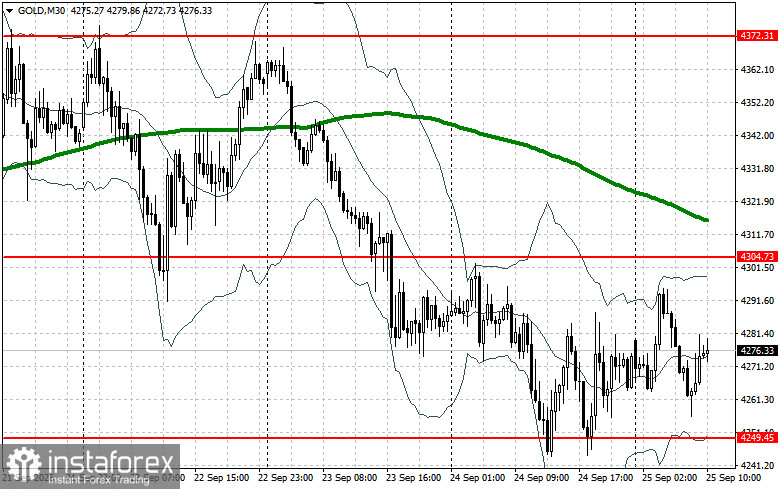
On the technical side, buyers need to take the nearest resistance at $4,304. That would allow a target of $4,372, beyond which a breakout will be fairly difficult. The farthest target is $4,424. If gold falls, bears will try to seize control of $4,249. If they succeed, a range breakout would seriously damage bulls' positions and push Gold down to $4,186, with the prospect of reaching $4,156.
*The market analysis posted here is meant to increase your awareness, but not to give instructions to make a trade.
InstaSpot analytical reviews will make you fully aware of market trends! Being an InstaSpot client, you are provided with a large number of free services for efficient trading.


