




The legend in the InstaSpot team!
Legend! You think that's bombastic rhetoric? But how should we call a man, who became the first Asian to win the junior world chess championship at 18 and who became the first Indian Grandmaster at 19? That was the start of a hard path to the World Champion title for Viswanathan Anand, the man who became a part of history of chess forever. Now one more legend in the InstaSpot team!





Borussia is one of the most titled football clubs in Germany, which has repeatedly proved to fans: the spirit of competition and leadership will certainly lead to success. Trade in the same way that sports professionals play the game: confidently and actively. Keep a "pass" from Borussia FC and be in the lead with InstaSpot!


The release of the July Personal Consumption Expenditures (PCE) index, the Fed's preferred measure of inflation, comes at a highly vulnerable moment for the cryptocurrency market. The consensus forecast calls for core PCE to rise by 0.2% month-on-month and to 3.2% year-on-year. Meanwhile, softer-than-expected July CPI, PPI, and import prices have already convinced some analysts that the regulator will leave rates unchanged at its September meeting.
Based on this softer inflation picture, the probability of rates remaining unchanged has risen to 65%, compared with nearly even odds before the July data were released. Bitcoin, meanwhile, surged to $81,000, the Fear and Greed Index climbed to 74, and last week's short squeeze was driven largely by declining expectations of tighter monetary policy.
However, there is an important consideration here. The extent to which positive expectations have already been priced in creates a risk of a sharp reversal in the event of an unfavorable surprise. If today's PCE reading comes in above consensus, the market will immediately revise the probability of rates remaining unchanged in September back toward 50% or even toward a rate hike. The transmission mechanism to the cryptocurrency market is direct and well established: rising inflation expectations strengthen the dollar, push up Treasury yields, and undermine the rationale behind the entire rally of the past week—the expectation that the Treasury will increase liquidity through bond buybacks precisely because monetary conditions are easing rather than tightening.
The fact that the current rally has been partly driven by the forced closing of short positions rather than purely organic demand also creates a particular risk, making the market similarly vulnerable to a reversal.
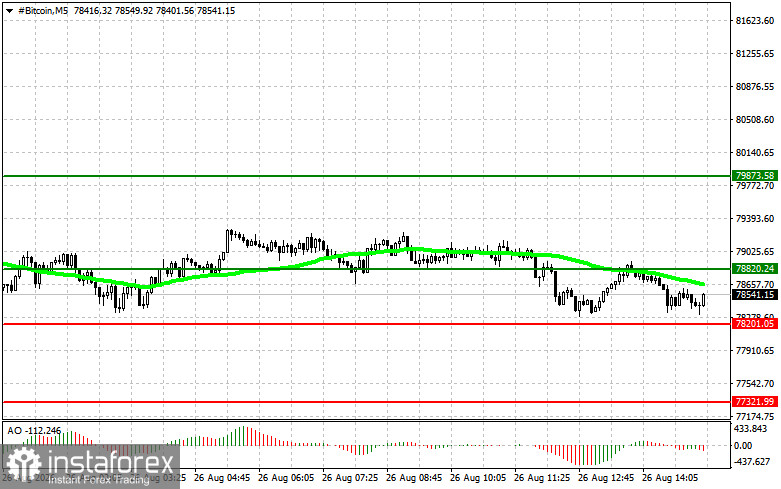
Scenario #1: Today, I will buy Bitcoin when the entry point reaches around $78,800, with a target of $79,800. Around $79,800, I will exit the long position and immediately sell on a rebound. Before buying on a breakout, make sure that the 50-day moving average is below the current price and that the Awesome Oscillator is above zero.
Scenario #2: Bitcoin can be bought from the lower boundary at $78,200 if there is no market reaction to a breakout below this level, with a reversal toward $78,800 and $79,800.
Scenario #1: Today, I will sell Bitcoin when the entry point reaches around $78,200, with a target of $77,300. Around $77,300, I will exit the short position and immediately buy on a rebound. Before selling on a breakout, make sure that the 50-day moving average is above the current price and that the Awesome Oscillator is below zero.
Scenario #2: Bitcoin can be sold from the upper boundary at $78,800 if there is no market reaction to a breakout above this level, with a reversal toward $78,200 and $77,300.
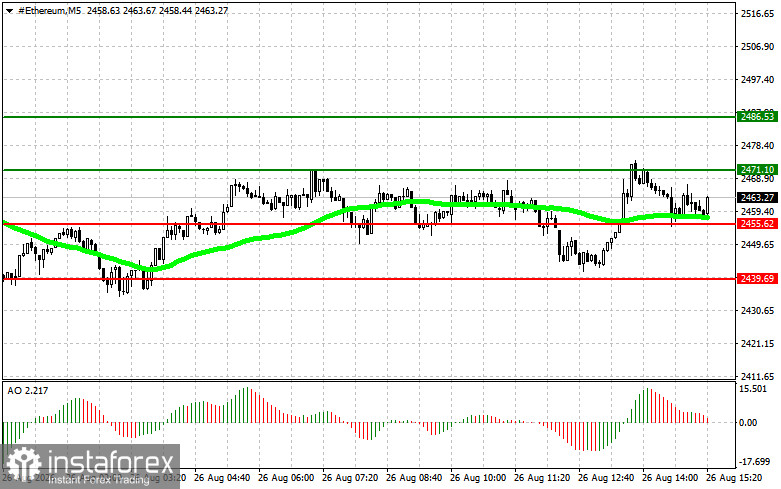
Scenario #1: Today, I will buy Ethereum when the entry point reaches around $2,471, with a target of $2,486. Around $2,486, I will exit the long position and immediately sell on a rebound. Before buying on a breakout, make sure that the 50-day moving average is below the current price and that the Awesome Oscillator is above zero.
Scenario #2: Ethereum can be bought from the lower boundary at $2,455 if there is no market reaction to a breakout below this level, with a reversal toward $2,471 and $2,486.
Scenario #1: Today, I will sell Ethereum when the entry point reaches around $2,455, with a target of $2,439. Around $2,439, I will exit the short position and immediately buy on a rebound. Before selling on a breakout, make sure that the 50-day moving average is above the current price and that the Awesome Oscillator is below zero.
Scenario #2: Ethereum can be sold from the upper boundary at $2,471 if there is no market reaction to a breakout above this level, with a reversal toward $2,455 and $2,439.
*The market analysis posted here is meant to increase your awareness, but not to give instructions to make a trade.
InstaSpot analytical reviews will make you fully aware of market trends! Being an InstaSpot client, you are provided with a large number of free services for efficient trading.


