




The legend in the InstaSpot team!
Legend! You think that's bombastic rhetoric? But how should we call a man, who became the first Asian to win the junior world chess championship at 18 and who became the first Indian Grandmaster at 19? That was the start of a hard path to the World Champion title for Viswanathan Anand, the man who became a part of history of chess forever. Now one more legend in the InstaSpot team!





Borussia is one of the most titled football clubs in Germany, which has repeatedly proved to fans: the spirit of competition and leadership will certainly lead to success. Trade in the same way that sports professionals play the game: confidently and actively. Keep a "pass" from Borussia FC and be in the lead with InstaSpot!

The inflation report published on July 20 exceeded expectations, as headline inflation decelerated more sharply than anticipated and the key core inflation measures dropped below the 2% target for the first time in years. This development significantly changes the outlook for the Bank of Canada's monetary policy.
Headline CPI slowed to 2.8% year-over-year from 3.2% in May, below the consensus forecast of 2.9%. On a monthly basis, CPI fell 0.4%, marking the sharpest monthly decline since December 2024, compared with market expectations for a 0.2% decrease. Meanwhile, the Bank of Canada's preferred core inflation measures—CPI-median and CPI-trim—eased to 1.9% and 1.8%, respectively, their lowest levels since September 2020.
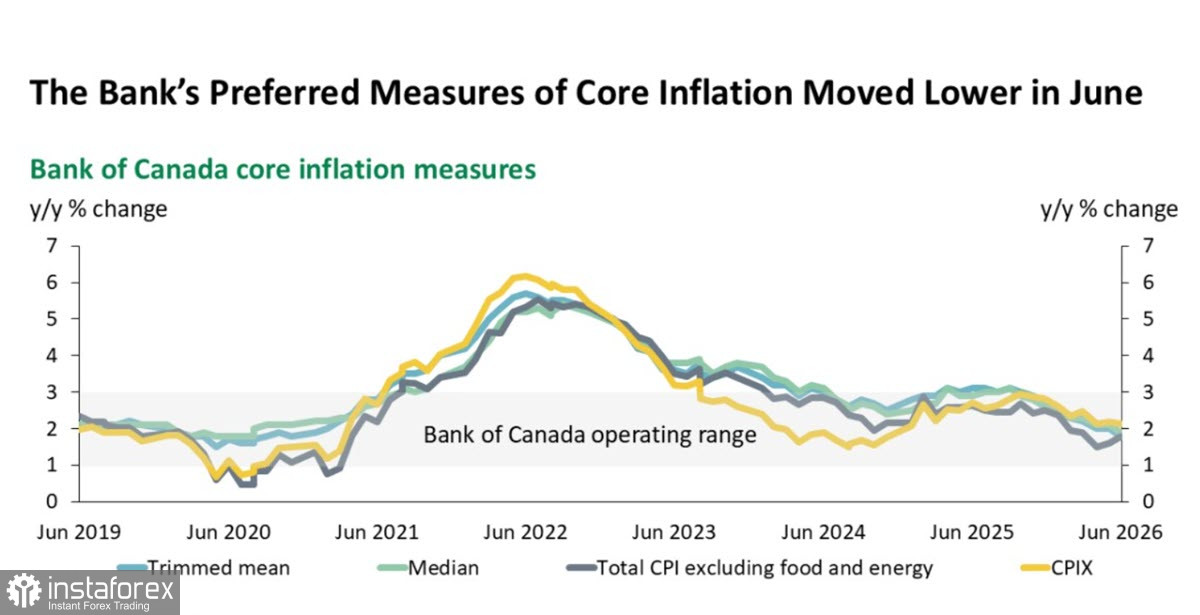
The primary driver of the slowdown was lower gasoline prices, reflecting both last year's high base effect and the temporary ceasefire between the United States and Iran. Excluding the volatile gasoline component, core CPI excluding gasoline remained at 2.2% year-over-year, suggesting that while overall inflation dynamics are improving, the underlying trend still remains above the Bank of Canada's target.
The Canadian economy is showing signs of recovering after stagnating earlier this year. In its July Monetary Policy Report, the Bank of Canada upgraded its growth forecasts for 2027 and 2028 and expects economic activity to strengthen during the second half of 2026. Second-quarter GDP growth is projected at 2.5% year-over-year, following zero growth in the first quarter.
Cooling inflation—and, in particular, the decline in the core inflation measures below 2%—strengthens the case for maintaining an accommodative monetary policy stance. The Bank of Canada is therefore expected to keep its policy rate at 2.25% through the end of 2026. At its July meeting, the Bank also indicated that it is closely monitoring whether higher energy prices spill over into broader inflationary pressures. So far, there is little evidence that this is occurring.
Market participants have shifted their expectations toward future rate cuts rather than additional tightening. Most economists surveyed by Reuters expect the Bank of Canada to leave its policy rate unchanged at least until July 2027. As a result, the market consensus points to a prolonged pause in the current monetary policy cycle.
The fundamental backdrop for the Canadian dollar remains mixed. On the one hand, softer inflation is weighing on the currency by reducing expectations of tighter monetary policy. On the other hand, a 20% rally in oil prices—Canada's key export commodity—during July, together with a resilient labor market, continues to provide support for the Canadian dollar.
Net short positioning in the Canadian dollar increased by CAD 0.4 billion over the latest reporting week to CAD -12.5 billion. Overall positioning remains firmly bearish, although the estimated fair value no longer shows a clear directional bias.
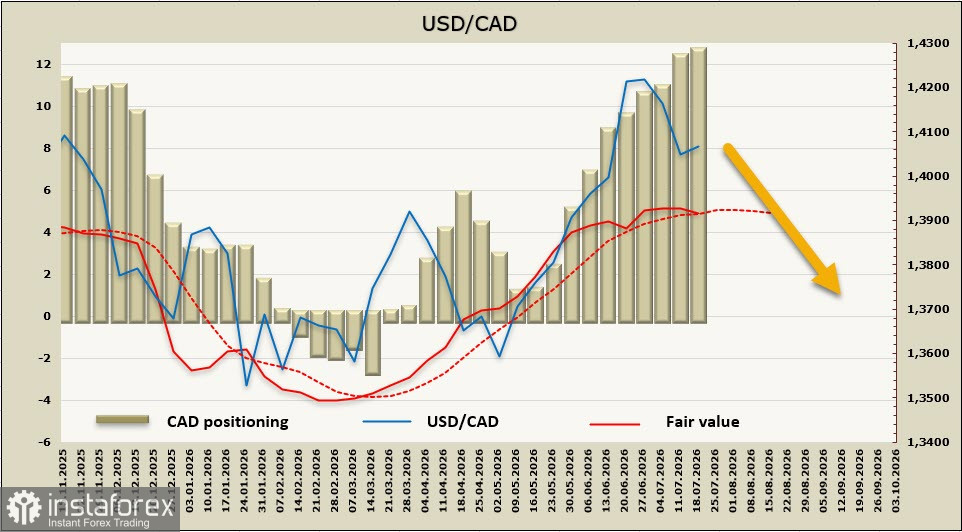
From a technical perspective, the market structure remains bearish. USD/CAD continues to trade below its descending channel, while U.S. dollar bulls remain inactive following weaker-than-expected U.S. inflation data, which reduced expectations of additional Federal Reserve rate hikes.
The pair is expected to consolidate within the 1.4000–1.4100 level. Initial resistance is located at 1.4050. A break above this level could trigger a corrective move toward the 1.4140–1.4150 level, where former support has now turned into resistance. The primary outlook remains bearish. Although expectations of a prolonged pause by the Bank of Canada may exert some medium-term pressure on the Canadian dollar, elevated oil prices are likely to limit the extent of any decline.
*The market analysis posted here is meant to increase your awareness, but not to give instructions to make a trade.
InstaSpot analytical reviews will make you fully aware of market trends! Being an InstaSpot client, you are provided with a large number of free services for efficient trading.


