




Our team has over 7,000,000 traders!
Every day we work together to improve trading. We get high results and move forward.
Recognition by millions of traders all over the world is the best appreciation of our work! You made your choice and we will do everything it takes to meet your expectations!
We are a great team together!
InstaSpot. Proud to work for you!





Actor, UFC 6 tournament champion and a true hero!
The man who made himself. The man that goes our way.
The secret behind Taktarov's success is constant movement towards the goal.
Reveal all the sides of your talent!
Discover, try, fail - but never stop!
InstaSpot. Your success story starts here!

Yesterday, US equity indices finished mixed. The S&P 500 slipped by 0.01% and the Nasdaq 100 fell by 0.46%. The Dow Jones Industrial Average rose by 0.14%.
One Micron print was not enough to prevent another leg down in tech. Today South Korea's KOSPI was halted for the second time this week after plunging by about 9% before paring losses. The broader Asian benchmark lost over 3%, while Nasdaq 100 futures are down roughly 1.3% and S&P 500 futures about 0.7%. European contracts fell by about 0.8%.
Two tech shocks triggered the move. The first was Apple: the stock tumbled by 6.1% after the company raised prices on Macs, iPads, and home electronics, citing an unprecedented memory-chip shortage driven by data-center demand. If one of the world's largest component buyers cannot absorb price increases and must pass them on to consumers, that raises serious questions about demand elasticity and the sustainability of memory makers' margins. In short, the very chip shortage that yesterday lifted Micron and SK Hynix is now a threat to end-market demand. Microsoft, meanwhile, raised Xbox prices for the third time, underscoring that the component bottleneck hits the entire consumer-electronics chain.
The second hit came via a New York Times report that OpenAI is leaning toward moving its IPO into 2027. The reaction was immediate and painful for the company's Japanese investor: SoftBank shares plunged by about 14%, dragging the Nikkei down roughly 4.5%.
Recall that last week, SpaceX's successful IPO raised hopes of a wave of AI?related listings. A potential OpenAI delay shows that the window for those floats can close as fast as it opened.
Notably, falling oil did not lift sentiment. Brent dropped to around $74/bbl, although prices spiked the day before after a projectile struck a vessel in the Strait of Hormuz, reminding markets of the fragility of the truce and the risks to safe passage.
The main macroprint yesterday was the PCE, which — unlike the tech shocks — provided relief. The Fed's preferred inflation gauge rose by 0.4% month-on-month, below the 0.5% expected. Year-on-year headline PCE accelerated to 4.1% — still more than double target — but the miss versus the monthly consensus prompted traders to scale back the odds of near-term Fed hikes. New York Fed President John Williams said current rates are well placed to bring inflation back to target.
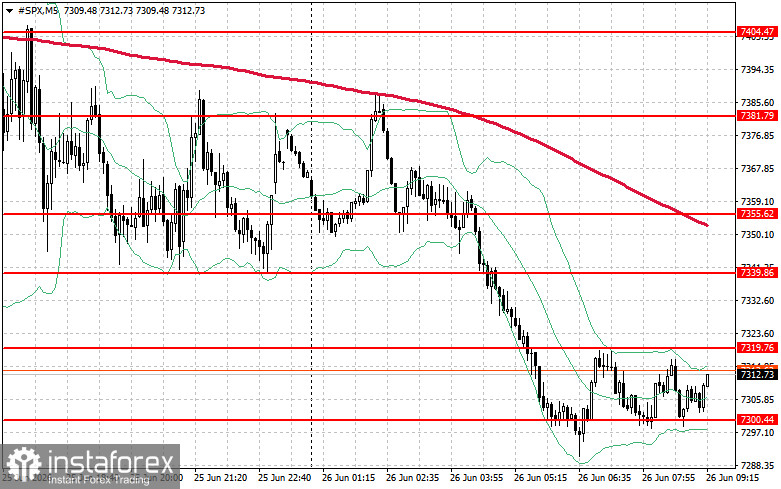
Technically, the S&P 500 analysis suggests that the immediate task for buyers is to overcome the resistance level of $7,319. Doing so would confirm upside and open the path to $7,339. Maintaining control above $7,355 would further strengthen buyers' positions. On the downside, buyers need to defend $7,300. A break below that level would likely push the index back to $7,279 and open the way to $7,256.
*এখানে পোস্ট করা মার্কেট বিশ্লেষণ আপনার সচেতনতা বৃদ্ধির জন্য প্রদান করা হয়, ট্রেড করার নির্দেশনা প্রদানের জন্য প্রদান করা হয় না।
ইন্সটাফরেক্স বিশ্লেষণমূলক পর্যালোচনাগুলো আপনাকে মার্কেট প্রবণতা সম্পর্কে পুরোপুরি সচেতন করবে! ইন্সটাফরেক্সের একজন গ্রাহক হওয়ায়, দক্ষ ট্রেডিং এর জন্য আপনাকে অনেক সেবা বিনামূল্যে প্রদান করা হয়।


