




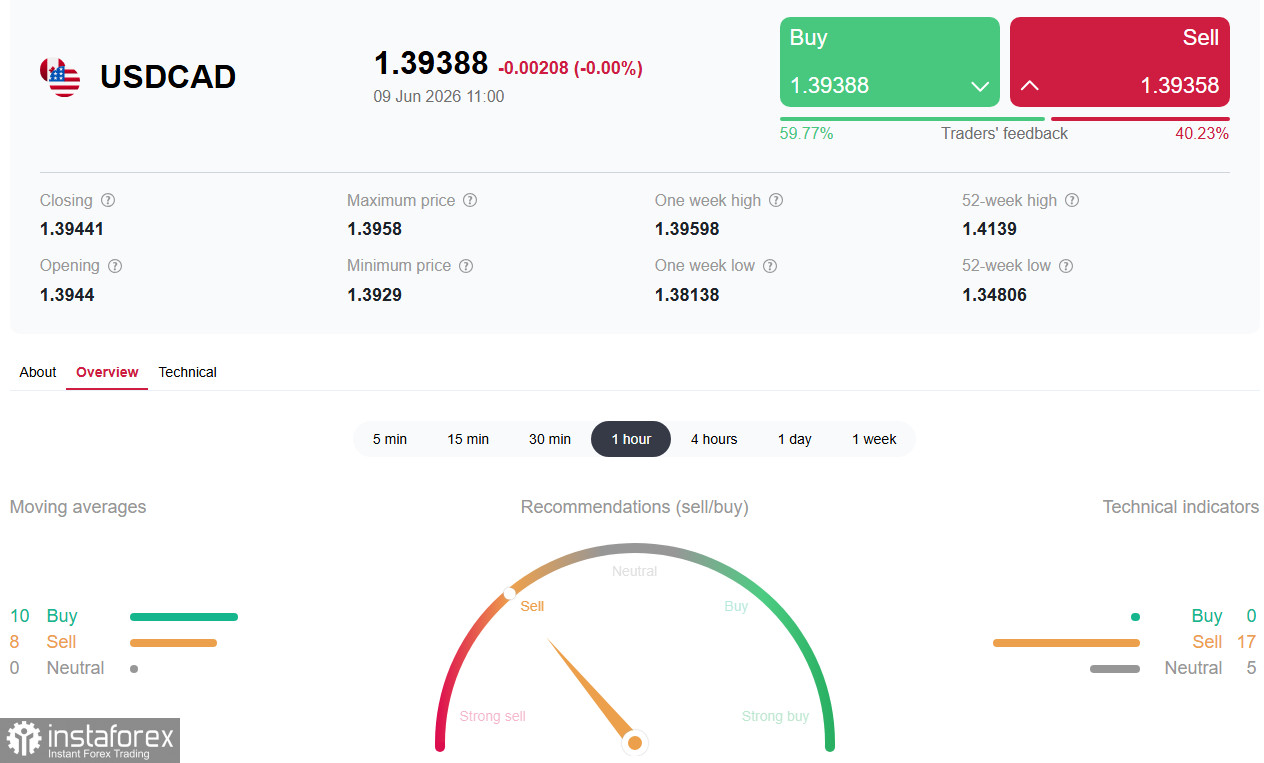
See also: InstaSpot trading indicators for USD/CAD.
The USD/CAD pair continues to attract traders' attention, showing a rare mix of opposing forces. On the one hand, an aggressive Federal Reserve stance and geopolitical tensions are pushing the pair higher, testing multi-month highs. On the other hand, peace attempts in the Middle East and domestic problems in the Canadian economy are forcing the loonie to balance on a knife edge.
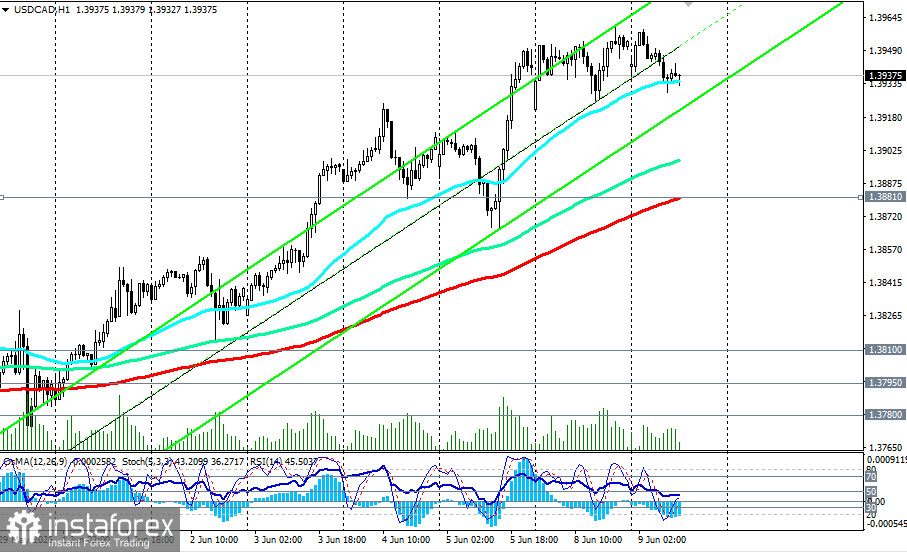
The first week of June closed on a major note for USD/CAD, with the pair updating two-month highs around 1.3950 and rising another ten pips on Monday to 1.3960. The combination of two powerful factors — a hawkish shock from US labor market data and rising Middle East tensions — hit the risk-sensitive Canadian dollar while strengthening the US dollar as a safe haven.
Yet the loonie has its own oil cushion that limits a deeper fall. As a result, the pair is in a state of tenuous equilibrium, trading just below the psychological 1.4000 level while awaiting key trigger—US inflation (CPI) data on Wednesday.
Fundamental background: double hit to CAD, triple support for USD
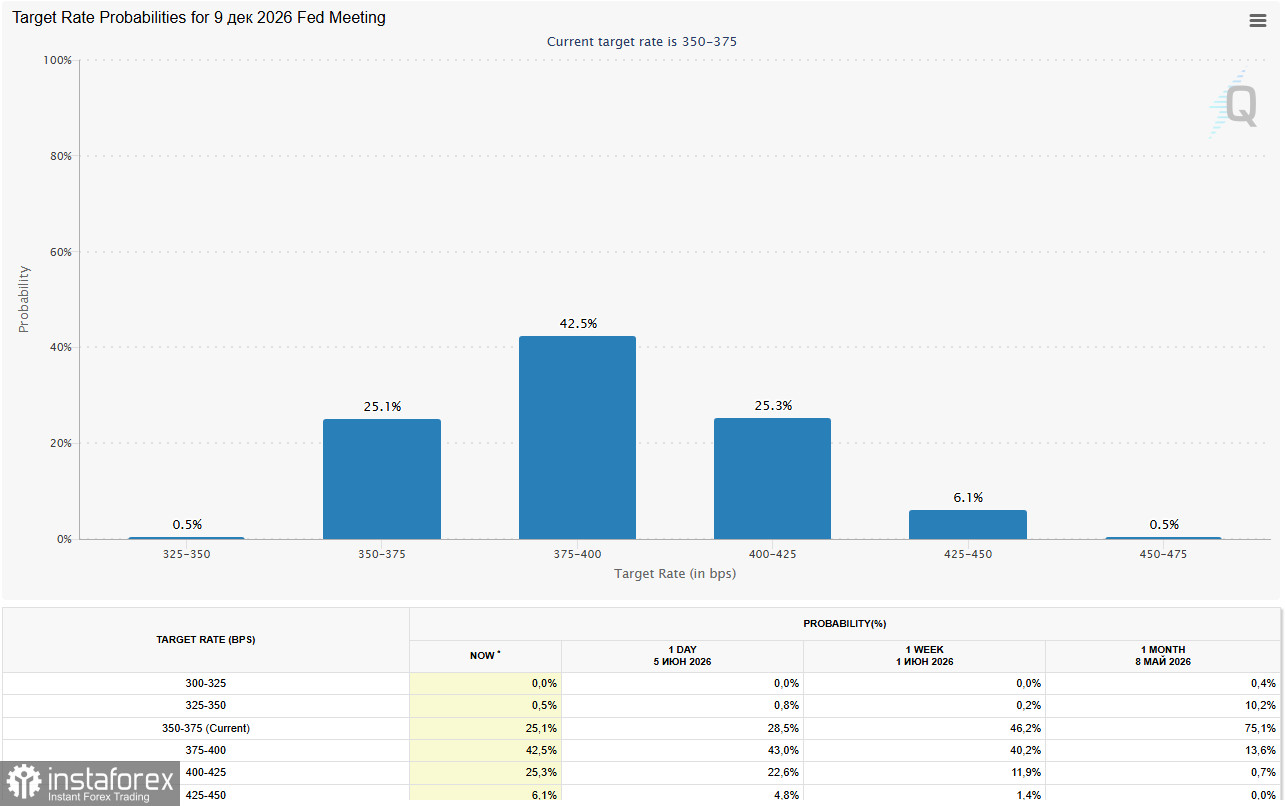
The main driver of the pair's rise was the shocking US nonfarm payrolls report for May. The US economy added 172,000 jobs (consensus 85,000), and revisions to the previous two months added 93,000 more jobs. This prompted a radical repricing of Fed rate expectations. According to CME FedWatch, the probability of at least one Fed rate hike by year-end jumped above 70% (from 45% a week earlier).
Ten-year US Treasury yields settled above 4.55%, and the dollar index (USDX) pushed toward 100.00, renewing two-month highs.
While the US dollar strengthens on hawkish expectations, the Canadian dollar remains vulnerable because the domestic economy unexpectedly slipped into recession and the Bank of Canada is giving dovish signals.
Key Canadian indicators
- GDP (Q1 2026) was -0.1% q/q versus a +1.5% forecast; Q4 contraction was revised to -1.0%—a technical recession is confirmed.
- Labor market: unemployment rose to 6.6% in May, although employment unexpectedly increased 0.4% m/m.
- Inflation remains slightly above the 2.0% target, at 2.8% y/y.
Geopolitical and commodity factor: oil swings
The weekend saw a fresh escalation in the Middle East. Israel and Iran exchanged direct missile strikes, and Yemeni Houthis attacked Israeli territory. That pushed crude prices up (WTI spiked to $94.80 per barrel), which paradoxically supported CAD while also strengthening the dollar as a safe haven.
By Tuesday morning, oil prices had corrected to $88–89 as hopes of a US-Iran deal resurfaced following statements from Trump about a "final stage" of talks. For Canada, a major oil exporter, a decline in crude is bearish for the loonie.
- Strong NFP (172k) — Upward pressure: probability of Fed hike rose above 70%.
- Escalation in Iran/Israel — Upward pressure: flight to the dollar as a safe haven.
- Hopes for a US-Iran deal — Downward pressure: weaker dollar demand, falling oil hurts CAD.
- Expectations of a Bank of Canada pause (June)—Upward pressure: markets price a 2.25% BoC rate to hold.
- Weak Canadian GDP (-0.1%) — Upward pressure: economy in recession limits BoC action.
- US CPI (Wednesday) — High volatility expected; forecast 4.2% y/y; strong prints could push the pair above 1.4000.
Brief technical analysis
Technically the price has closed above key moving averages on the daily and weekly charts, confirming a shift to a medium-term uptrend. Late last month the pair broke key resistance at 1.3795 (200-day EMA on the daily) and 1.3810 (50-week EMA) and is now approaching the psychologically important round level 1.4000.
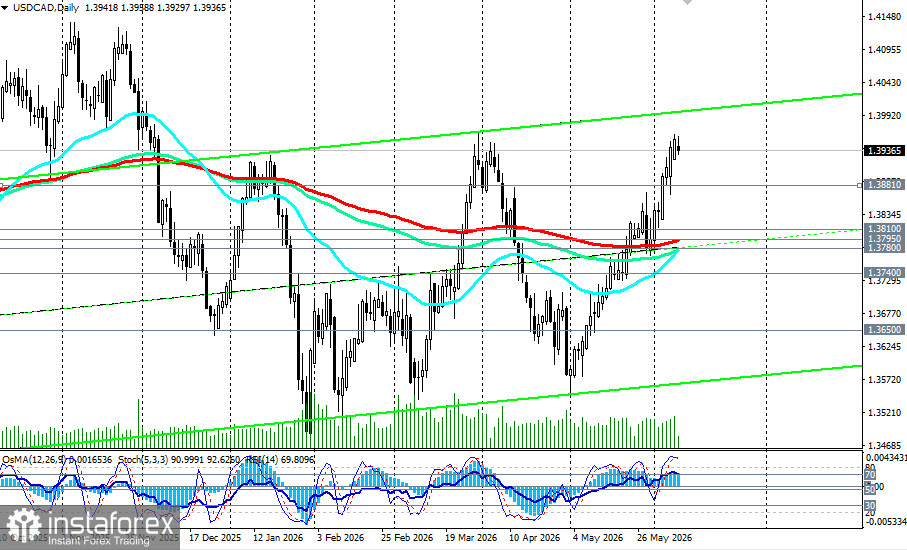
The 14-day RSI on the daily is near 70, indicating sustained upside momentum but close to overbought territory. On the 4-hour chart, the RSI (59) and Stochastic (exiting overbought and moving toward the sell zone) warn of a likely correction in the next one to two days. The OsMA on D1 is positive (+0.0085), but the histogram is contracting, indicating slowing momentum.
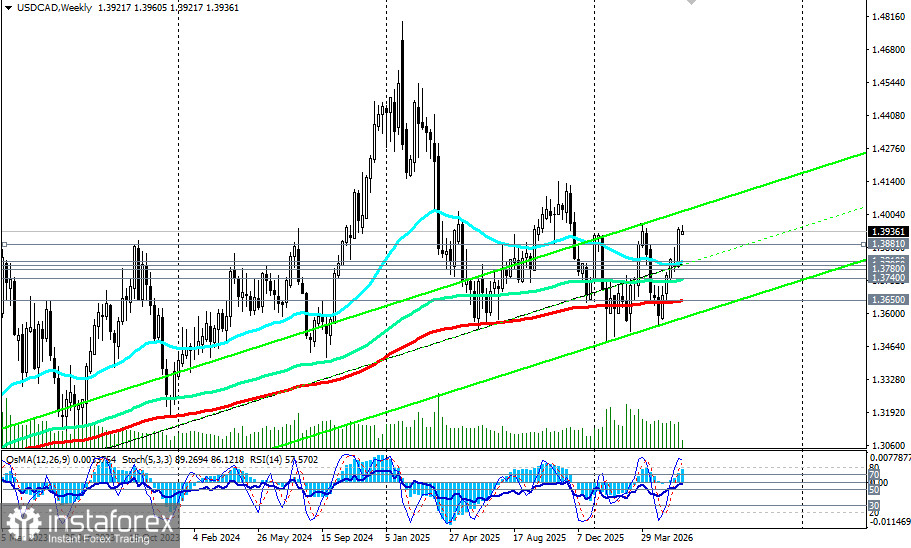
The nearest resistance levels: 1.3960 and 1.4000 (psychological), then 1.4130 (annual high, November 2025).
The nearest support levels: 1.3900 (central pivot), 1.3881 (200-hour EMA on H1), 1.3850 (Friday low), and 1.3780 (50-day EMA on D1).
Key events this week
- Wed, 10 June 12:30 GMT — US CPI (May). Forecast: 4.2% y/y (prev. 3.8%). Impact: strong print will push USD/CAD above 1.4000; weak print will trigger a correction.
- Wed, 10 June 13:45 GMT — Bank of Canada rate decision. Expected: 2.25% (no change). A dovish signal will boost the pair; an unexpected hike will sharply lower USD/CAD.
- Thu, 11 June 12:30 GMT — US PPI. Secondary inflation indicator: the data may reinforce or weaken the trend after CPI.
- Thu, 11 June 12:15 GMT — ECB rate decision and Lagarde press conference. Expected: hike to 2.40%. The data may affect USD via EUR crosses.
Conclusion
USD/CAD sits at the epicenter of an "ideal storm" for the Canadian dollar, with an important caveat. On one side, a hawkish Fed pivot (probability of a Fed hike rose to ~70%) and a dollar rally to 100.00 on the USDX create strong tailwinds for USD. On the other hand, the Bank of Canada pause expectations (economists warn that market pricing for a 50-bp BoC move in the next 12 months looks aggressive given the weak economy) and Canada's unexpected recession (GDP -0.1% q/q) remove internal support for the loonie.
High oil prices and a geopolitical premium continue to support the Canadian dollar, preventing a sharp USD/CAD plunge.
The key zone 1.3850–1.4050 will be the battlefield over the coming days. A technical break below 1.3850 would open the way to 1.3800–1.3780 and 1.3650 (200-week EMA), while a sustained close above 1.4000 could trigger a move to 1.4130.
Priority in the current setup is to short near the upper range boundary 1.3960–1.4000, especially if CPI does not confirm accelerating inflation in the US; conversely, take long positions if US inflation confirms acceleration. Traders should exercise extreme caution: Wednesday will be a decisive macro test driven by two powerful factors — US CPI and the Bank of Canada decision.
*এখানে পোস্ট করা মার্কেট বিশ্লেষণ আপনার সচেতনতা বৃদ্ধির জন্য প্রদান করা হয়, ট্রেড করার নির্দেশনা প্রদানের জন্য প্রদান করা হয় না।
ইন্সটাফরেক্স বিশ্লেষণমূলক পর্যালোচনাগুলো আপনাকে মার্কেট প্রবণতা সম্পর্কে পুরোপুরি সচেতন করবে! ইন্সটাফরেক্সের একজন গ্রাহক হওয়ায়, দক্ষ ট্রেডিং এর জন্য আপনাকে অনেক সেবা বিনামূল্যে প্রদান করা হয়।