




The legend in the InstaSpot team!
Legend! You think that's bombastic rhetoric? But how should we call a man, who became the first Asian to win the junior world chess championship at 18 and who became the first Indian Grandmaster at 19? That was the start of a hard path to the World Champion title for Viswanathan Anand, the man who became a part of history of chess forever. Now one more legend in the InstaSpot team!





Borussia is one of the most titled football clubs in Germany, which has repeatedly proved to fans: the spirit of competition and leadership will certainly lead to success. Trade in the same way that sports professionals play the game: confidently and actively. Keep a "pass" from Borussia FC and be in the lead with InstaSpot!

The ISM services activity index for the US rose to 55.4 points in August from 54.1 in July, according to the Institute for Supply Management. Expansion has now continued for the twenty-sixth consecutive month. The business activity index jumped to 61.7 from 59.1, marking the highest level since November 2022, while new orders surged to 60.9 from 57.2 — the strongest reading since February 2023. By every demand metric, US services are enjoying their best period in more than three years.

However, inside this impressive report are two indicators that completely change its interpretation. The employment index came in at 47.8 and remained in contraction for a second month, having been below 50 in thirteen of the last eighteen months. The price index rose to 72.6 from 70.3, exceeding the 70 threshold for the fifth time in six months and reaching its highest level since August 2022. Demand at multi-year highs, hiring in negative territory, and prices at a four-year peak — I consider that combination the most worrying development in recent US economic data.
The report names the cause of price pressure very specifically, and it takes us back to the Strait of Hormuz. After six categories of goods became cheaper in July, their number fell to a single category in August: fuel — which, for the seventh consecutive month, appeared among the rising items. Petroleum products, diesel, and gasoline were again reported as higher in price, and tariffs plus the Middle East conflict have returned to the list of major supply-chain problems.
The causal chain then unfolds via corporate margins to the labor market. Higher fuel prices pushed up transport and operating costs; companies faced margin pressure, and instead of hiring amid rising demand, they began to accumulate backlogs. Companies benefit from this arrangement because margins are protected; workers and ultimately consumers lose out, since services take longer to deliver and cost more.
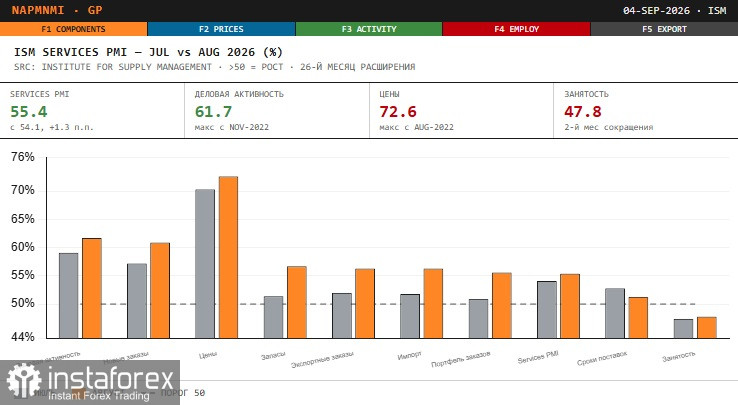
Does this mean the services labor market is turning toward layoffs? In my view, rather the opposite, and the report contains an argument for a turnaround. The share of firms cutting staff fell from 19% in July to 17.1% in August, and the report itself notes that business activity and new orders at multi-year highs may signal a shift toward rising employment. The logic is simple: order backlogs cannot be accumulated forever, and sooner or later companies will have to choose between hiring and losing customers.
The sectoral picture confirms that the current upswing is largely seasonal and therefore not guaranteed to persist into autumn. Twelve industries showed expansion versus thirteen a month earlier, while five contracted versus four. Among the five fastest-growing sectors were accommodation & food services and arts, entertainment & recreation, which can be directly explained by summer seasonality. Lagging were agriculture, construction, management of companies, finance & insurance, and health care & social assistance.
I will single out construction, where a respondent's comment explains the problem more clearly than any statistic. The bond market pushed 30-year mortgage rates up to 6.67%, reducing housing affordability and putting potential buyers on the sidelines; discounts have become the norm. Here I see a direct link to Kevin Warsh's remarks at Jackson Hole, where he argued that financial conditions are not restrictive. For builders, however, conditions are very restrictive because the market has essentially frozen, and this is a case where the Fed chair's broad formulation diverges from reality in a specific sector.
Another interesting detail: the investment boom around artificial intelligence, which Warsh called the main driver of capital spending, is beginning to create physical shortages of components and thus to feed cost inflation in industries unrelated to AI.
I view this report as an argument in favor of a September rate hike by the Fed, and here's why. The 12-month average of the price index rose to 68.5, the highest since April 2023, increasing for the eighth month in a row, while the manufacturing ISM earlier showed 71.1 on the same metric. Price pressure is broad, persistent and not confined to a single sector. I believe the Federal Reserve will raise interest rates by a quarter point on September 15–16, and the market's roughly 70 probability looks fair. The main risk to this forecast is today's employment report: after ADP's August reading of just 38,000 jobs, a weak Bureau of Labor Statistics print could bring the committee's debate back to square one. But even with weak employment, a prices index at 72.6 will not allow the dovish wing to claim victory over inflation.
Technically, for EUR/USD, buyers' key task is to hold above 1.1641 — only that would open the way to test 1.1657. From there, the currency pair can reach 1.1673, but without participation from major players, such a move looks unlikely. On the downside, I expect serious buying only around 1.1621. If demand does not appear there, it would be wiser to wait for a new low at 1.1601 or to consider longs from 1.1584.
For GBP/USD, the technical picture centers on nearby resistance at 1.3545, which pound buyers must first take. Only then can the pair target 1.3573, above which further gains will likely be difficult; the more distant target is 1.3596. On the downside, bears will try to seize control of 1.3521. If they succeed, a range break would deal a significant blow to bulls and, in my view, push the currency pair to 1.3501 with a prospect of reaching 1.3480.
*Analiza tržišta koja se ovde nalazi namenjena je boljem razumevanju tržišta i ne pruža instrukcije za vršenje trgovanja.
Uz InstaSpot-ove analitičke preglede uvek ćete biti u toku sa tržišnim trendovima! Klijentima InstaSpot-a su dostupni mnogobrojni besplatni servisi za uspešno trgovanje.


