




Today, during the first half of the day, the US dollar once again remained dominant against the euro and the pound, and the morning brought no change to this pattern, although both currencies experienced some local volatility spikes.

For the eurozone, the main event was Germany's September IFO Business Climate Index, which rose to 89.9 points from 88.8 in August, continuing its recovery for the fourth consecutive month. The services sector returned to positive territory, while expectations in the industrial sector also improved, although retailers remain cautious amid rising inflation. The euro initially rose in response to the release, but the move was short-lived: the market quickly reversed and resumed its decline, as the strength of the dollar, supported by strong US data and hawkish Fed rhetoric, has continued to outweigh even positive surprises from the eurozone for the second consecutive day. The backdrop from yesterday should also be taken into account: the eurozone's preliminary composite PMI for September rose to 53.1 points from 52.0 in August, reaching a multi-year high, while Germany and France posted their strongest growth rates in a long time. In other words, today's IFO data are not an isolated development but rather a continuation of the improvement already underway, which the market is nevertheless continuing to largely ignore.
In the UK, the data were clearly weak. The CBI Distributive Trades Survey retail sales balance for September was -55, compared with expectations of -42 and an August reading of -48, meaning that the deterioration was significantly sharper than the market had anticipated. Before the release, the pound had managed to make a small upward correction, but it quickly resumed its decline afterward: such weak retail sales only confirmed the continued weakness of consumer demand in the UK economy. This adds to the picture already seen yesterday, when the UK's composite PMI fell to 51.7 from 52.5, retreating to a three-month low, while the pound's decline has continued for the second consecutive day with virtually no interruption.
Only two US indicators will be released this afternoon: initial jobless claims, which are expected to rise to 201,000, and New Home Sales. Both figures are technically important but not decisive: jobless claims remain within the familiar range of 203,000–206,000, indicating a resilient labor market, while New Home Sales had previously declined to 607,000 on an annualized basis from 678,000 a month earlier, and further developments could provide important information about the state of the housing sector amid mortgage rates above 6.6%.
More important than the data themselves will be speeches by three Fed officials—Thomas Barkin, Beth Hammack, and John Williams. It is worth recalling their previous rhetoric: Barkin previously warned that the current period of persistent inflation would inevitably have consequences, although he could not say when; Hammack voted against a pause as recently as July, calling for an immediate rate hike; while Williams has traditionally taken a much more cautious tone, pointing to the slow decline in inflation and focusing on a neutral rate of around 1%. If all three support further tightening today, this would represent a notable shift even for the relatively dovish Williams, and such rhetoric could provide the dollar with additional momentum against both currencies.
For EUR/USD, this means continued pressure against the backdrop of the ECB's already more restrained tone, while the situation for GBP/USD looks even more vulnerable, given the pound's complete lack of strong domestic drivers in the coming days.
Momentum
For the euro, the key level on the upside is 1.1392, a break above which could take the pair to 1.1414 and then 1.1433. Such a scenario is realistic only if today's Fed speakers are genuinely disappointing—the strength of the IFO data alone is clearly insufficient, given that the market already ignored a similar positive development yesterday. I consider a break below 1.1373 toward targets of 1.1355 and 1.1335 to be the more likely setup, as Fed rhetoric continues to outweigh any positive European surprises.
For the pound, the key level on the upside is 1.3252, above which the pair could reach 1.3284 and then 1.3313, but following today's sharp decline in CBI retail sales, such a move appears unlikely without a clear interruption in the dollar's advance. A break below 1.3220 toward targets of 1.3189 and 1.3150 fits the current picture much better, especially given that UK economic data have weakened for the second consecutive day.
Mean Reversion
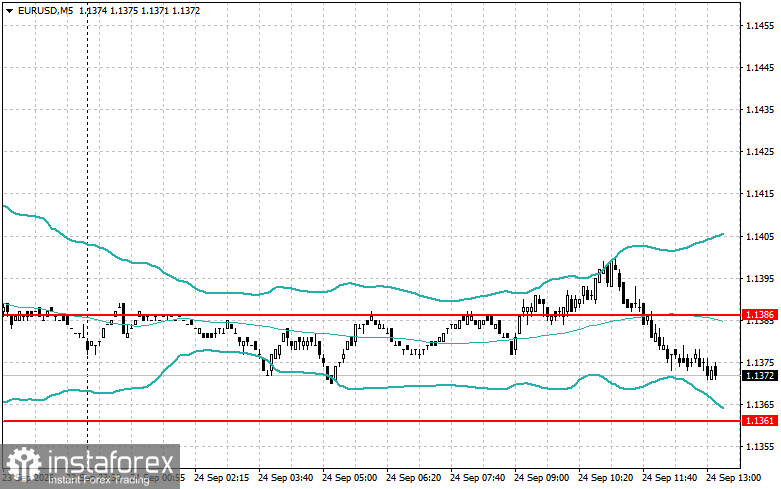
For the euro, I am watching the upper boundary at 1.1386. The logic is straightforward: the pair attempts to move above this level, but buyers fail to sustain the upward movement, and the price moves back down—providing a sell signal. Even taking the strong IFO data into account, this scenario remains appropriate while the market clearly prefers to ignore positive developments in Germany. The lower reference level of 1.1361 works according to the opposite logic, but buying here should be approached with caution: the strength of Germany's business climate alone is not enough to reverse the overall market sentiment, and it is reasonable to keep the target for such a trade modest.
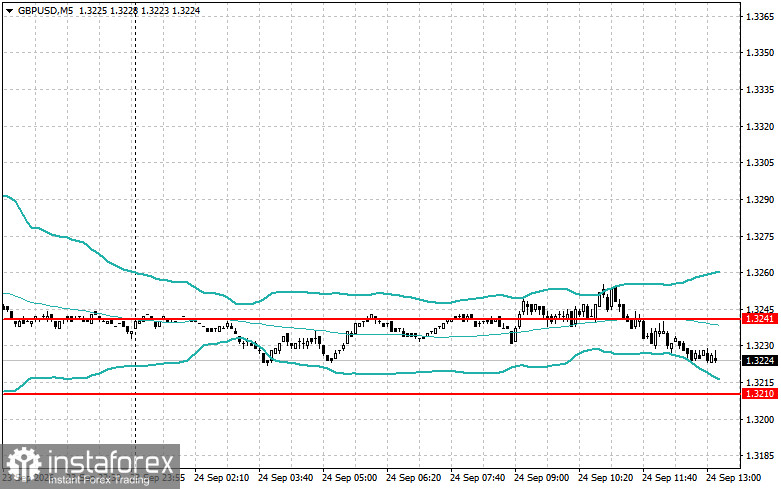
For the pound, the upper boundary is 1.3241. The same reversal pattern applies here, and given today's sharp decline in retail sales, a false break above the level followed by a quick return inside the range appears to be a plausible scenario. The lower reference level of 1.3210 implies buying on a rebound after a false break below the level, but this setup should be traded with caution—weak consumer demand in the UK does not support a sustained reversal, and any rebound here is more appropriately viewed as a purely technical move rather than the beginning of a trend reversal.
*تعینات کیا مراد ہے مارکیٹ کے تجزیات یہاں ارسال کیے جاتے ہیں جس کا مقصد آپ کی بیداری بڑھانا ہے، لیکن تجارت کرنے کے لئے ہدایات دینا نہیں.
InstaSpot analytical reviews will make you fully aware of market trends! Being an InstaSpot client, you are provided with a large number of free services for efficient trading.