




Bitcoin and Ethereum gained significantly yesterday. Bitcoin was primarily driven by large wallets, but there were also purchases of Ethereum by big players, as evidenced by small inflows into spot ETFs.

While traders and investors are focused on accumulating and increasing profits, interesting reports on cryptocurrency taxes in various countries have caught attention. The global cryptocurrency taxation map demonstrates a colossal disparity in approaches, ranging from a complete absence of tax to nearly confiscatory rates. This difference is explained not so much by economic logic as by national strategies for attracting capital. The UAE takes the most liberal stance with a zero rate; Singapore has no capital gains tax; Switzerland exempts private investors; and Hong Kong generally has zero rates for investors. This group also includes Malaysia, Slovenia, and most Gulf countries, including Saudi Arabia, Qatar, Bahrain, Kuwait, and Oman, where crypto assets are typically not taxed at all. These jurisdictions purposefully turn the absence of tax into a tool for competition for capital and industry specialists.
A separate and largely more pragmatic category consists of countries with holding period incentives, where the state encourages long-term investing rather than speculative trading. Germany and Portugal exempt taxes after one year and 365 days of ownership, respectively; Luxembourg reduces it to six months, while Belgium and Malta allow for a zero-rate regime under certain conditions. The Czech Republic requires a much longer holding period of three years, making the incentive available only to truly patient investors. Moderate rates from 10% to 27.5% are typical for Russia, Hungary, Nigeria, Kosovo, Norway, Lithuania, Latvia, and Austria, with Russia having a range of 13-15% appearing relatively lenient in this context, especially considering that the basic law regulating the crypto market in the country will come into effect only on September 1 and the issue of granting crypto exchanges tax agent functions is also being discussed.
The US applies a range of 0% to 20% depending on the holding period of the asset; the UK taxes capital gains at 18-24%; and continental Europe, represented by Spain, Italy, and France, sets noticeably higher thresholds, up to 33%. The most stringent regimes are concentrated in Asia and Northern Europe: Japan taxes crypto income up to 55%, Denmark up to 52%, and India applies a fixed rate of 30% plus an additional 1% withholding on each transaction, making it one of the most demanding jurisdictions for traders.
As for short-term trading, the strategy and conditions are described below.
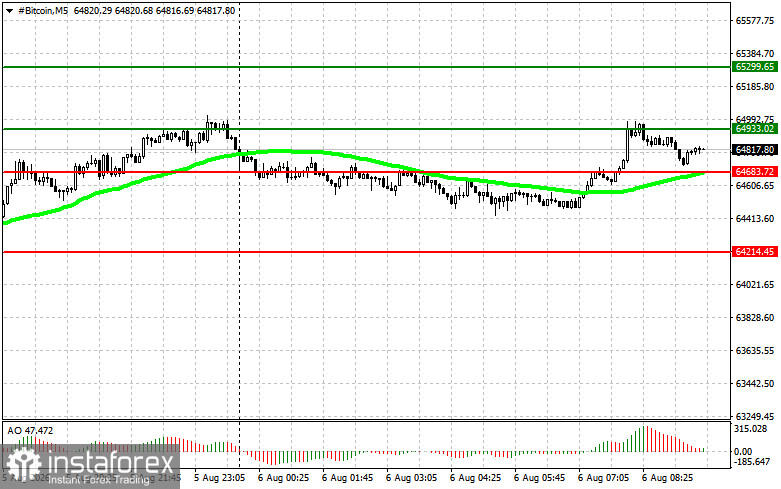
Scenario No. 1: I plan to buy Bitcoin today when the entry point is reached around $64,900, targeting a rise to $65,300. Around $65,300, I will exit the buy positions and sell immediately for a rebound. Before buying on a breakout, ensure that the 50-day moving average is below the current price and the Awesome indicator is in the zone above zero.
Scenario No. 2: Buying Bitcoin can be done from the lower boundary of $64,600 if there is no market reaction to its breakout in the opposite direction to levels of $64,900 and $65,300.
Scenario No. 1: I plan to sell Bitcoin today when the entry point is reached around $64,600, targeting a fall to $64,200. Around $64,200 I will exit the sell positions and buy immediately for a rebound. Before selling on a breakout, ensure that the 50-day moving average is above the current price and the Awesome indicator is in the zone below zero.
Scenario No. 2: Selling Bitcoin can be done from the upper boundary of $64,900 if there is no market reaction to its breakout in the opposite direction to levels of $64,600 and $64,200.
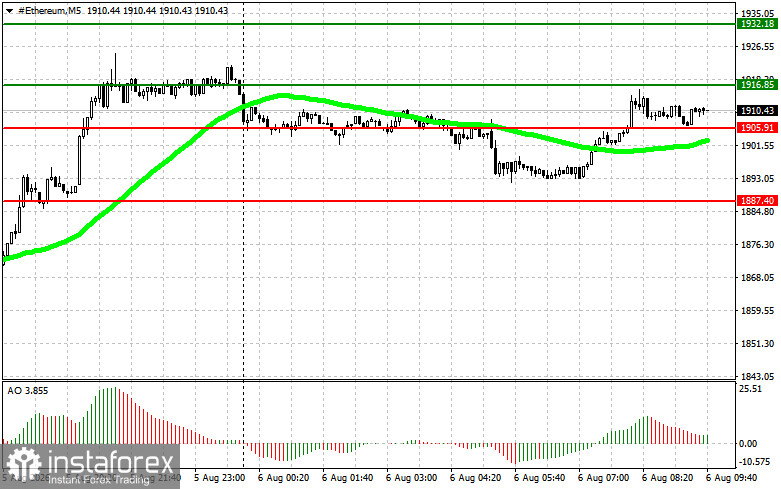
Scenario No. 1: I plan to buy Ethereum today when the entry point is reached around $1,916, targeting a rise to $1,932. Around $1,932, I will exit the buy positions and sell immediately for a rebound. Before buying on a breakout, ensure that the 50-day moving average is below the current price and the Awesome indicator is in the zone above zero.
Scenario No. 2: Buying Ethereum can be done from the lower boundary of $1,905 if there is no market reaction to its breakout in the opposite direction to levels of $1,916 and $1,932.
Scenario No. 1: I plan to sell Ethereum today when the entry point is reached around $1,905, targeting a fall to $1,887. Around $1,887, I will exit the sell positions and buy immediately for a rebound. Before selling on a breakout, ensure that the 50-day moving average is above the current price and the Awesome indicator is in the zone below zero.
Scenario No. 2: Selling Ethereum can be done from the upper boundary of $1,916 if there is no market reaction to its breakout in the opposite direction to levels of $1,905 and $1,887.
*تعینات کیا مراد ہے مارکیٹ کے تجزیات یہاں ارسال کیے جاتے ہیں جس کا مقصد آپ کی بیداری بڑھانا ہے، لیکن تجارت کرنے کے لئے ہدایات دینا نہیں.
InstaSpot analytical reviews will make you fully aware of market trends! Being an InstaSpot client, you are provided with a large number of free services for efficient trading.