Thursday began calmly, but the market backdrop is heating up. The euro spent yesterday in a sideways channel and now stands around 1.1243 after briefly rising to 1.1256 in the morning and failing to hold. The pound is holding near 1.3395; it reached 1.3408 in the morning but then fell back. Against this backdrop, the dollar showed neither strong strength nor noticeable weakness.
U.S. data yesterday gave the market no serious reason to move, but news from the Middle East remained negative. Iranian journalists reported that aircraft were being evacuated from Al-Udeid airbase in Qatar. Reports also say U.S. military and diplomats are secretly leaving the region. Iran itself expects an attack from the U.S. and Israel and views Washington's diplomatic gestures as insincere. For a beginner, the simple takeaway is this: such news usually nudges traders to be cautious, and when they do, the dollar, as a safe-haven currency, gets support. But the sideways market shows traders are not yet ready to draw conclusions and are waiting for confirmations. I expect that, without a sharp escalation, the euro will hold within the channel and eventually try to break out upward, while a real deterioration in the situation would easily derail that scenario.
The pound strengthened yesterday after UK inflation, which increased fears of a Bank of England rate hike at the nearest meeting. Consumer prices rose 3.5% year-on-year versus a 3.4% forecast, and 0.4% month-on-month versus 0.3% forecast. More importantly, the core index, excluding volatile components, accelerated to 2.8% versus a 2.7% forecast. This shows that price pressure has deeply penetrated the economy, and the central bank will find it difficult to remain on hold. Producer prices also looked worrying: input prices rose 8.3% year-on-year versus 7.2% forecast, output prices 4.6% versus 4.3% forecast. Such cost growth usually eventually passes through to consumer prices. U.S. data that could reverse sentiment usually arrives in the second half of the day, but yesterday there were none. Without U.S. figures, sellers of the pound had no arguments and GBP/USD kept its gain. I believe the market prices in the possibility of a rate hike, so the pound will have support, and a reversal will require weak UK data or a strong dollar impulse.
What to expect today? Only the October consumer-confidence indicator is due in European reports. Analysts forecast -17.0 points after -16.5 last month — a slight deterioration in sentiment. Such a figure is unlikely to materially change the balance, since deviations from forecasts here are usually small and the market is already living by other stories. Attention will shift to U.S. Treasury yields and the Middle East. These two factors will determine where the dollar goes, and therefore EUR/USD. If yields rise, the pair will feel pressure; if yields fall, the euro will have room to gain. Without fresh European data, any confident move will most likely originate outside Europe.
In the UK, the Confederation of British Industry's industrial orders balance for October will be released in the first half of the day. Analysts expect -20 points versus -9 last month. Hence, a noticeable deterioration is forecast. By comparison, total orders were -25% in August, so the market is already used to weak readings from this report. It is unlikely to trigger a strong move. Then Bank of England Governor Andrew Bailey will speak. His remarks yesterday had no impact on GBP/USD, and this is not the first time. In September he spoke about central-bank independence, and on October 14 he talked about social networks — in both cases the pound had nothing to latch onto. As long as Bailey does not touch on rates, the market remains indifferent. I think the pair is unlikely to react today unless the governor gives clear hints about the near decision.
For the euro, the main references are 1.1259 above and 1.1233 below. The price at 1.1243 sits almost in the middle — 16 pips below the top level and 10 pips above the bottom — and such a narrow range calls for caution. The morning high near 1.1256 missed 1.1259 by only three pips, then fell back, so I don't count the first touch as a confirmed breakout. I consider long positions only after a confident close above 1.1259; then targets are 1.1298 and 1.1336. I view that scenario as slightly more likely while there is no escalation. Short positions below 1.1233, targeting 1.1207 and 1.1183, will require Middle East news or a rise in yields. Most likely, until European policymakers speak, the pair will continue to trade inside the narrow channel.
For the pound, buy above 1.3405 with targets 1.3437 and 1.3467; sell below 1.3365 with targets 1.3335 and 1.3303. The price at 1.3395 stands ten pips under the upper level. In the morning, sterling poked above 1.3405, reached 1.3408, and fell back, so the first touch proved nothing. If Bailey talks about rates and industrial orders don't spook the market, I'll consider an upside breakout. The lower level 1.3365 is far — about 30 pips — and sells from there are needed only if the dollar receives a strong impulse.
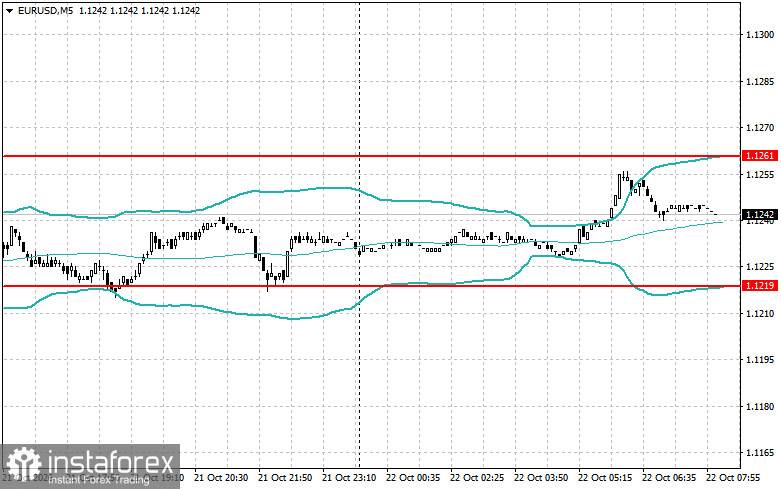
For the euro, the mean-reversion levels are 1.1261 and 1.1219. The upper level, 1.1261, is only two pips above the breakout buy at 1.1259, so a beginner must exercise particular caution. Two pips in the market is just noise. If price moves above 1.1259 to 1.1261 and quickly falls back, I think about selling—and the morning retracement from 1.1256 showed that character. If it holds above 1.1261, that is a confirmed breakout and selling is not allowed. The lower level, 1.1219, lies 14 pips below the breakout sell at 1.1233. Here, I expect that after a breakdown, price will reach 1.1219, fail to hold, and return above 1.1233—then longs with a stop under the false-break low are appropriate. If it closes below, the reversal failed.
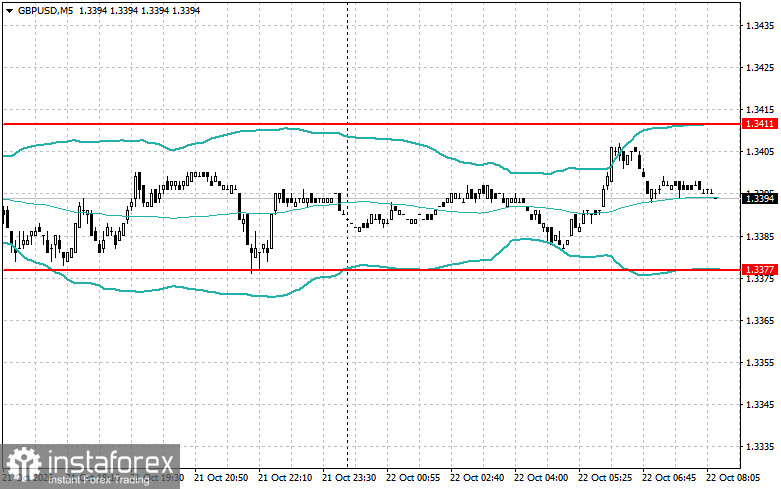
For the pound, the mean-reversion levels are 1.3411 and 1.3377. The upper level is six pips above the breakout buy at 1.3405. The morning high of 1.3408 did not reach it, so the mean-reversion scenario has not yet been tested. If the price breaks above 1.3405, reaches 1.3411 and quickly falls back, I consider selling. If it holds above 1.3411, selling is not allowed — that is a breakout. The lower level, 1.3377, sits 12 pips above the breakout sell at 1.3365, i.e., between the current price and the lower boundary. Here I expect the price to dip below 1.3377, fail to hold, and return above — then I look for longs with a stop under the false-break low. If the price holds below 1.3377 and reaches 1.3365, the mean reversion failed, and attention shifts to the breakout-sell target at 1.3335.
*The market analysis posted here is meant to increase your awareness, but not to give instructions to make a trade.
InstaSpot analytical reviews will make you fully aware of market trends! Being an InstaSpot client, you are provided with a large number of free services for efficient trading.