




The legend in the InstaSpot team!
Legend! You think that's bombastic rhetoric? But how should we call a man, who became the first Asian to win the junior world chess championship at 18 and who became the first Indian Grandmaster at 19? That was the start of a hard path to the World Champion title for Viswanathan Anand, the man who became a part of history of chess forever. Now one more legend in the InstaSpot team!





Borussia is one of the most titled football clubs in Germany, which has repeatedly proved to fans: the spirit of competition and leadership will certainly lead to success. Trade in the same way that sports professionals play the game: confidently and actively. Keep a "pass" from Borussia FC and be in the lead with InstaSpot!

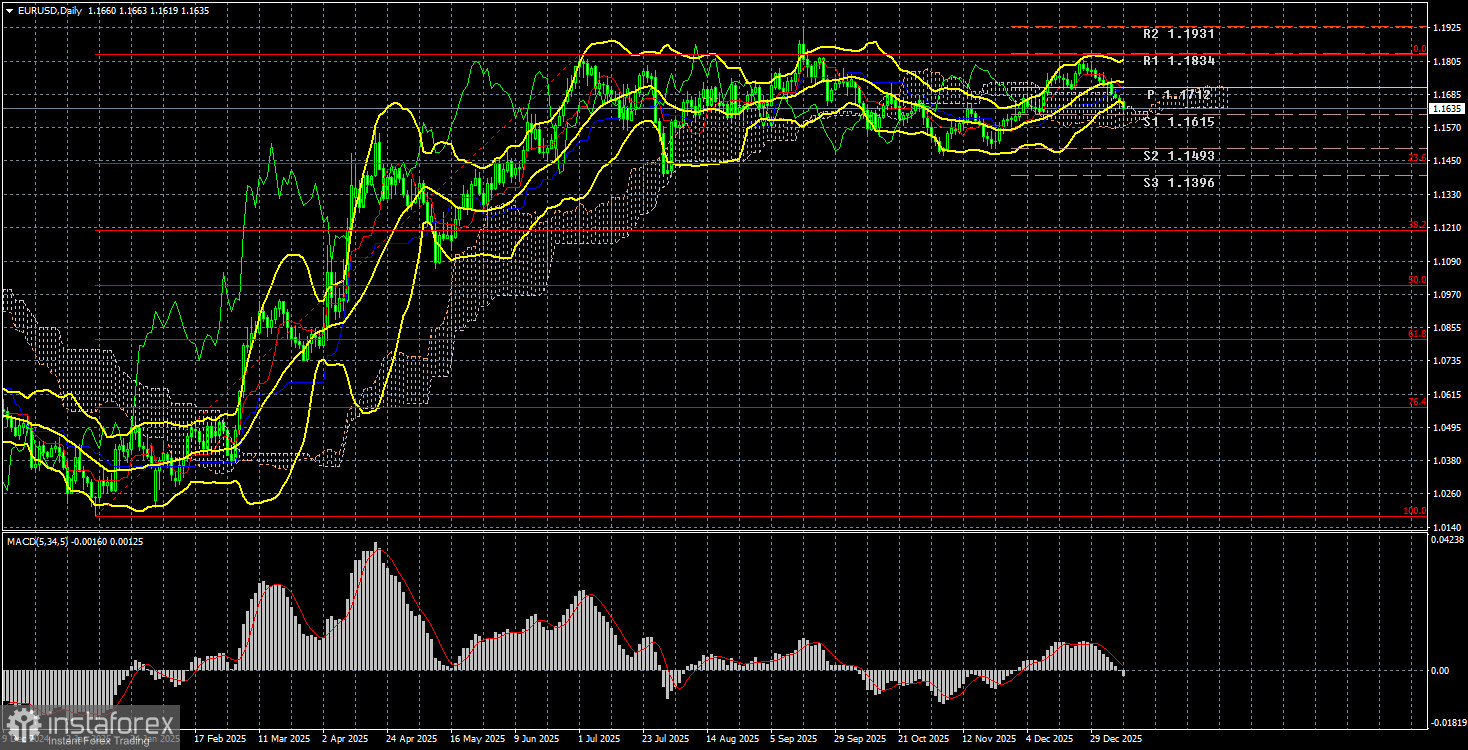
The EUR/USD currency pair lost 90 pips over the past week. That is, the US dollar rose by almost 1 cent against the euro. Is this logical? Is it fair? We believe it is — but not because of geopolitics, belligerent actions and threats by Donald Trump, or any "hidden positive" in US macroeconomic data.
We still consider that under Trump, the dollar cannot be regarded as a "safe-haven" asset. Recall that from 2008 to 2022, the US currency rose consistently. Over that period, the EUR/USD rate fell from 1.6 to 1.0. Thus, the "safe" dollar was not so much safe as profitable. Investors understood the dollar was appreciating, so it was profitable to buy it for any purpose. As a result, demand for it rose during any geopolitical conflict.
In 2022, the situation changed sharply. Inflation in the US reached multi-decade highs, and the Federal Reserve pushed the key rate to "super-restrictive" levels. As soon as inflation began to slow, the dollar fell as the market expected the Fed to ease monetary policy. Under the influence of an expected future rate cut, the dollar fell from $0.96 per euro to $1.11. Then Donald Trump became the US president for the second time.
In January 2025, the price dipped in a correction to $1.02, but Trump quickly closed that gap with a trade war that sharply reduced investors' willingness to hold dollars. 2026 began, and Trump decided not only to revise US trade terms with many countries but also to establish control over some of them. Venezuela, Mexico, Cuba, Iran, and even Greenland are now under threat. Protectionist policy is turning into a dictatorship. In our view, this will not end well for the dollar.
Overall, EUR/USD has been trading in a sideways channel between 1.1400 and 1.1830 for the past 6 months, and we believe this factor is driving price movement. Consider: the price reached the upper boundary of the sideways channel and began to fall. Logical? Yes. The amount and significance of the US macroeconomic backdrop last week were off the charts, but the volatility illustration below shows that, on average, the market traded 49 pips per day on those days. Why, if the market is buying the dollar on geopolitical tension, does the dollar rise so weakly, and why are there virtually no moves? Why did the most important macroeconomic information not trigger the usual 80–100 pip "flights"? Because of the flat, geopolitics and macroeconomics have almost no meaning right now.
If one analyzes the macroeconomic data, the dollar should rather have fallen than risen. But the market is flat, so technical factors come first. We believe the US currency may quietly continue to rise in the coming weeks, as the pair is likely to move toward the 1.1400 level (the lower boundary of the flat).
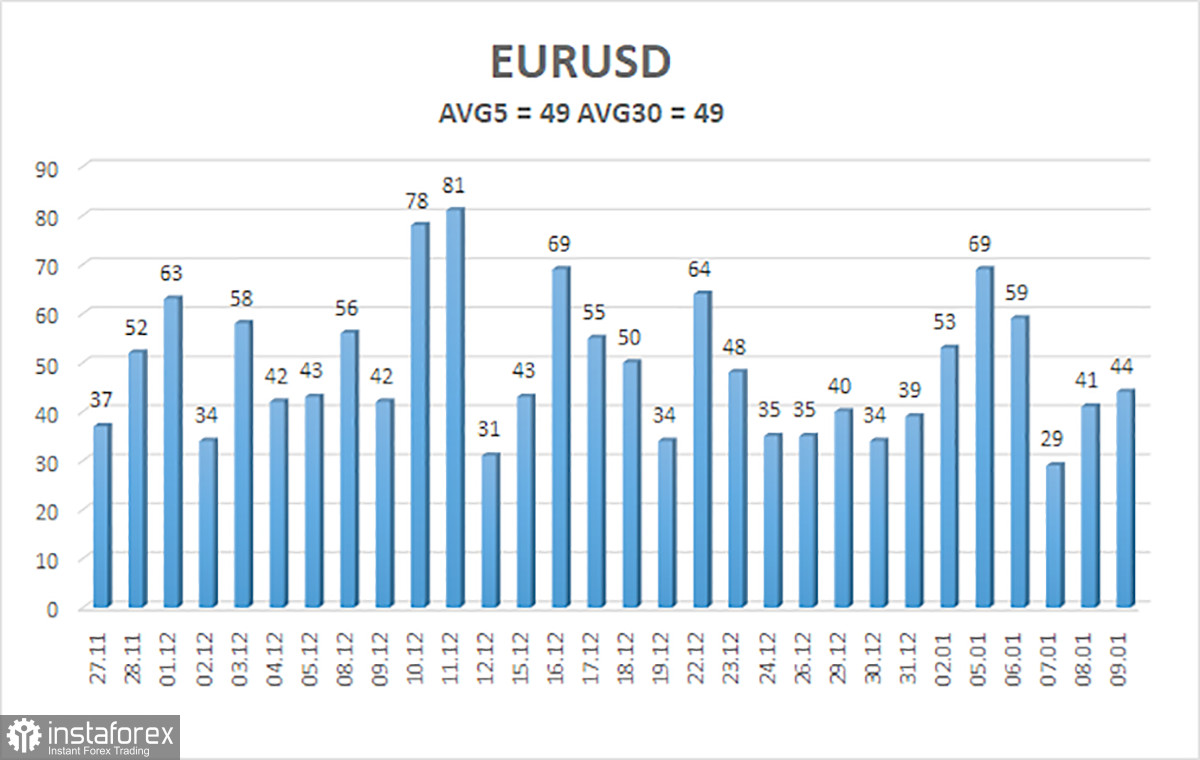
Average volatility of EUR/USD over the last 5 trading days as of January 12 is 49 pips and is characterized as "low." We expect the pair to move between 1.1586 and 1.1684 on Monday. The higher linear regression channel is pointing upward, but the daily timeframe is still range-bound. The CCI indicator has just formed a "bullish" divergence, indicating a resumption of the uptrend. However, the key point remains the flat on the daily timeframe.
S1 – 1.1658
S2 – 1.1597
S3 – 1.1536
R1 – 1.1719
R2 – 1.1780
R3 – 1.1841
The EUR/USD pair remains below the moving average, while on all higher timeframes the uptrend persists, and on the daily timeframe the flat continues for the sixth consecutive month. The global fundamental backdrop still matters greatly, and it remains negative for the dollar. Over the past six months, the dollar occasionally shown weak growth, but exclusively within the sideways channel. It has no fundamental basis for long-term strengthening. With the price below the moving average, small short positions can be considered on purely technical grounds, with targets at 1.1597 and 1.1586. Above the moving average, long positions remain relevant with a target of 1.1830 (the upper line of the daily flat), which has already effectively been tested and not overcome.
*The market analysis posted here is meant to increase your awareness, but not to give instructions to make a trade.
InstaSpot analytical reviews will make you fully aware of market trends! Being an InstaSpot client, you are provided with a large number of free services for efficient trading.


