




Kumpulan kami mempunyai lebih daripada 7,000,000 pedagang!
Setiap hari kami bekerjasama untuk meningkatkan perdagangan. Kami mendapat keputusan yang tinggi dan bergerak ke hadapan.
Pengiktirafan oleh berjuta-juta pedagang di seluruh dunia adalah penghargaan terbaik untuk kerja kami! Anda membuat pilihan anda dan kami akan melakukan segalanya yang diperlukan untuk memenuhi jangkaan anda!
Kami adalah kumpulan yang terbaik bersama!
InstaSpot. Berbangga bekerja untuk anda!





Pelakon, juara kejohanan UFC 6 dan seorang wira sebenar!
Lelaki yang membuat dirinya sendiri. Lelaki yang mengikut cara kami.
Rahsia di sebalik kejayaan Taktarov adalah pergerakan berterusan ke arah matlamat.
Dedahkan semua segi bakat anda!
Cari, cuba, gagal - tetapi tidak pernah berhenti!
InstaSpot. Kisah kejayaan anda bermula di sini!

Trade Review and Tips for Trading the Japanese Yen
The test of the 157.91 level occurred when the MACD indicator had already moved well above the zero line, limiting the pair's upward potential.
The market's attention will now shift to the upcoming batch of U.S. economic data, including the trade balance, the Job Openings and Labor Turnover Survey (JOLTS), and factory orders. Traders will carefully analyze each release to assess the current state of the U.S. economy and anticipate the Federal Reserve's next policy moves. An improving trade balance, for example, could indicate strengthening export performance, while a sharp increase in job openings combined with lower labor turnover is generally interpreted as a sign of a strong labor market, which could encourage the Fed to consider further monetary policy tightening. On the other hand, weak or unexpectedly disappointing factory orders could raise concerns about slowing manufacturing activity and, consequently, weaker overall economic growth.
The Japanese yen is likely to react to these releases through changes in the U.S.–Japan yield differential. Strong U.S. labor market data could push USD/JPY higher by increasing expectations for higher U.S. interest rates, while weaker-than-expected figures could trigger a decline in the pair.
As for my intraday strategy, I will primarily rely on the implementation of Scenario #1 and Scenario #2.
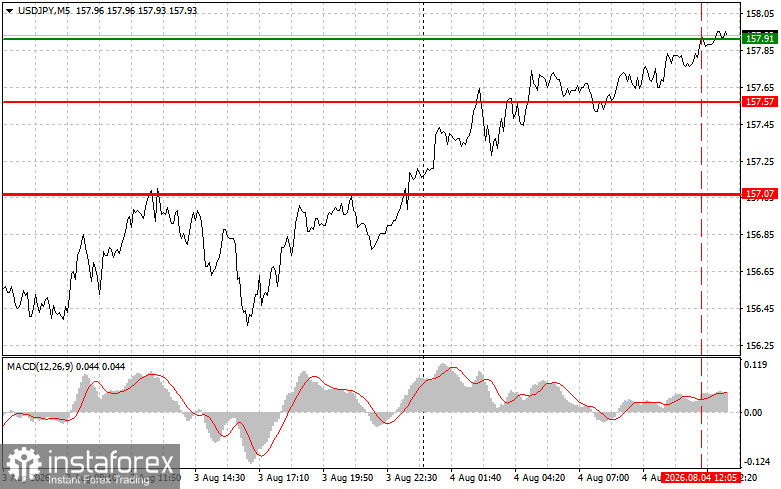
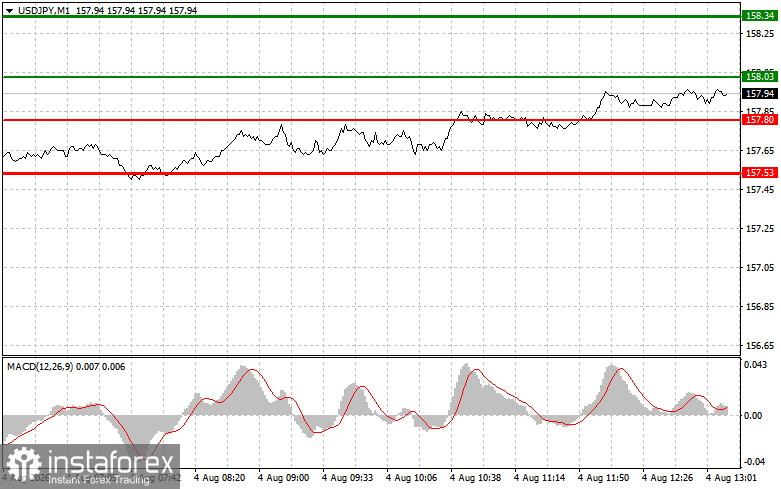
Scenario #1: Today, I plan to buy USD/JPY if the price reaches the entry level around 158.03 (green line on the chart), targeting a move to 158.34 (the thicker green line on the chart). At 158.34, I plan to close long positions and open short positions, expecting a 30–35 point pullback. A further rise in the pair is possible today, although any gains are likely to be limited.
Important: Before opening a long position, make sure the MACD indicator is above the zero line and is just beginning to move higher.
Scenario #2: I also plan to buy USD/JPY if the 157.80 level is tested twice consecutively while the MACD indicator is in oversold territory. This would limit the pair's downward potential and trigger a bullish reversal. In this case, a rise toward 158.03 and 158.34 can be expected.
Scenario #1: I plan to sell USD/JPY after the price breaks below 157.60 (red line on the chart), which is expected to trigger a rapid decline in the pair. The primary downward target is 157.53, where I plan to close short positions and immediately open long positions, expecting a 20–25 point rebound. Downward pressure on the pair is likely to return if the central bank intervenes.
Important: Before opening a short position, make sure the MACD indicator is below the zero line and is just beginning to move lower.
Scenario #2: I also plan to sell USD/JPY if the 158.03 level is tested twice consecutively while the MACD indicator is in overbought territory. This would limit the pair's upward potential and trigger a bearish reversal. In this case, a decline toward 157.80 and 157.53 can be expected.
Important: Beginner Forex traders should exercise great caution when making trading decisions. It is generally advisable to stay out of the market ahead of major fundamental releases to avoid sharp price swings. If you choose to trade during news releases, always use stop-loss orders to minimize potential losses. Trading without stop-loss orders can quickly result in the loss of your entire deposit, especially if you trade large position sizes without proper risk management.
Finally, remember that successful trading requires a clear trading plan, such as the one outlined above. Making spontaneous trading decisions based solely on current market conditions is generally a losing strategy for an intraday trader.
* Analisis pasaran yang disiarkan di sini adalah bertujuan untuk meningkatkan kesedaran anda, tetapi tidak untuk memberi arahan untuk membuat perdagangan.
Kajian analisis InstaSpot akan membuat anda mengetahui sepenuhnya aliran pasaran! Sebagai pelanggan InstaSpot, anda disediakan sejumlah besar perkhidmatan percuma untuk dagangan yang cekap.


