




The morning session was dominated by the US dollar. With no new data from the eurozone, the euro found little reason to attract buying interest, and EUR/USD continued to drift lower, while the pound attempted to recover some of its losses against the dollar but lacked sufficient momentum to sustain the move. Buyers are trying to halt the recent bearish sentiment, but for now this looks more like an attempt to test market strength than a reversal. Demand for the dollar remains strong, and it is currently setting the tone for both pairs.
There were no significant releases from the eurozone, and when there is no new data, market participants have little to counter the prevailing sentiment. Funds are moving toward where the market picture is clearer, namely the US dollar. The UK economic calendar is also empty. Morning statements from British politicians provided some support for the pound, but did not change the balance of market forces.
No significant US economic data is expected in the second half of the day either. Recent US figures, as a reminder, were solid, so the dollar retains some support even without new data. The pound, meanwhile, has no opportunity to make an independent move in the absence of economic releases. Simply put, the dollar remains in a strong position, while the euro and pound have to react to it rather than to their own domestic news.
Instead of economic data, we will hear from Federal Reserve officials. In the second half of the day, FOMC members Michelle Bowman and Lisa Cook, as well as Thomas Barkin, are scheduled to speak. The FOMC is the Federal Reserve committee responsible for deciding the level of interest rates, so markets scrutinize its statements almost as closely as official economic data. Such speakers usually discuss their assessment of inflation, including rising service prices, the degree of tightness in the labor market, consumer spending, and what all of this means for future interest-rate decisions. They often also address rising bond yields because these affect borrowing costs for businesses and consumers. The policy rate has already been raised this month, and the committee's tone remains hawkish, meaning officials continue to indicate that further tightening may be necessary. If today's speeches confirm this stance, traders will become more convinced that further rate hikes are ahead, giving the dollar additional support.
I believe a sharp change in rhetoric is unlikely. Therefore, both the pound, which attempted to recover in the morning, and the euro, which has limited potential for a rebound, are more likely to remain under pressure from the dollar. A surprise is possible only if one of the three officials significantly softens their tone, in which case buyers could gain an opportunity.
Momentum
As a reminder, here I look for a continuation of the move after the price breaks through a level.
For the euro, the upward breakout level is 1.1386. If the price moves above this level and consolidates there, the pair could move toward 1.1410 and then 1.1433. This scenario requires a strong catalyst, and the only potential catalyst today would be an unexpectedly dovish speech from one of the Fed officials, which I consider unlikely. On the downside, 1.1362 remains the key level, and a break below it opens the way toward 1.1335 and then 1.1312. I consider this the main scenario because it is consistent with the morning move and the Fed's hawkish stance. I would also warn beginners that 1.1362 is relevant to the reversal scenario as well, which I discuss below. Therefore, a single test of the level is not enough to determine whether it is a breakout or a rebound.
For the pound, the upward breakout level is 1.3258, followed by targets at 1.3284 and 1.3313. The morning recovery attempt shows that buyers have not given up, but they need an external catalyst to continue the move, and today's calendar does not provide one. On the downside, 1.3224 is the key level, and a move below it opens the way toward 1.3182 and 1.3137. I believe this scenario is more likely to develop if demand for the dollar remains strong, especially since the pound has no domestic economic data to provide additional support. If Fed officials soften their rhetoric, however, a sharp move higher from 1.3258 is possible, and it would need to be acted on quickly.
Mean Reversion
Now for the reversal strategy. It targets situations in which the price breaks through a level, lacks sufficient momentum to continue, and then reverses back. This often occurs when the market initially reacts to a statement or economic release and then retraces after reassessing the information.
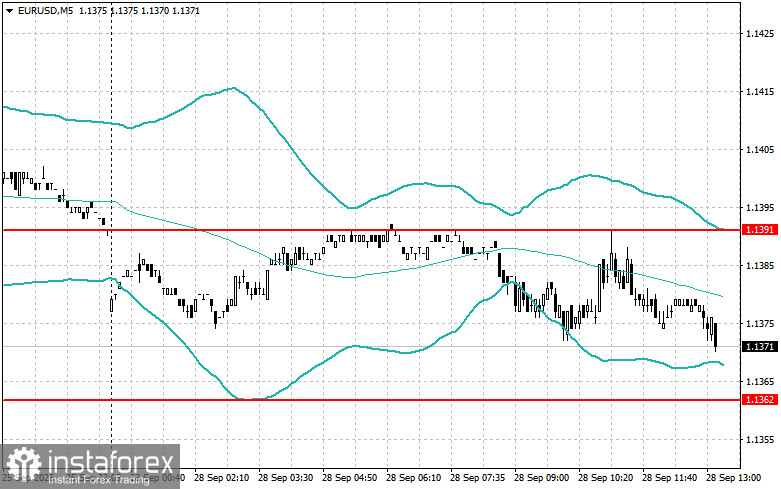
For the euro, the upper boundary is at 1.1391 and the lower boundary at 1.1362. The upper level is only five points above the breakout level of 1.1386, which is an important detail for beginners. If the price moves above 1.1386 and consolidates firmly above 1.1391, this is a breakout, and short positions should not be opened there. If, however, the price enters the zone, fails to hold above it, and quickly returns below, the reversal scenario comes into play, and I would consider short positions toward the lower boundary. This scenario makes sense if the Fed officials' speeches trigger a brief surge in euro buying and the market then realizes that there is no new signal. For such a trade, I would place the stop above the highest point reached during the move, with a small buffer. The lower boundary at 1.1362 coincides with the downside breakout level, so distinguishing a breakout from a rebound is possible only by observing price behavior after the test. If the price moves below the level, consolidates there, and continues to trade below it, buying is not appropriate; the breakout scenario is in effect. If the price briefly moves below 1.1362, quickly returns above it, and fails to continue lower, I would consider a long position targeting 1.1386, with the stop below the lowest point of the move below the level. Given the current market conditions, I would consider such a long position only if the setup is particularly clear.
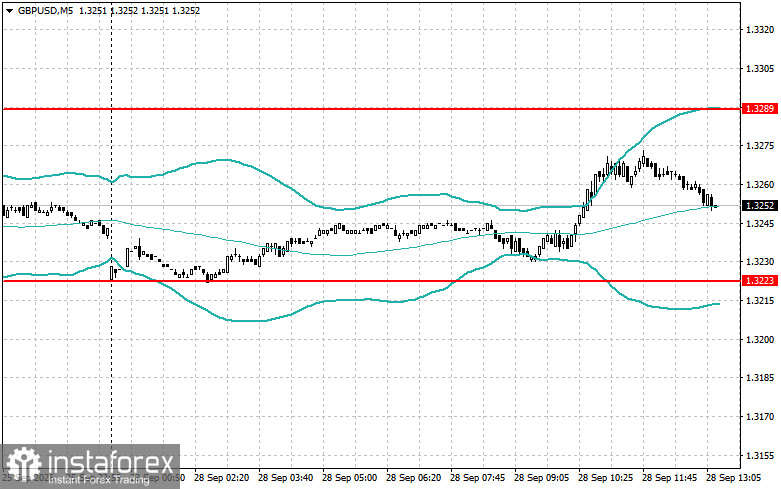
For the pound, the upper boundary is at 1.3289 and the lower boundary at 1.3223. The upper level is unusual because it is only five points above the first target of the breakout scenario at 1.3284 and 31 points above the breakout level itself at 1.3258. This means the price would first have to move a relatively long distance higher, and I do not expect such a move today. If it does occur, however, the 1.3284–1.3289 level would be a natural area for breakout buyers to take profits and for reversal sellers to attempt to regain control. I would look for short positions only after the price moves above 1.3289 and then returns below it, with the stop above the high reached during the move. The lower boundary at 1.3223 is literally one point below the breakout level at 1.3224, so beginners need to exercise particular caution here. Such proximity means that the nature of the move cannot be determined from a single test. If the price moves below 1.3223 and consolidates there, this is a breakout, and buying is not appropriate. If it briefly moves below the zone and quickly returns above 1.3224, the reversal scenario is in effect, and I would consider a long position targeting 1.3258, with a protective stop below the lowest point reached during the move below the level. The difference between the two scenarios may emerge within a few minutes, so it is reasonable to avoid acting on the initial reaction at this zone. Given the strength of the dollar, the downside breakout remains the primary scenario, while a long position on a reversal is considered a secondary option.
*यहां पर लिखा गया बाजार विश्लेषण आपकी जागरूकता बढ़ाने के लिए किया है, लेकिन व्यापार करने के लिए निर्देश देने के लिए नहीं |
InstaSpot analytical reviews will make you fully aware of market trends! Being an InstaSpot client, you are provided with a large number of free services for efficient trading.