




Tim kami memiliki lebih dari 7.000.000 trader!
Setiap harinya kami bekerja sama untuk meningkatkan trading. Kami memperoleh hasil tinggi dan terus bergerak maju.
Pengakuan dari jutaan trader diseluruh dunia merupakan apresiasi terbaik dari kerja kami! Anda membuat pilihan anda dan kami akan melakukan semua yang dibutuhkan untuk memenuhi ekspektasi anda!
We are a great team together!
InstaSpot. Bangga bekerja bersama anda!





Seorang Aktor, juara 6 turnamen UFC dan pahlawan sesungguhnya!
Pria yang berhasil. Pria yang berusaha keras.
Rahasia dibalik kesuksesan Taktarov adalah pergerakan konstan menuju target.
Tunjukkan seluruh sisi dari bakat anda!
Temukan, coba, gagal - namun jangan pernah berhenti!
InstaSpot. Cerita sukses anda dimulai disini!

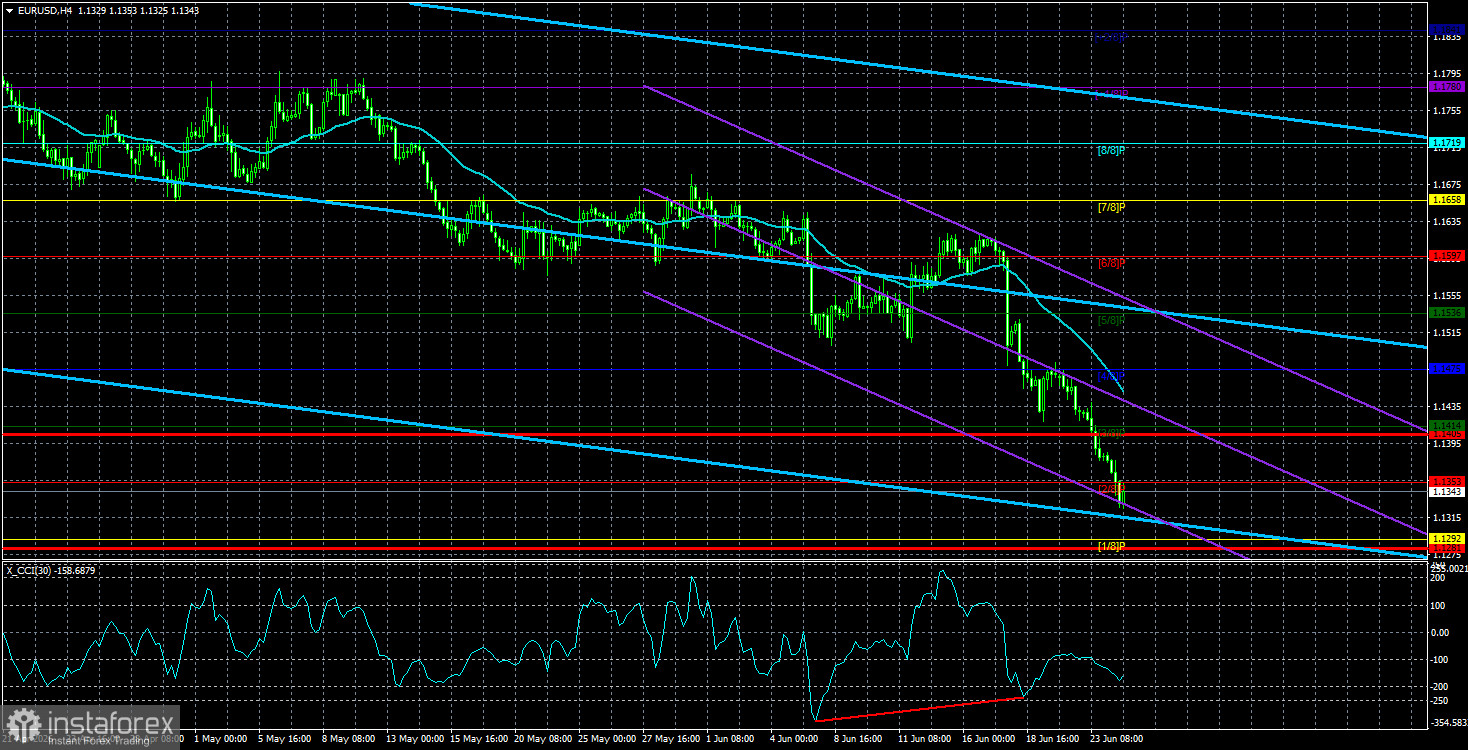
The EUR/USD currency pair continued its decline on Wednesday. The downward movement did not halt for a moment—neither in the evening, at night, nor in the morning. Thus, we still believe that the current rise of the U.S. dollar is not connected with geopolitics, macroeconomics, or fundamentals. While on Tuesday it was plausible to suggest that the decline in the euro and pound was linked to weak business activity indices in the Eurozone, Germany, and the UK (although we had strong doubts about that), on Wednesday, no significant data were published. Yet, the market continued to buy the U.S. dollar across the board.
What could be the reasons for such a stable and strong movement? We have already answered this question. There are none. The dollar rises because it is being bought, and it is being bought because it is rising. This is purely a technical and speculative rise. We would like to remind you that last week, Iran and the U.S. signed an interim agreement; negotiations on the nuclear deal began on Sunday; the U.S. lifted sanctions on Iranian oil; and a plan for Iran's recovery was agreed upon, alongside the lifting of the blockade of Iranian ports. In other words, the parties are indeed moving toward each other, albeit with great difficulty. However, to gauge the level of optimism, one needs only look at the price of oil. The price of premium Brent has dropped to $76, just $5 above the price at the onset of the war in the Middle East. Therefore, markets are optimistic about the agreement, believing in long-term peace and safe traffic through the Strait of Hormuz. So why is the dollar rising?
Could the problem lie with the Federal Reserve? Recall that a week ago, the Fed adopted a fairly "hawkish" stance, but is it really too much to buy the dollar for an entire week based on the possibility that the Fed might raise rates by the end of the year? Furthermore, yesterday, Treasury Secretary Scott Bessent stated that the Iranian agreement would stabilize oil and fuel prices and slow inflation in the U.S. If inflation decreases, why would the Fed pursue a tightening of monetary policy, even as the American currency has already risen nearly 300 pips in just a week?
On Tuesday, Christine Lagarde stated that the ECB may not necessarily raise rates at the July meeting, which somewhat eased market "hawkish" expectations. However, what kind of "hawkish" expectations can one talk about when the market ignored the policy tightening in June and the euro has been falling for a month and a half, almost without interruption? Thus, central banks might indeed rejoice at the end of the war and reconsider their rate plans. Yet this factor currently plays no role for the EUR/USD pair. The U.S. dollar is rising without clear reasons, or at least without visible ones. The movement is effectively one-sided, so intraday trading is particularly convenient and profitable now. We still do not believe in a long-term rise in the U.S. currency, but in the short term, why not capitalize on the strong move?
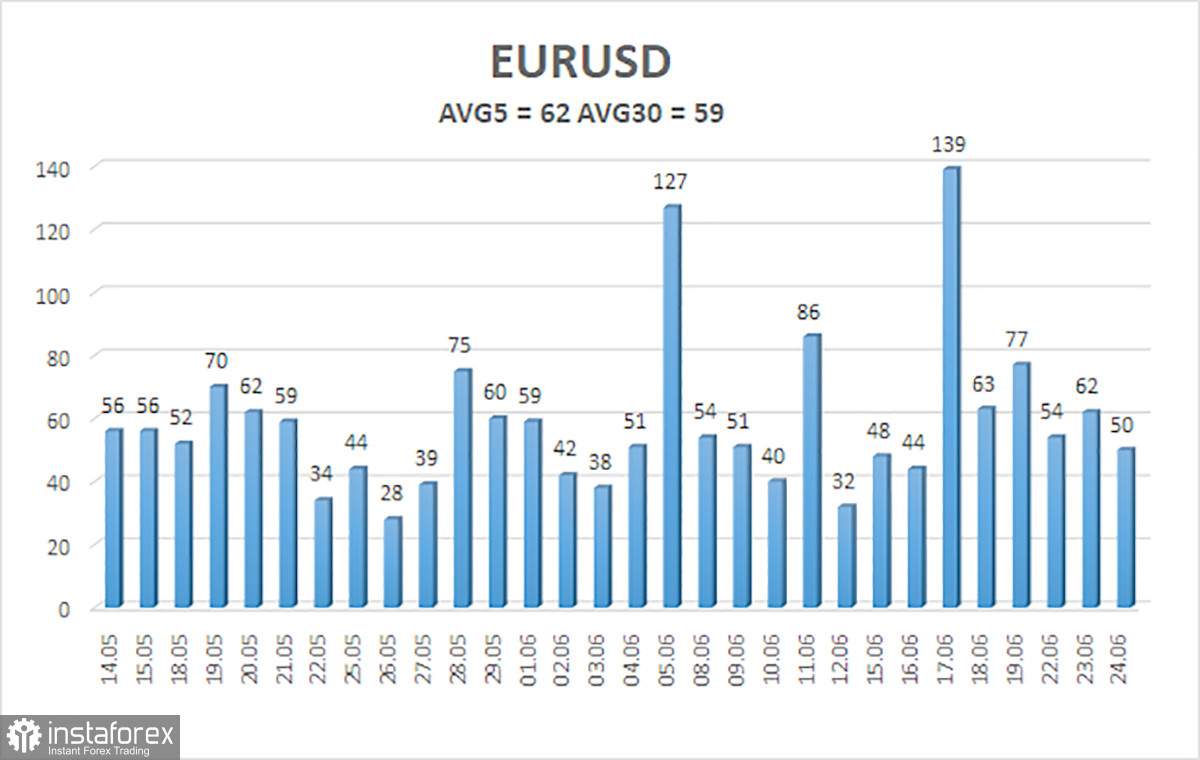
The average volatility of the EUR/USD pair over the last five trading days, as of June 25, is 62 pips, which is considered "average." We expect the pair to move between levels 1.1281 and 1.1405 on Thursday. The upper channel of linear regression has turned downward, indicating the continuation of the downward trend. The CCI indicator has entered the oversold area and has formed two "bullish" divergences, warning once again of a possible end to the downward trend. However, the market is ignoring absolutely all factors.
S1 – 1.1292
S2 – 1.1230
S3 – 1.1169
R1 – 1.1353
R2 – 1.1414
R3 – 1.1475
The EUR/USD pair continues its downward movement, which is presumed to be a correction within the framework of a global upward trend, clearly visible on the daily or weekly timeframe. The global fundamental backdrop for the dollar remains negative, but in 2026, first geopolitics and then the Fed's hawkish stance have provided strong support to the U.S. currency. When the price is below the moving average, short positions can be considered with targets of 1.1292 and 1.1281. Above the moving average line, long positions are relevant with targets of 1.1536 and 1.1597. The conclusion of the conflict in the Middle East has posed no issues for the dollar. Bears are currently extremely strong for no visible reason.
Linear regression channels help determine the current trend. If both are directed in the same way, it means the trend is currently strong;
The moving average line (settings 20,0, smoothed) determines the short-term trend and the direction in which trading should currently be conducted;
Murray levels are target levels for movements and corrections;
Volatility levels (red lines) indicate the probable price channel in which the pair will move over the next day based on current volatility metrics;
The CCI indicator – its entry into the oversold area (below -250) or the overbought area (above +250) indicates that a trend reversal in the opposite direction is approaching.
*Analisis pasar yang diposting disini dimaksudkan untuk meningkatkan pengetahuan Anda namun tidak untuk memberi instruksi trading.
Tinjauan analitis InstaSpot akan membuat Anda menyadari sepenuhnya tren pasar! Sebagai klien InstaSpot, Anda dilengkapi dengan sejumlah besar layanan gratis untuk trading yang efisien.


