




我们的团队有超过700万的操盘手!
我们每天都在一起努力改善交易。我们得到了很高的成绩,并继续前进。
世界各地数以百万计的操盘手的认可是我们工作的最大赞赏! 您做出了您的选择,我们将尽一切努力来满足您的期望!
我们是一个共同的伟大团队!
InstaSpot. 自豪地为您工作!



US equity indices finished yesterday's session in positive territory. The S&P 500 gained 0.15%, while the Nasdaq 100 added 0.09%. The industrial Dow Jones outperformed, jumping by 0.55%.
Asian equity markets are also advancing for a second consecutive day and are now heading toward a weekly gain, as investors shift their focus from a narrow group of semiconductor suppliers to the broader AI ecosystem.
The MSCI Asia Pacific Index rose by 1%, with Japan's Nikkei leading the region higher at +2.7%. The standout performer was SoftBank, whose shares surged by 11% following strong momentum in its US subsidiary, Arm Holdings. Meanwhile, Lenovo hit a 26-year high in Hong Kong after reporting solid earnings, driven in large part by its AI-related business. Nasdaq 100 futures are already up another 0.5% today.
What is particularly important here is the structural shift behind this rally. Until recently, the AI-driven market surge was concentrated in a very small group of companies — primarily advanced chipmakers such as Nvidia and TSMC. Now, traders are actively rotating into the next wave of AI beneficiaries: memory manufacturers, robotics firms, and infrastructure providers. This transition from a narrowly concentrated rally to broader market participation makes the move significantly more sustainable. Once multiple sectors begin contributing to upside momentum, the rally becomes much harder to derail with a single negative headline.
According to Franklin Templeton, markets are still not fully pricing in what could happen once companies begin integrating AI deeply into their business processes and that starts feeding through into earnings growth. Data from the Ramp AI Index supports this view: the share of US companies paying for AI models and AI-based tools has accelerated sharply in recent months, suggesting AI adoption is becoming structural rather than experimental.
Geopolitical risks, however, remain firmly in the picture. After three straight sessions of declines, Brent crude rebounded above $105 per barrel. Comments from Iran regarding uranium reserves and disputes over transit fees through the Strait of Hormuz dampened some of the optimism generated by recent diplomatic signals. Donald Trump openly opposed any attempts to establish a permanent transit-fee system through the strait. US Secretary of State Marco Rubio mentioned "some positive signs," while Iranian President Masoud Pezeshkian responded that Iran would never abandon its objectives. Negotiations are ongoing, but a tangible breakthrough still appears distant.
Gold edged slightly lower to around $4,520 per ounce. The US dollar strengthened against most G10 currencies ahead of comments from Federal Reserve Governor Christopher Waller. Meanwhile, the Japanese yen traded near 159 per dollar, hovering close to its weakest level since late April after Japan's core inflation data slowed more than expected.
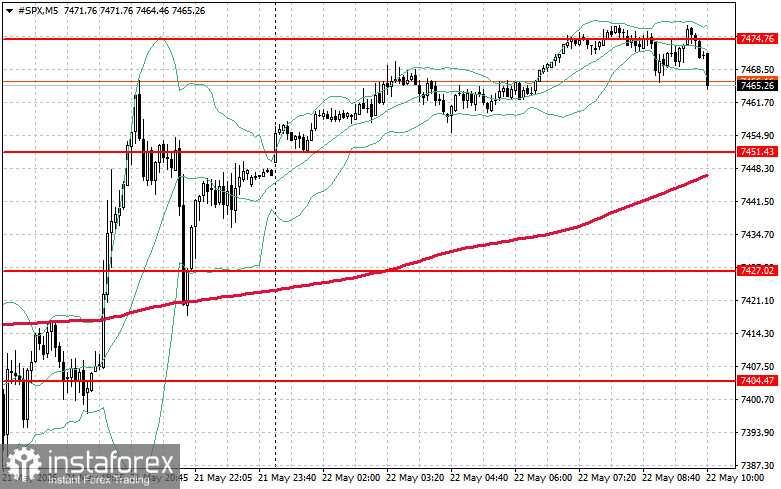
From a technical S&P 500 perspective, the key task for buyers today is to break above the nearest resistance level of 7,474. A successful breakout there would reinforce bullish momentum and open the door for a push toward 7,494. Another critical objective for bulls is maintaining control above 7,518, which would further strengthen buyer positioning. On the downside, if risk appetite weakens, buyers must defend the 7,451 area. A break below that level would likely send the index back toward 7,427, with further downside potential extending to 7,404.
*这里的市场分析是为了增加您对市场的了解,而不是给出交易的指示。
InstaSpot分析评论将让您充分了解市场趋势! 作为InstaSpot的客户,您将获得大量的免费服务以实现有效的交易。