



Our team has over 7,000,000 traders!
Every day we work together to improve trading. We get high results and move forward.
Recognition by millions of traders all over the world is the best appreciation of our work! You made your choice and we will do everything it takes to meet your expectations!
We are a great team together!
InstaSpot. Proud to work for you!



Actor, UFC 6 tournament champion and a true hero!
The man who made himself. The man that goes our way.
The secret behind Taktarov's success is constant movement towards the goal.
Reveal all the sides of your talent!
Discover, try, fail - but never stop!
InstaSpot. Your success story starts here!

Friday began with no bounce for the euro. Yesterday, the single currency fell sharply against the dollar, briefly rose to 1.1232 in the evening, but failed to hold and now stands around 1.1212. The main drivers are not U.S. data but oil and news from Europe.
First, the U.S. data. Initial jobless claims totaled 194,000, below the 200,000 forecast. This number counts people who filed for benefits for the first time that week; a lower-than-expected figure signals a stronger labor market. The leading indicators index for September, which compiles about a dozen measures and looks several months ahead, came in at 0.0% versus an expected -0.1%. Continuing claims were slightly above expectations at 1,728,000 versus 1,720,000, so the picture is mixed, but overall it did not hurt the dollar.
Now about the euro. Attacks in Saudi Arabia have pushed Brent to $111. For the euro area, which depends on imported energy, such price rises hit the economy and prices directly. Adding to this, France is preparing for a new wave of protests on Saturday and is stepping up police and military presence to prevent a repeat of last weekend's unrest. Yesterday's euro-area consumer-confidence index didn't help either: it was -17.9 versus a forecast of -17.0 and -16.5 a month earlier. I believe that against this backdrop the euro has little reason to rally confidently.
This morning the market's attention will be on preliminary October purchasing-managers indices for the euro area. These survey-based indicators are built from responses by purchasing managers; a reading above 50 points means expansion, and below 50 means contraction. PMI is considered a fast indicator of the economy because it is released well ahead of official GDP and industrial data. For the FX market, these figures are also important because the state of the economy influences European Central Bank policy. Forecasts this time almost repeat the previous values: manufacturing is expected at 52.7 after 52.9 in September, services 52.6 after 53.0, and the composite index — which previously was 53.1 — has no published forecast. In other words, analysts expect only a slight cooling, not a collapse, so these releases are unlikely to trigger a large spike in volatility. The situation would change if the readings are very weak, especially in services. Then pressure on the euro would intensify toward the end of the week, since the single currency already faces problems from expensive energy and worrying news from the Middle East. I believe that with neutral figures, EUR/USD will keep its current range, while a PMI miss could push the pair noticeably lower.
For the euro, the main reference points are 1.1231 above and 1.1204 below. The price at 1.1212 sits 19 pips below the upper level and eight above the lower, so it is closer to the lower boundary. Last night, the pair rose to 1.1232, touched the upper level, and fell back, so I don't count that first touch as a confirmed breakout. I consider long positions only if the price rises above 1.1231 again and holds convincingly; then targets are 1.1259 and 1.1298. Frankly, I have little faith in that scenario because oil and France are weighing on the euro. Short positions below 1.1204 with targets of 1.1183 and 1.1155 look more likely. Weak PMIs would be enough to trigger them. But the distance from the price to the level is only eight pips, so a small intraday breach without a hold should not be regarded as a confirmed breakout.
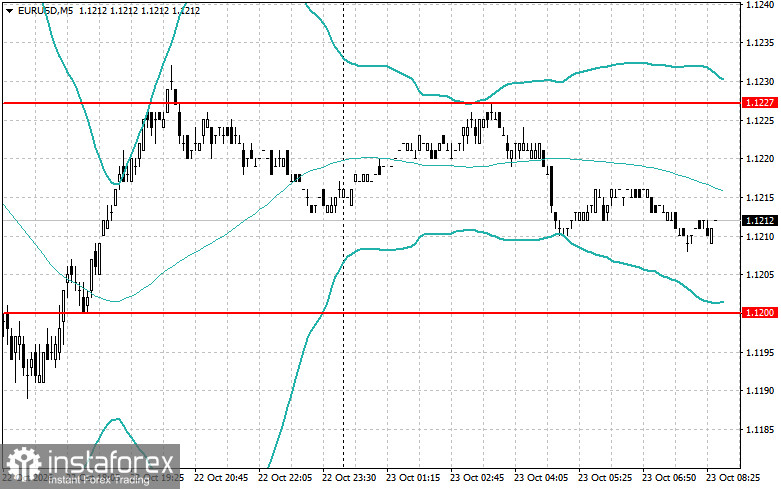
For the euro, the mean-reversion levels are 1.1227 and 1.1200. Both lie very close to the breakout thresholds. The upper level, 1.1227, is four pips below the breakout-buy at 1.1231; the lower level, 1.1200, is four pips below the breakout-sell at 1.1204. Four pips is market noise, so on the first touch you cannot reliably distinguish a rebound from a breakout — beginners must be especially cautious.
My view of the upper scenario: price rises to 1.1227 and then quickly falls back—that would be a sell signal, since the pair reached about this level overnight and reversed. If the price holds above 1.1231, selling is not allowed — that is a confirmed breakout.
The lower scenario: the price moves below 1.1204, reaches 1.1200, fails to hold and returns above 1.1204 — then longs are appropriate with a stop under the false-break low. If price closes below 1.1200, mean reversion has failed, and attention shifts to the 1.1183 target.
*এখানে পোস্ট করা মার্কেট বিশ্লেষণ আপনার সচেতনতা বৃদ্ধির জন্য প্রদান করা হয়, ট্রেড করার নির্দেশনা প্রদানের জন্য প্রদান করা হয় না।
ইন্সটাফরেক্স বিশ্লেষণমূলক পর্যালোচনাগুলো আপনাকে মার্কেট প্রবণতা সম্পর্কে পুরোপুরি সচেতন করবে! ইন্সটাফরেক্সের একজন গ্রাহক হওয়ায়, দক্ষ ট্রেডিং এর জন্য আপনাকে অনেক সেবা বিনামূল্যে প্রদান করা হয়।


