




Our team has over 7,000,000 traders!
Every day we work together to improve trading. We get high results and move forward.
Recognition by millions of traders all over the world is the best appreciation of our work! You made your choice and we will do everything it takes to meet your expectations!
We are a great team together!
InstaSpot. Proud to work for you!





Actor, UFC 6 tournament champion and a true hero!
The man who made himself. The man that goes our way.
The secret behind Taktarov's success is constant movement towards the goal.
Reveal all the sides of your talent!
Discover, try, fail - but never stop!
InstaSpot. Your success story starts here!

The wave count on the four-hour EUR/USD chart has become more complex. On the higher time frame (lower chart), the downward trend segment has taken the form of a five-wave structure, A-B-C-D-E, which may be complete at any time, as it appears structurally well developed. All the waves in this segment are approximately equal in size, so it is considered corrective. If this assumption is correct, an upward impulsive trend segment will begin once the correction is complete, with targets well above the 1.2000 level.
On the lower time frame (upper chart), an impulsive wave sequence is still developing and may belong to wave E on the higher time frame. If this is indeed the case, the U.S. dollar's strengthening is approaching its end, regardless of how much further it appreciates. A fifth wave in the downward structure may develop, as the current structure appears impulsive. In any case, however, the current wave count suggests that the downward wave sequence is nearing completion on both charts. The news background and the sharp shift in market sentiment have driven a substantial appreciation of the U.S. dollar, but further gains are becoming increasingly difficult to achieve.
The EUR/USD exchange rate fell by 90 basis points on Wednesday, erasing all the gains made by the euro and buyers in the previous session. A year-on-year increase in the U.S. Consumer Price Index of just 0.1 percentage points above expectations was enough to trigger another substantial appreciation of the U.S. dollar. The market had expected inflation to accelerate to 3.6% in September, but the actual figure reached 3.7%. This 0.1-percentage-point difference caused the U.S. dollar to strengthen by another cent.
What has changed as a result of higher-than-expected inflation? Nothing. The Fed still anticipates one further round of monetary policy tightening, expects inflation to slow next year, and maintains that the broader disinflationary process will continue over the long term. It also points to the influence of temporary factors, including high investment in AI and elevated energy prices. Therefore, the U.S. inflation report does not materially increase the likelihood of more than one additional round of Fed tightening before the end of the year. Consequently, the market once again had little fundamental justification for further dollar purchases.
Market participants continue to buy the U.S. dollar whenever a potential justification arises. Traders followed this approach throughout the U.S. trading session. The euro continues to decline sharply, despite inflation in the European Union remaining higher than in the United States and the ECB having already raised interest rates twice, compared with the Fed's rate hike. At present, however, these factors have little influence on market behavior. The wave count still indicates that the five-wave structure forming part of the higher-degree wave E may be nearing completion, along with the entire corrective structure that began in January this year.
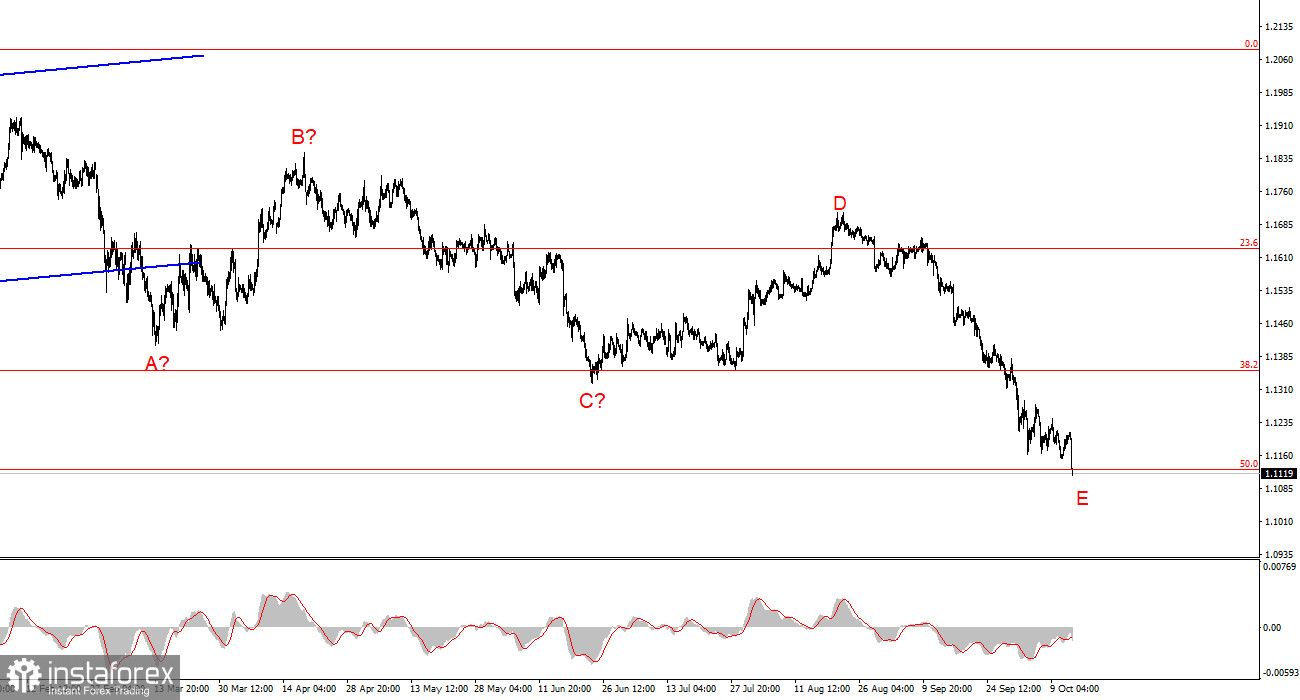
Based on the EUR/USD analysis, the pair remains within a broader corrective trend segment, A-B-C-D-E. If this assumption is correct, the decline will continue toward targets below the low of wave C at 1.1325. This scenario was previously considered an alternative, or backup, outlook. Without the FOMC meeting, it would have remained a secondary scenario. However, the Fed delivered a surprise, leaving the market with little alternative but to initiate another wave of U.S. dollar buying. Nevertheless, these purchases have continued for several weeks, despite the absence of new supporting factors for the dollar. Opening short positions in the current news environment would not be advisable; instead, preparation for a potential reversal would be more appropriate.
On the higher time frame, the downward trend segment is clearly visible and takes the form of A-B-C-D-E. Consequently, EUR/USD may continue falling below the low of wave C, while the internal wave structure of wave E may develop into a five-wave impulse.
The main principles of the analysis:
*এখানে পোস্ট করা মার্কেট বিশ্লেষণ আপনার সচেতনতা বৃদ্ধির জন্য প্রদান করা হয়, ট্রেড করার নির্দেশনা প্রদানের জন্য প্রদান করা হয় না।
ইন্সটাফরেক্স বিশ্লেষণমূলক পর্যালোচনাগুলো আপনাকে মার্কেট প্রবণতা সম্পর্কে পুরোপুরি সচেতন করবে! ইন্সটাফরেক্সের একজন গ্রাহক হওয়ায়, দক্ষ ট্রেডিং এর জন্য আপনাকে অনেক সেবা বিনামূল্যে প্রদান করা হয়।


